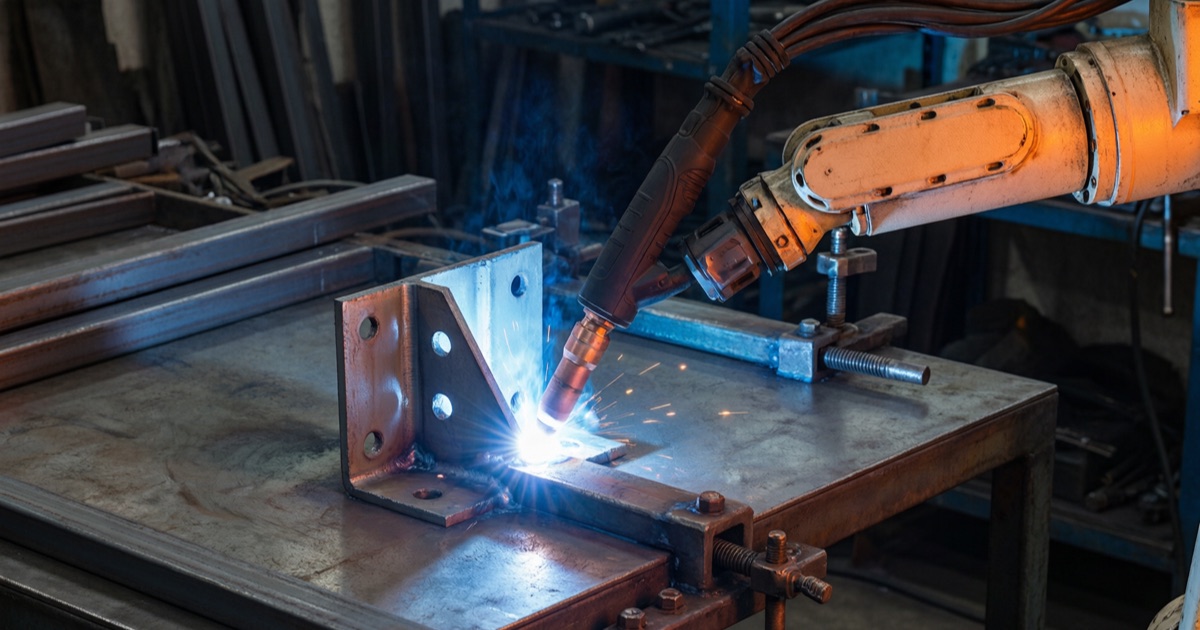
Cooper is Lincoln Electric's collaborative welding line. Unlike most of the cobot market, it is not sold as a bare arm — a Cooper is a package: a cobot arm, a Lincoln welding power source, torch, wire feed, cart or table, and the Cooper App that does the programming.
That packaging matters for budgeting. Buyers who have priced a $35,000 cobot arm and assume a welding version costs a little more are usually off by a factor of three. Below are the prices US distributors actually list for Cooper packages in July 2026, opened and confirmed on the product pages rather than taken from search snippets.
Which arm is under a Cooper?
Lincoln does not build the arm. The Cooper App runs on FANUC CRX and ABB GoFa cobots, and packages are sold on both:
- FANUC CRX-10iA/L — 10 kg payload, 1,418 mm (55.8 in) reach
- FANUC CRX-30iA — the heavier, longer-reach option in the line
- ABB GoFa-10 — 10 kg payload, 1,620 mm (64 in) reach at the flange
There is also Cooper ADAPT, a table-based system; external-axis support arrived in Cooper software version 1.9 in April 2026.
Lincoln Electric Cooper price list 2026
These are the prices listed with working add-to-cart buttons by Harris Welding Supplies, a US Lincoln distributor, in July 2026:
| Package | Part number | Listed price |
|---|---|---|
| Cooper CRX-10iA/L air-cooled, non-cart | AD2495-9 | $103,990.87 |
| Cooper GoFa-10 air-cooled, non-cart (Gen II) | AD2501-12 | $107,299.87 |
| Cooper GoFa-10 air-cooled, cart | AD2501-7 | $114,190.87 |
| Cooper GoFa-10 water-cooled, non-cart (Gen II) | AD2501-13 | $118,595.00 |
| Cooper CRX-30iA air-cooled (Gen II) | AD2631-1 | $122,575.00 |
| Cooper GoFa-10 water-cooled, cart (Gen II) | AD2501-6 | $124,034.87 |
| Cooper CRX-30iA water-cooled (Gen II) | AD2631-2 | $130,095.00 |
| Cooper CRX-30iA aluminum package (Gen II) | AD2631-3 | $141,695.00 |
| Cooper CRX-30iA air-cooled, cart (Gen II) | AD2630-1 | $143,983.87 |
| Cooper CRX-30iA water-cooled, cart (Gen II) | AD2630-2 | $153,535.87 |
| Cooper CRX-30iA aluminum, cart (Gen II) | AD2630-3 | $155,042.99 |
| Cooper ADAPT air-cooled table | AD2650-1 | $179,000.00 |
| Cooper ADAPT water-cooled table | AD2650-2 | $188,995.00 |
The entry point is $103,990.87 and the line tops out at $188,995.00 for the water-cooled ADAPT table.
What moves the price
Reading down the table, four things drive cost:
Arm size. Stepping from the CRX-10iA/L to the CRX-30iA is roughly $18,600 in an otherwise comparable air-cooled configuration ($103,990.87 to $122,575.00). That is the cost of payload and reach headroom.
Cooling. Water-cooled torches carry a consistent premium of roughly $6,000 to $11,000 over air-cooled in matched pairs — for example, the CRX-30iA cart packages at $143,983.87 air-cooled versus $153,535.87 water-cooled. Water cooling buys duty cycle on heavier, longer welds.
Cart versus fixed. A cart adds roughly $6,900 to $21,400 depending on package. It buys the ability to roll the cell between jobs, which is exactly the flexibility most small shops are buying a cobot for in the first place.
Aluminum capability. The aluminum packages sit about $11,600 above their steel equivalents, reflecting the push-pull feeding hardware aluminum wire requires.
Cross-checking the numbers
One distributor is not a market. Three independent checks put Cooper in the same band:
- Welder Supply advertises its welding cobot category as starting at $103,726.19 — within $265 of the Harris entry price.
- Hirebotics, a competing turnkey cobot welder built on UR arms, publishes "starting at $105k" for its Cobot Welder on its own website (alongside $100k for its Cobot Cutter and $140k for its Cobot Painter).
- Miller's Copilot system is reported to land above $90,000 once the required Miller power source is included, per a competitor teardown by Standard Bots — a vendor with an interest in the comparison, so treat it as directional rather than authoritative.
The consistent story: a production-ready welding cobot in the US is a $100,000 to $190,000 purchase, not a $50,000 one. The bare-arm price you see quoted for a cobot is roughly a third of the finished cell.
Is a Cooper the right buy?
The case for Cooper is that Lincoln is a welding company first. You get a Power Wave-class power source, real welding process control, and a distributor network that knows welding rather than robotics. For a shop whose bottleneck is finding welders rather than programming robots, that matters more than a lower sticker.
The case against is the sticker itself. At $104,000 entry, a Cooper needs meaningful weld hours to pay back, and shops running short, high-mix jobs may find a fixed cell or a cheaper cobot-plus-torch build a better fit. We worked through that trade-off in cobot welder vs dedicated welding cell, and the broader process background is in our arc welding robot guide.
For alternatives across the category, see the welding robot category page or our collaborative robot listings.
*Prices confirmed on US distributor product pages in July 2026 and stated in USD. They exclude freight, installation, fixturing, gas and consumables, and change without notice.*