Two robotic pool cleaners can share the same motor and suction rating and still deliver wildly different results — because the thing that decides whether your whole pool gets clean is not suction, it is navigation. In 2026 this is the spec that separates a $300 impulse buy from a genuinely capable machine, and it is the one most buyers understand least. If you are choosing a unit for yourself, or sourcing a model to import, this is the feature to interrogate first.
Random-bounce vs planned coverage
The oldest and cheapest navigation is random-bounce: the robot drives until it hits a wall, turns a random angle, and repeats, trusting that enough time covers the pool. It sometimes works in a small, simple pool — but it wastes battery, re-cleans the same lanes, and reliably misses corners and odd-shaped sections.
The 2026 upgrade is sonar-based smart navigation. The robot scans the pool, builds an internal map, and plans efficient routes — the systems described this year use S-path and N-path patterns to cover the floor methodically and avoid corners most of the time. The practical payoff is threefold: fuller coverage, far less wasted battery, and predictable finish times instead of "hope it got everything."
AI path planning and vision
The top tier goes beyond mapping the floor plan. AI path planning analyzes pool depth, slopes and climbing angles, calculates viable routes up walls, and actively returns the robot from deep zones back to shallow areas so it does not strand itself. Some flagship cordless models add a front-facing AI camera that reportedly detects 20-plus debris types and drives the robot straight to dirt rather than blindly covering water — closer to how a robot vacuum targets a spill than to a dumb sweep.
This matters for irregular pools — freeform, infinity-edge, split-level. A random-bounce unit degrades badly the moment the pool stops being a simple rectangle; a mapping-plus-AI unit adapts.
Wall climbing and the waterline
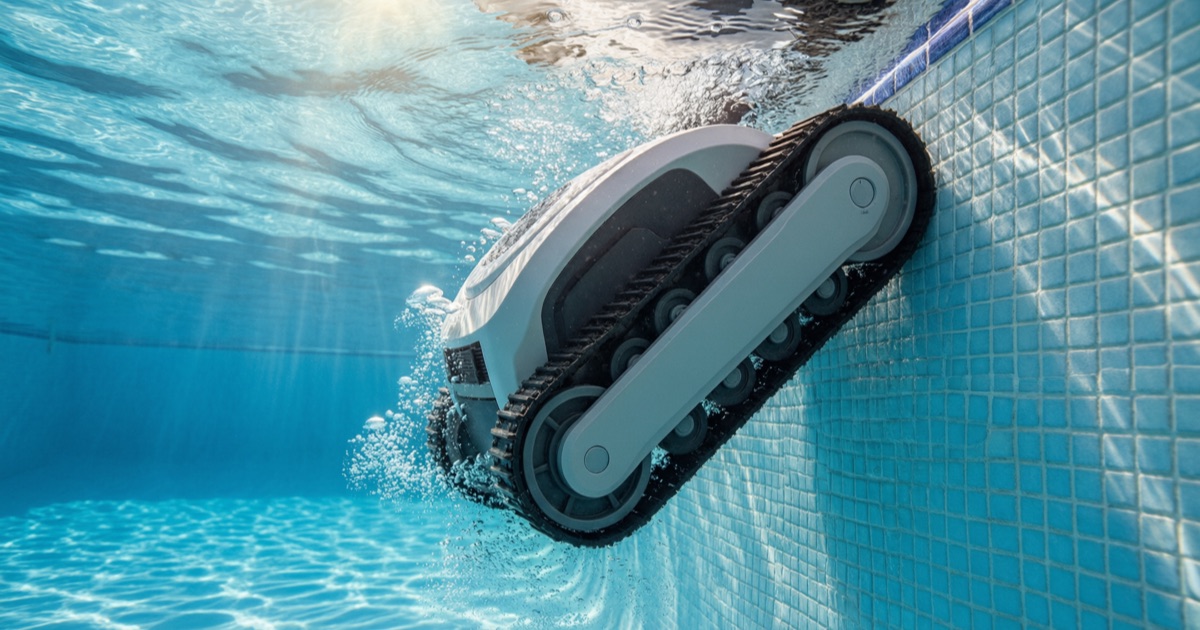
Coverage is not just the floor. The waterline — where oils, sunscreen, algae and scum collect — is the dirtiest band in most pools, and reaching it requires the robot to climb the wall. The 2026 generation uses high-traction track systems to climb reliably; the better cordless models (across the leading brands) are documented climbing walls effectively, and some add dual-pass waterline scrubbing that reaches slightly above the water surface to attack the oily residue line directly.
When you compare units, separate the claims: *floor-only*, *floor + wall*, and *floor + wall + waterline* are three different capability tiers, and many multi-mode robots (five cleaning modes is now common) let you choose per cycle. Match the tier to the mess — a leaf-heavy pool needs floor power; a heavily-used pool needs the waterline pass.
Why navigation also drives runtime
There is a hidden link between navigation and battery. Efficient routing means the robot cleans the whole pool in fewer meters travelled, so smarter navigation effectively extends usable runtime. Vendors reinforce this with hydrodynamic body designs that cut water resistance for up to around 20% longer runtime per charge. A well-navigated cordless robot can finish an average pool inside a single charge; a random-bounce unit may die mid-job and leave a half-cleaned pool.
What to verify before buying or importing
- Ask what the navigation actually is. "Smart" is a marketing word. Get specifics: sonar mapping? Gyroscope-assisted path? AI vision? Random-bounce dressed up? The honest answer predicts real-world coverage.
- Match capability tier to your pool shape. Simple rectangle on a budget — mapping is a nice-to-have. Freeform, large, or split-level — mapping and AI path planning are worth paying for.
- Confirm the climbing claim in your pool type. Track climbing behaves differently on tile vs vinyl vs fiberglass and on steep vs gentle walls. Verify against your surface.
- Check runtime against pool size honestly. A robot rated "up to 4 hours" still needs the coverage-per-charge to finish *your* square footage in one cycle.
For importers evaluating models to private-label, navigation is the single spec most worth validating with an in-pool sample test. Our pool cleaning robot category page lays out the machine classes so you can line navigation tiers up against price.
Bottom line
Navigation is the spec that quietly decides whether a robotic pool cleaner actually cleans your whole pool or just the easy middle. In 2026 the meaningful ladder is random-bounce → sonar smart mapping → AI path planning with vision, layered on top of a floor/wall/waterline capability tier. Buy or source to your pool's real shape and dirt profile, insist on a straight answer about what the navigation system truly is, and — if you are importing — prove it in a real pool before you commit to volume. Suction sells the spec sheet; navigation decides the result.