The agricultural spray drone is one of the clearest examples of a Chinese hardware category riding a cost curve straight into global markets. A decade ago a crop-protection drone carried about 6 kg and cost around 200,000 RMB. By 2024 payloads had climbed to 80 kg while prices fell below 40,000 RMB — and the cost per kilogram of payload has dropped roughly 90% over ten years, now under 1,000 RMB per kilo of lift. That is the kind of curve that turns a niche tool into an export commodity.
If you are sourcing spray drones for farms, contractors, or a distribution business outside China, here is what the 2026 lineup looks like and where the real risks sit.
Payload and pricing: where the current models land
The two dominant Chinese makers now anchor a clear product ladder. Representative 2026 pricing and specs from one leading brand's catalog:
- Mid-tier (P120-class) — guide price around 39,999 RMB, with spring-season promotions dropping it near 31,000 RMB; a flagship trim runs closer to 44,000 RMB.
- Heavy-lift (P150-class) — maximum payload around 80 kg.
- Top-end (P200-class) — maximum takeoff weight near 150 kg, with roughly an 85 L spray tank and a 150 L spreader hopper for granular application.
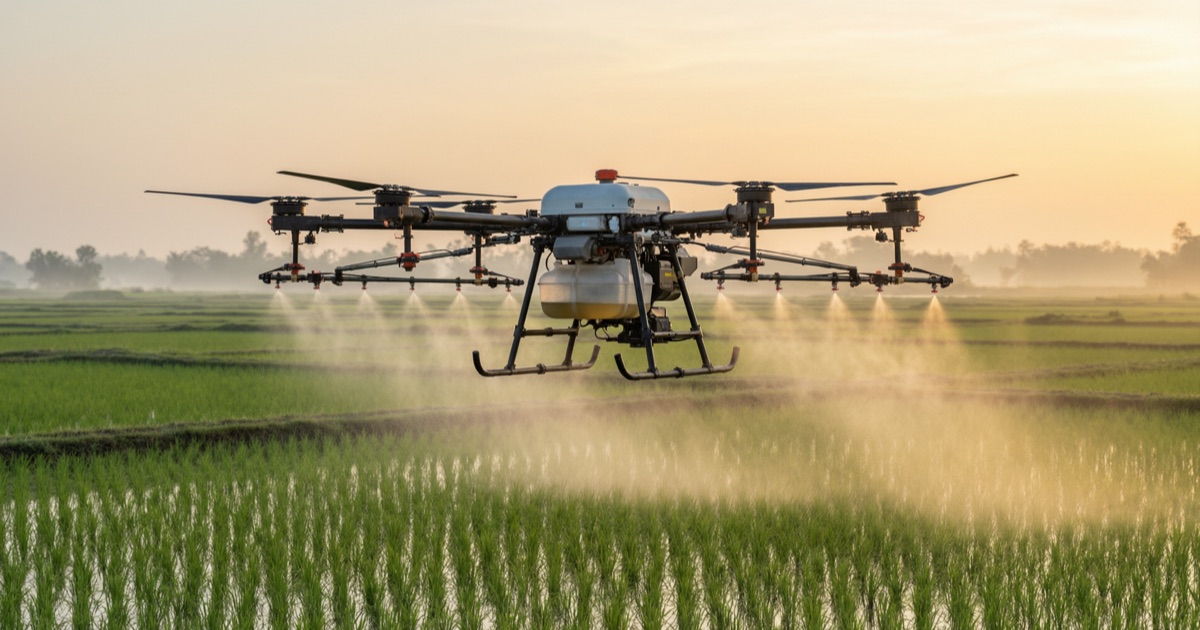
The headline number to anchor on is not the sticker price but the payload-cost ratio. At under 1,000 RMB per kilogram of lift, the economics of covering large acreage per flight now beat manual and tractor-boom spraying in many contexts — especially flooded rice, terraced fields, and terrain a ground rig cannot enter without crushing crop.
The export story is already global
Overseas is where both major players are chasing growth, and the numbers show it is working. One maker's overseas revenue climbed from roughly 146 million RMB to 371 million RMB across 2022–2024, moving from about 24% to nearly 35% of total revenue before settling around 25% in early 2025. The other has expanded on a crop-similarity path — starting in rice regions like Japan, Korea and Southeast Asia, then extending to dryland-crop markets such as Brazil and Mexico. By late 2025 that maker's agricultural drones covered more than 100 countries, with global shipments growing from about 2,000 units in 2015 to roughly 200,000 units in 2025.
The takeaway for a buyer: this is a mature supply chain, not a frontier experiment. Parts, training material, and field-proven playbooks exist. Our agricultural drone category page lays out the model tiers and typical application rates if you are still scoping which class fits your acreage.
Where overseas buyers get caught
The hardware is the easy part. The category's real friction is regulatory, and it is exactly where an inexperienced importer loses months:
- Pilot certification timelines. In some countries earning a drone-operator license can take around a month — factor that into your go-live plan, because a warehouse full of drones and no certified pilots is dead capital.
- Aerial chemical-application bans. Certain jurisdictions prohibit spraying agricultural chemicals from aircraft outright, or restrict it to specific licensed operators and crop types. Confirm this before you import a spray-configured fleet — you may only be able to legally sell the spreader/granular configuration.
- Region-by-region rule fragmentation. Airspace class, night-flight rules, beyond-visual-line-of-sight permissions, and registration all vary. There is no single approval that unlocks a continent; each market is its own project.
- Chemical and tank compatibility. Verify the spray system, nozzles and filtration are rated for the formulations your customers actually use, and that tank materials tolerate them.
Sourcing checklist
- Match payload to field size, not ego. A 150 kg-class drone is impressive but heavier to transport, slower to swap batteries, and overkill for smallholder plots. For fragmented fields, a mid-tier unit often has better real-world duty-cycle economics.
- Battery logistics. Real throughput is gated by how fast you can cycle charged batteries in the field. Price the charging generator, spare packs, and swap workflow — not just the airframe.
- RTK and terrain-following. For terraced or uneven ground, confirm the drone's terrain-following radar and centimeter-grade positioning actually hold at your application height.
- Local support and spares. Rotors, pumps and nozzles are consumables. Confirm parts lead times to your region before committing to a fleet size.
- Import and dual-use paperwork. Drones can trip export-control and import-licensing rules. Clear the customs classification for your destination early.
If your operation is also weighing broader field automation, it is worth cross-shopping against ground-based options on our industrial drone category page so aerial and ground tools fit one coherent plan.
Bottom line
Chinese spray drones have ridden a 90% cost-per-kilo decline into 100-plus countries, and the hardware is genuinely mature — payloads, tanks and positioning are all field-proven at scale. The category's risk has shifted almost entirely to the regulatory layer: pilot licensing lead times and outright aerial-spray bans are what sink first-time importers, not the drones themselves. Size the airframe to your real field geometry, price the battery-and-charging workflow honestly, and clear the certification path in your destination market *before* you place a fleet order.