For years, construction stayed stubbornly manual while warehouses and factories automated around it. That gap is closing fast. At China's 2026 building-technology expos, a full lineup of jobsite robots ran live demos — mortar screeding, floor leveling, tile laying, and putty-and-latex-paint spraying — and a growing share of the order book is now coming from outside China. If you run projects in a market where labor is expensive and finishing quality is hard to staff, these machines have crossed from novelty into something worth pricing.
This guide covers what the current generation actually does, realistic economics, and the sourcing checks that matter when you import.
The categories that are ready to buy
Not every construction task is automatable yet, but a few have matured into repeatable products:
- Interior finishing robots — A single putty-and-paint unit can run the full sequence: spray putty, scrape, sand, then spray latex paint. Vendors demonstrating these machines report throughput of roughly 4 to 5 times a manual crew on flat interior walls, plus around 10% material savings from more consistent film thickness and less overspray.
- Tile-laying robots — Track-mounted arms that pick, butter, place and level large-format floor tiles. One Chinese maker reports its tile-laying robot hits 5 to 6 times manual efficiency with about 60% integrated cost reduction on suitable floor areas.
- Floor leveling and screeding robots — Self-propelled units that laser-reference a slab and drive mortar to a flat plane, taking the most physically brutal task off human crews.
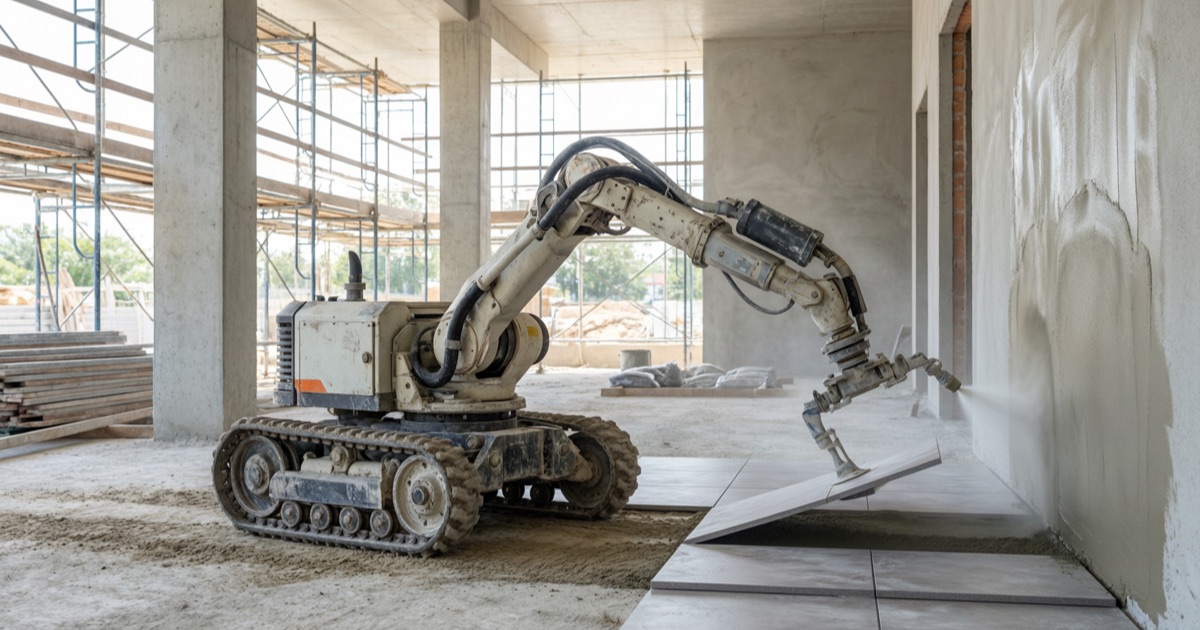
The pattern is consistent: these robots win on repetitive, large-area, flat-surface work. They do not yet handle the fiddly cut-ins, corners and detailing — that stays with skilled trades. Think of the robot as doing the 70% of surface area that is monotonous, so your crew spends its hours on the 30% that needs judgment.
Why the export orders are showing up now
China is already the largest incremental market for construction robots — by some industry accounts more than 30% of global volume — and finishing/construction robots are the fastest-growing slice, expanding around 22% a year. Domestic scale drives the unit economics down, and 2026 is being described inside the industry as the year the category hit genuine volume deployment rather than pilots.
That scale is what makes export viable. One industrial-robot maker that has shipped only two products — a tile-laying robot and an intelligent layout/marking robot — reports commercial orders exceeding tens of millions of RMB by 2025, with about 55% coming from overseas buyers. Chinese industrial-robot exports overall jumped sharply year over year, and construction machines are riding that channel.
The demand logic is simple: the markets pulling hardest are exactly the ones where a robot pays back fastest — high labor cost and highly standardized building methods. Europe and North America check both boxes, which is why a machine designed for a Chinese jobsite is finding a home on a German or American one.
Realistic economics before you commit
A construction robot is not a drop-in headcount replacement, and the payback math has more moving parts than a spec sheet suggests:
- Utilization is everything. A finishing robot at 4–5x throughput only pays back if you keep it fed with suitable wall area. On a project with lots of small, irregular rooms, effective throughput collapses toward manual and the capex never clears.
- Surface prep and setup time eat into the headline speed. Budget for the crew hours spent positioning, referencing and reloading the machine — the 4–5x figure is spray-time, not shift-time.
- One operator, multiple machines is where the labor math actually turns. The savings come less from the single-machine speed and more from one skilled operator supervising several units across a floor.
Before importing, model it on *your* project mix, not the vendor's demo wall. For teams still deciding which finishing category to prioritize, our construction robot category page breaks down the machine types and typical use cases side by side.
Sourcing checklist for overseas buyers
- Confirm the working envelope in your units. Max reach height, minimum room width, floor flatness tolerance, tile size range — get these in writing and match them against your real drawings.
- Power and consumables. Verify voltage/phase compatibility for your region and whether the sprayer accepts locally available putty and paint formulations, not just the vendor's reference mix.
- Spare parts and service response. A finishing robot down for a week can stall a whole floor's schedule. Ask for the parts list, lead times, and whether there is any regional service presence before you buy.
- Operator training. These machines shift labor from manual skill to supervision skill. Confirm the training package and get a realistic ramp-up estimate for your crew.
- Certification and jobsite compliance. Requirements for machinery on site vary by country — check that the unit can meet your local safety-marking and site-safety rules before it lands.
For buyers weighing a broader automation push, it is worth cross-shopping against adjacent categories such as inspection robots that handle site monitoring and progress verification, so your first robot purchase fits a coherent plan rather than a one-off.
Bottom line
Chinese construction robots have moved from expo demos to shippable products with real overseas order books, and the economics genuinely work — but only on the right job mix. If your projects are labor-expensive, standardized, and heavy on large flat surfaces, a tile-laying or finishing robot can clear its capex quickly. If your work is small-room and detail-heavy, the payback stretches out fast. Model it against your own drawings before you place the order, and treat the first unit as a supervised pilot, not a crew replacement.