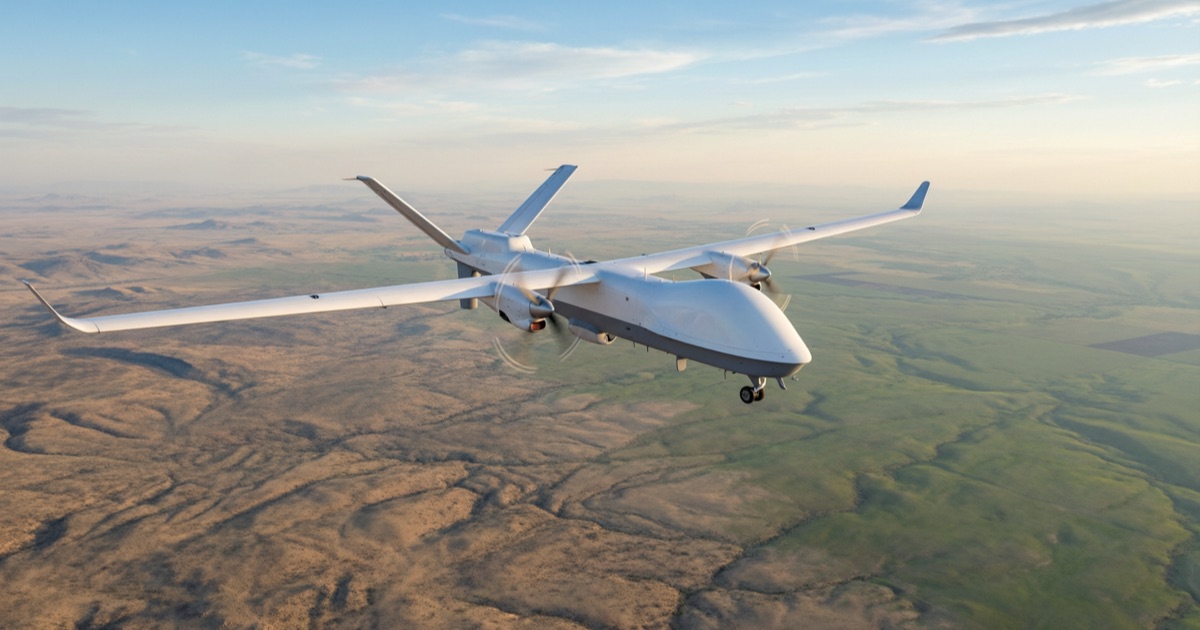
Small quadcopters get the headlines for "last-mile" delivery, but a quieter shift is happening at the other end of the payload curve: large fixed-wing cargo drones built for regional, long-haul freight. For logistics operators, 3PLs, and industrial buyers sizing up unmanned air freight, these aircraft are a fundamentally different tool from rotor-based delivery robots — and worth understanding before the low-altitude economy scales.
Why fixed-wing for cargo
Fixed-wing cargo UAVs trade vertical takeoff for range and load. A representative Chinese aerospace-backed platform in this class carries a maximum payload around 1.5 tonnes over a single-trip range near 1,200 km. On a recent inter-city test flight across mixed terrain, that kind of aircraft reportedly completed a route in about 2.5 hours — a large time saving versus ground transport over the same corridor, according to the operator.
That profile is the opposite of a delivery robot or small drone. Rotor drones excel at short hops, dense-city drop-offs, and sites without runways. Large fixed-wing platforms are for moving real tonnage between regions — think emergency supplies, cross-region e-commerce middle-mile, or freight into areas where roads are slow or absent.
What buyers should evaluate
Sourcing an industrial drone for cargo is closer to buying an aircraft than a gadget. The evaluation checklist looks different:
- Airworthiness certification — the meaningful differentiator. Look for civil UAV type and production certificates (TC/PC equivalents) rather than payload specs alone; without them, commercial route operation is off the table in most jurisdictions.
- Payload-vs-range trade curve — published maxima are rarely achievable together. Ask for the loaded-range envelope at your typical cargo weight.
- Ground infrastructure — fixed-wing units often need runway or catapult/recovery systems; factor in the site, not just the aircraft.
- Operational track record — prioritize platforms with documented, repeated cargo flights over prototype demos.
The low-altitude economy context
China's civil aviation regulator has projected the country's low-altitude economy could reach roughly 1.5 trillion yuan in market size by 2026 and several times that by 2035 — figures that explain the funding flowing into this space, including recent multi-hundred-million-yuan rounds for leading cargo-drone makers. Vendors in this segment typically build a product matrix spanning large fixed-wing, eVTOL, and multirotor platforms, and increasingly target overseas markets.
For buyers, the practical takeaway is that this is an early, certification-gated market. The technology works — documented cargo flights prove it — but commercial availability, approved routes, and cross-border operation are still being built out. Treat vendor market-size projections as directional, not as a delivery timeline.
Bottom line
If your need is dense last-mile drop-offs, a small rotor drone or ground delivery robot is the right tool. If it's moving hundreds of kilograms to over a tonne across regions, large fixed-wing cargo drones are the emerging option — led by China aerospace-backed suppliers with real certification progress. Buy on certification and documented operations, not on headline payload numbers, and plan around the ground infrastructure each platform actually requires.