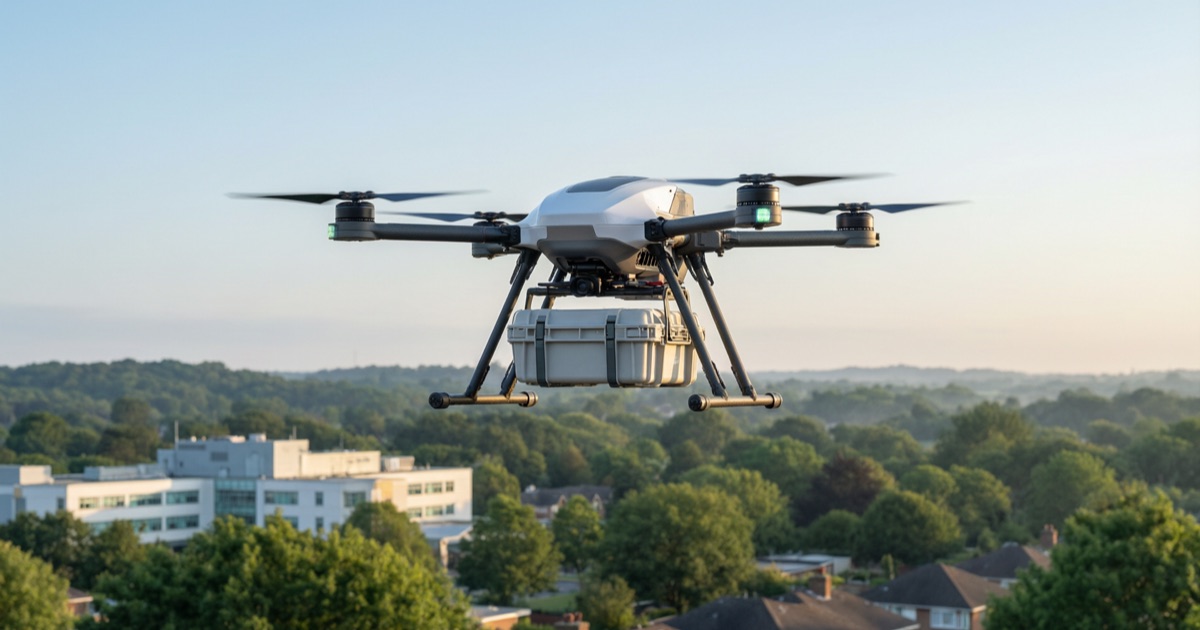
Drone delivery has quietly crossed the line from demo to daily operation. Leading operators now report routine networks running across dozens of cities, with cumulative flight distances in the millions of kilometers and hundreds of tons of cargo moved. The strongest use case isn't pizza — it's healthcare and hard-to-reach last-mile routes, where a drone beats a van on both time and cost. If you're evaluating low-altitude logistics for your operation, here's how the pieces fit and what to check before you source.
It's a network, not just an aircraft
The drone is the visible part, but a working delivery service is really three systems operating together:
- The aircraft — a cargo multirotor or fixed-wing hybrid sized to your payload and range.
- The ground stations — automated take-off, landing, and loading/unloading points that let flights run with minimal on-site staff.
- The scheduling and traffic layer (UTM) — cloud software that plans routes, deconflicts airspace, and manages the fleet in real time.
Buy only the airframe and you have a toy. The scheduling and ground-automation layers are what turn it into a service you can run at scale.
Why healthcare is the killer app
Medical logistics is where the economics land hardest. Blood, lab samples, and urgent medicines are low-weight, high-value, and time-critical — exactly what a drone carries well. Operators of regional medical networks report delivery-time improvements around 40% and comparable cuts in transport cost versus road couriers, while extending same-day reach into rural areas that ground vehicles serve slowly. Typical deployments connect blood banks to hospitals and link township clinics into a wider sample-testing network, tightening the effective service radius for remote communities.
Last-mile parcel and fresh-goods delivery is the second frontier, with cities opening consumer delivery corridors for medium-distance urban routes — but medical is where the value case is proven today.
What to check before you source
- Payload and range against your real routes. Map your actual origin-destination pairs and cargo weights first, then match the aircraft. Don't buy for the spec sheet's best-case numbers.
- Regulatory fit. Low-altitude flight rules vary sharply by country and city. Confirm the platform supports the operating approvals and automation-level standards your market requires — this is often the true bottleneck, not the hardware.
- Automation and reliability. How much ground crew does each flight need? Automated stations and mature scheduling software are what keep cost-per-delivery low.
- Weather and payload integrity. For medical cargo, verify temperature control, secure containment, and a stated wind/rain operating envelope.
- Integration and support. The UTM layer should tie into your dispatch or hospital systems, and the vendor should show real deployment history plus dependable spares and service.
Bottom line
Drone delivery is no longer speculative for the right routes — persistent medical and remote last-mile networks are running at scale today. Just remember you're sourcing a *system*, not a drone: match the payload and range to your routes, confirm the regulatory path, and weigh the scheduling and ground-automation stack as heavily as the aircraft.
Compare specs, payloads, and manufacturers of delivery robots and medical robots side by side before you reach out to suppliers.