For most of the last decade, robot navigation had a religious war attached to it. One camp held that a robot should see the world the way a person does, with cameras and enough intelligence to interpret them. The other held that guessing depth from pixels is a solved-looking problem that is not actually solved, and that a robot should measure distance directly with a laser.
That argument is ending. Not because either side produced a decisive technical victory, but because one side's costs collapsed.
Our view: LiDAR won the pricing argument, vision won the semantics argument, and the settled answer in shipping products is both. "Vision-only" in 2026 is mostly a price-tier marker, not an engineering philosophy — and buyers should read it that way.
The number that ended the debate
RoboSense, one of the two Chinese suppliers that dominate the category, reported that its blended average selling price fell 52% year over year to RMB 1,336 in Q1 2026 — the lowest since the company was founded. The company attributes the drop primarily to product mix: lower-priced blind-spot sensors and lidar units built specifically for robotic lawn mowers made up about half of quarterly volume.
Read that twice. Lawn mower lidar is now high enough in volume to move a major supplier's blended ASP by half.
The volume data points the same way. RoboSense said robotics sensor shipments rose 1,458.8% in Q1 2026 and surpassed its automotive business for the first time, with robotics lidar sales of 282,600 units in H1 2026, up 510.4%. Rival Hesai has reportedly planned to halve the price of its key lidar product to accelerate adoption. At Seyond, the average selling price of advanced driver systems fell from $662 in 2024 to $443, more than 30% down.
Four independent signals, one direction: a sensor that used to be the reason a robot cost too much is now a line item that fits inside a consumer lawn mower's bill of materials. Once that happened, the strongest argument for vision-only — that lasers price you out of the mass market — stopped being true.
What vision actually won
This is not a story about cameras losing. A laser returns geometry: there is a solid object 40 cm ahead, 12 cm tall. It does not tell you that the object is a phone charging cable, a dog's water bowl, or a sock. Classification is a camera problem, and every serious product now uses cameras for exactly that.
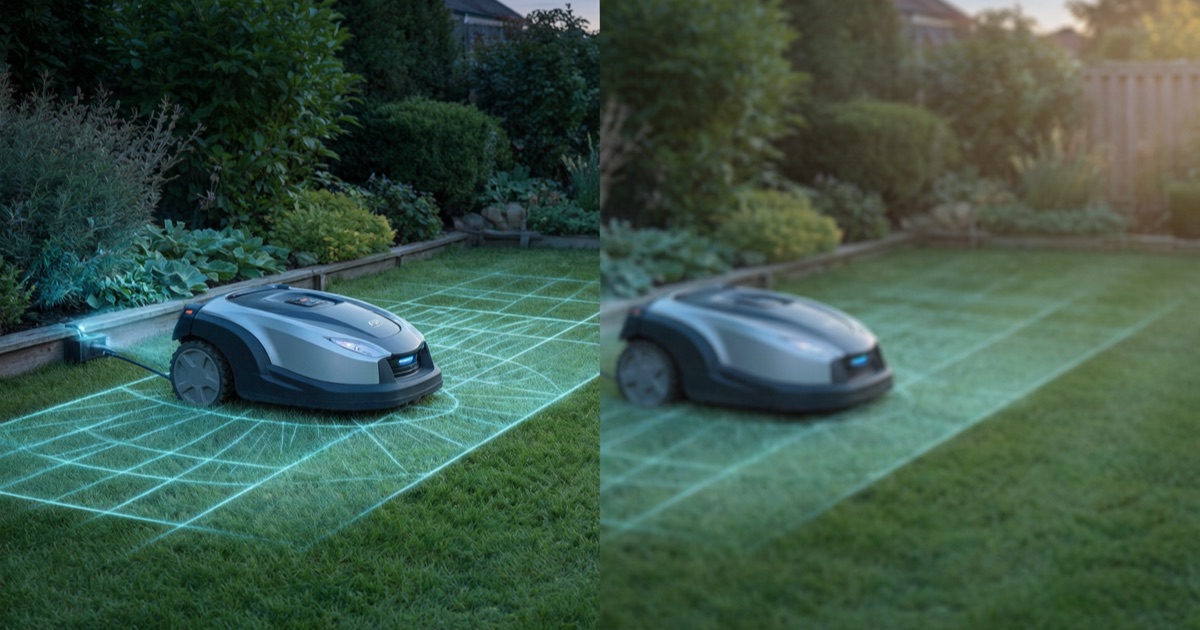
What has changed is that vendors stopped presenting the two as alternatives. Mammotion's Tri-Fusion navigation explicitly combines satellite positioning for open ground, lidar for tight and cluttered areas, and vision for object recognition — the pitch is that the mower switches between them so it never gets lost. Segway's Navimow X430 builds on RTK positioning and adds AI-assisted vision for obstacle handling and edge awareness. These are not compromise products; they are the premium tier.
Meanwhile vision-only survives at the bottom of the range, with the constraints you would expect. The Eufy E15 relies entirely on visual navigation and is recommended for daytime use — a hard operational limit that follows directly from the sensor choice, and one a buyer of a machine meant to run unattended should notice.
The clearest evidence: one company, both answers, same price
Roborock shipped the two philosophies simultaneously, in the same product family, at the same list price of $1,599.99.
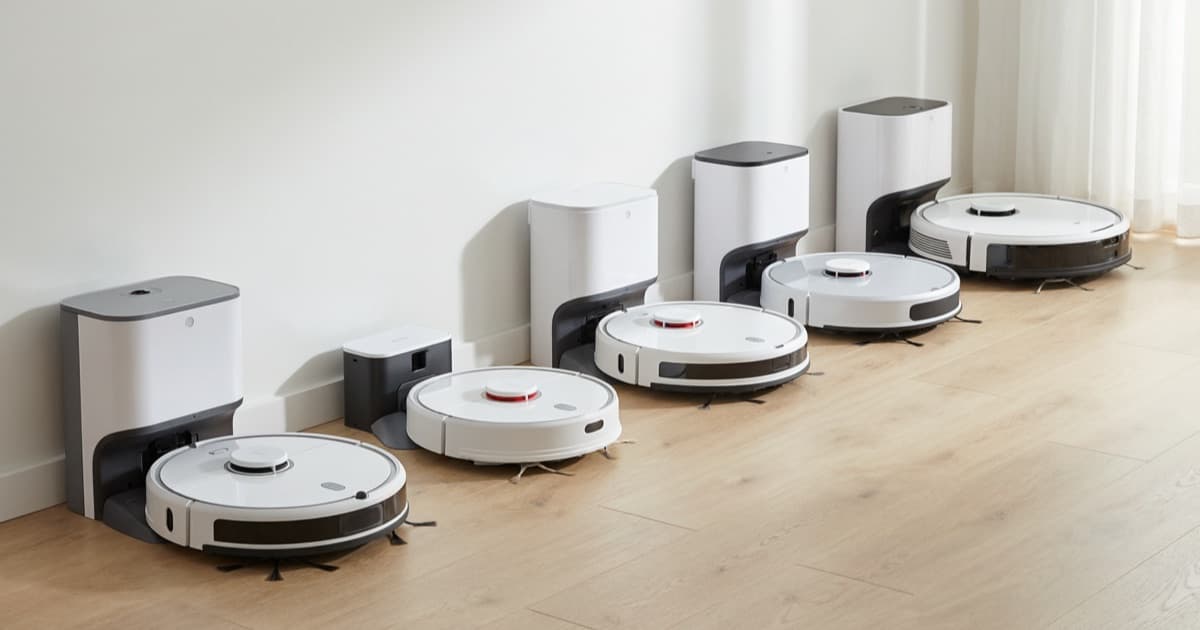
The Saros 10 uses a traditional rotating lidar in a retractable turret that drops into the body to clear low furniture. The Saros 10R drops the turret entirely for StarSight 2.0 — a solid-state system flush with the body, combining a dual-transmitter design, a 3D time-of-flight sensor and structured light.
Reviewers' verdicts split exactly along the theoretical lines: the rotating lidar maps and navigates the house slightly more efficiently with its longer range, while the solid-state system is better at close-range obstacle avoidance. Neither is the successor to the other. They are two points on a trade-off curve, sold side by side, and the company let buyers choose the failure mode they cared about.
That is what a settled debate looks like in practice — not a winner, but a market that has stopped arguing about sensors and started segmenting by trade-off.
What buyers should actually do
Buy the failure mode, not the sensor. Every architecture fails somewhere specific, and the spec sheet will not tell you where. RTK positioning delivers centimetre accuracy on open ground and degrades under heavy tree cover or beside tall buildings. Rotating lidar maps large spaces well but adds height, which is why turrets now retract. Vision degrades in low light. Ask the vendor which condition breaks their system, and treat a claim of no weakness as a sales answer.
Treat "vision-only" as a price signal. In 2026 it usually means the sensor budget did not stretch to a laser, not that the engineers chose purity. That can be entirely fine for a small, well-lit, daytime job. It is a poor choice for anything expected to work at night or in a cluttered room.
Check what "lidar" means on the box. A rotating turret and a flush solid-state module carry different heights, different ranges and different close-range behaviour. As the Saros pair shows, the same brand may sell you either.
Do not pay a premium for fusion you cannot use. Triple-sensor systems earn their price in complex, obstacle-dense yards and rooms. On a simple rectangular lawn with clear sky, RTK alone has been adequate for years, and the extra sensors mostly buy resilience you will not exercise.
For a closer look at how these systems compare in one category, see our robot mower navigation comparison and our analysis of what AI claims on robot vacuums really mean. Browse current models on our lawn mower robot and cleaning robot category pages.
Sources
- RoboSense: H1 2026 LiDAR sales of 719,200 units, robotics segment up 510.4% (company announcement)
- CnEVPost: RoboSense robotics LiDAR shipments surpass automotive for the first time (ASP down 52% to RMB 1,336)
- Benzinga: Seyond narrows annual loss but faces intense pricing pressure (ASP $662 to $443)
- Yahoo Finance: Hesai reportedly plans to cut LiDAR prices by half
- PCWorld: Mammotion's Tri-Fusion navigation
- Navimow: LiDAR vs NRTK vs Vision navigation guide (vendor source, used for stated RTK accuracy and its limits)
- VacuumWars: Roborock Saros 10 vs 10R comparison (navigation trade-offs between rotating and solid-state)
- Roborock US store (list pricing for both Saros models, read 27 July 2026)
---
*Supplier shipment and pricing figures are as reported by the companies and the outlets cited above. Where a claim comes from a vendor with a commercial interest in the answer, it is identified as such in the text.*