The story of robot mower navigation in 2026 is largely a Chinese one. When Segway-Ninebot's Navimow put RTK positioning into a wire-free consumer mower back in 2021, it cracked open a market that boundary-wire incumbents had sat on for years. By 2024 — widely described in the industry as the year wire-free mowers hit true mass production — "RTK plus vision" had become the mainstream navigation recipe. If you're sourcing mowers today, understanding this stack is the difference between a machine that works and one that strands customers under a tree.
Why boundary wire lost
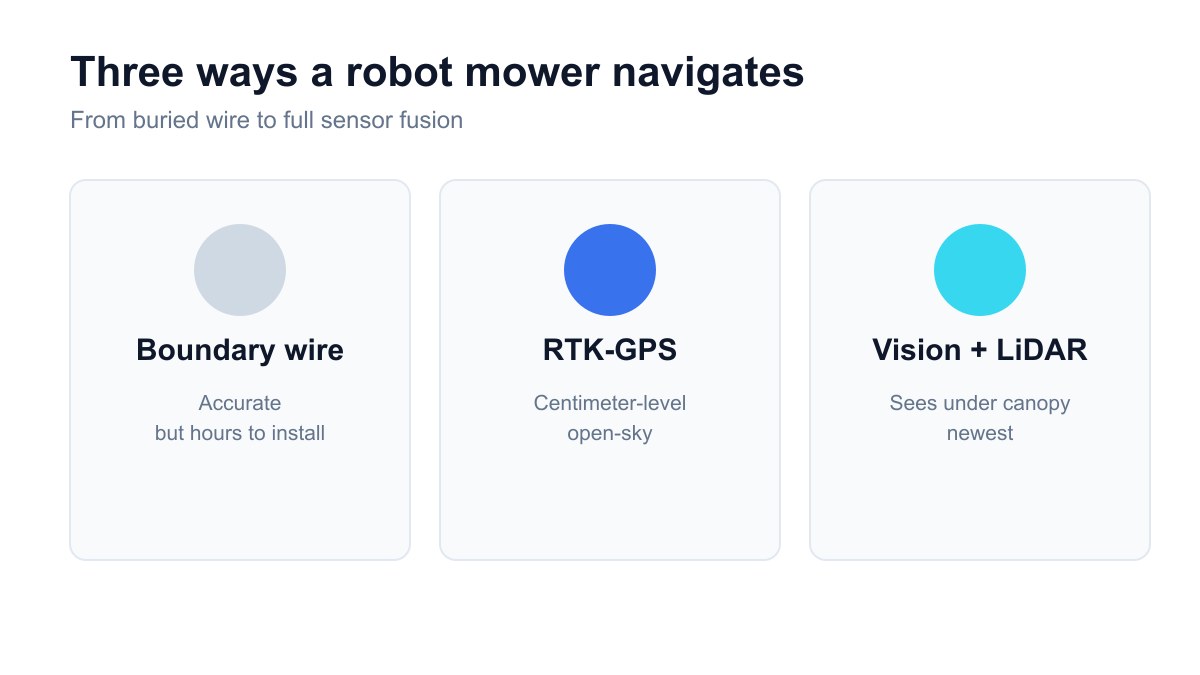
The old method buries a perimeter wire the mower senses to stay in bounds. It's accurate and weather-proof, but installation runs hours to a full day and a broken wire is the classic failure. Chinese entrants skipped it entirely, betting that satellite positioning plus onboard sensing could replace the cable — and the market followed.
The three navigation layers
- RTK-GPS pairs satellite positioning with a correction source for centimeter-level accuracy and 15–30 minute setup. Newer designs lean on cloud-based NRTK correction, removing the external base station that early kits required. The catch: RTK degrades under dense canopy or tight against buildings — the same open-sky dependence seen in agricultural drones.
- Vision / AI cameras map the lawn by landmarks, filling in where GPS drops. Binocular (dual-camera) AI vision now ships on flagship models.
- LiDAR adds 3D obstacle sensing — some units carry 360° or multi-line 3D LiDAR for all-weather reliability.
Fusion is the 2026 standard
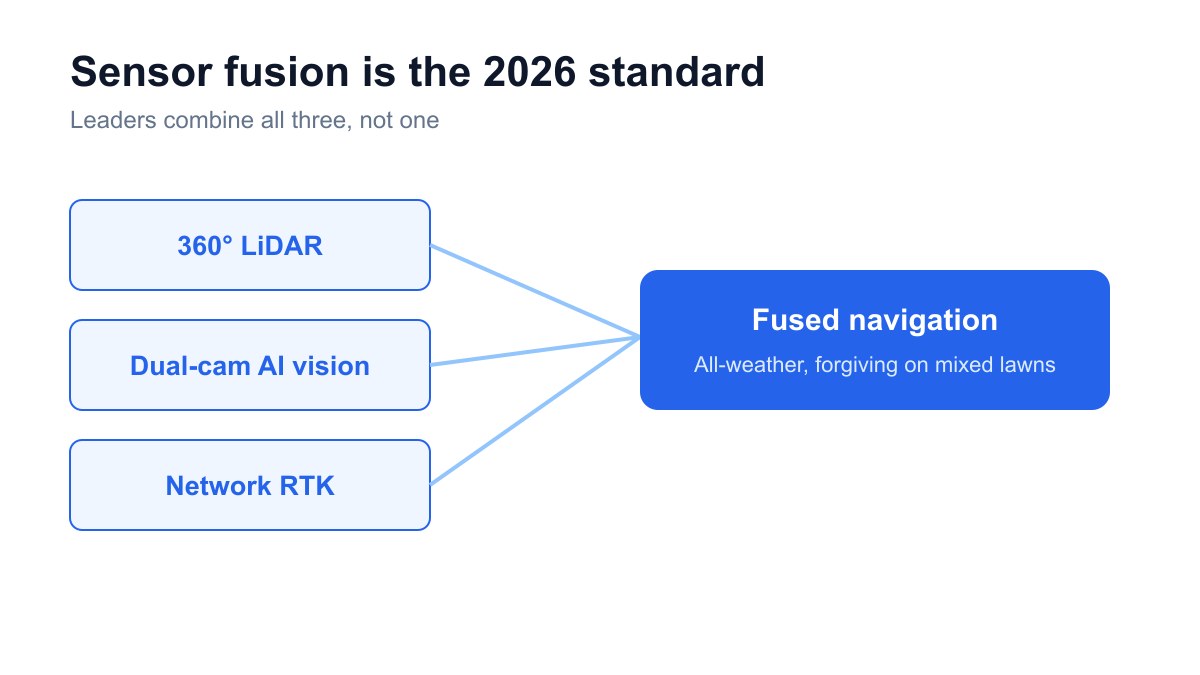
The leaders no longer pick one — they fuse all three. Mammotion's LUBA 3 AWD markets a "Tri-Fusion" stack of 360° LiDAR, dual-camera AI vision, and network RTK. Other 2026 entrants pair satellite RTK with binocular vision and 360° LiDAR to run with no buried wire and no external base at all. Fused systems are far more forgiving on mixed properties, though you still want safety buffers at no-go zones and edges.
What it means for sourcing
Navigation is where the cost sits: on a mid-to-high-end RTK-plus-vision unit, reported teardowns put navigation, obstacle avoidance, and amortization at more than 60% of the bill of materials. So match the stack to the lawn:
- Open, sunny lawns — RTK-first is fastest and cleanest.
- Tree-heavy or building-tight yards — insist on vision or full fusion; pure RTK frustrates.
- Reselling across mixed markets — a fused RTK + vision + LiDAR platform is the safest single SKU.
Bottom line
Chinese brands won the navigation race by abandoning wire and racing to sensor fusion. When sourcing, ask vendors for performance data under canopy — not just open-sky specs — and confirm which of the three layers a machine actually carries. Compare navigation systems and suppliers of robotic lawn mowers before you shortlist.