
For years the robot-mower story was residential — small backyards, one machine. In 2026 Chinese brands are pushing hard into commercial turf, and the specs that matter change completely once the target is a golf course, a sports field, a corporate campus, or community green space. If you're sourcing autonomous mowers for large-area professional use, here's the buyer's checklist.
Coverage-per-charge is the headline number
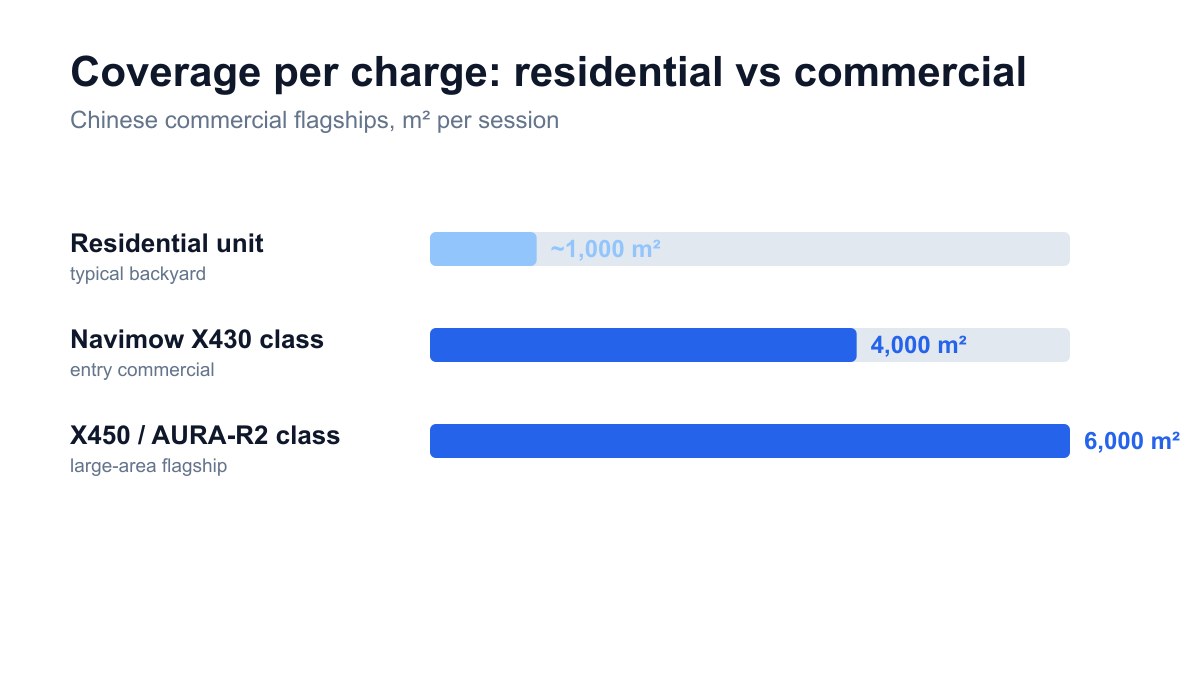
Commercial-grade machines are rated for far larger areas than backyard units. Chinese flagships now advertise coverage in the thousands of square meters — model lines that pair a 4,000 m² unit with a 6,000 m² sibling are typical of the 2026 crop, and some new wire-free platforms claim up to 6,000 m² on a single deployment. When comparing, normalize on area per charge at your required cut quality, not the marketing maximum — the two can differ widely on real terrain.
Turf quality separates hobby from pro
Professional venues — golf courses, football pitches — demand strict, uniform grass height, which means precise cutting and tight path planning, not the random-pattern mowing of cheap machines. Newer commercial series (such as the Terranox-class lines aimed at community greens and golf courses) are built specifically for this gap. When sourcing, ask for cut-height consistency and path-planning behavior on large open turf, not just a coverage figure.
Navigation must survive real worksites
Big properties mean obstacles, slopes, and mixed sky exposure. Commercial systems typically fuse RTK — increasingly cloud-based NRTK — with vision and LiDAR. Confirm how the machine behaves near tree lines, buildings, and stadium structures, because the RTK backbone degrades under obstruction. For the full navigation breakdown, see our guide to robot mower navigation.
The commercial sourcing checklist
- Area per charge at your actual cut-quality target.
- Turf uniformity and path planning for professional venues.
- Slope and obstacle handling for the terrain you'll mow — see our slope guide.
- Battery strategy — charge time and whether the duty cycle keeps machines running.
- Durability and after-sales — commercial duty cycles are brutal; confirm spares and support.
- Certification for your market and safety features for public spaces.
Bottom line
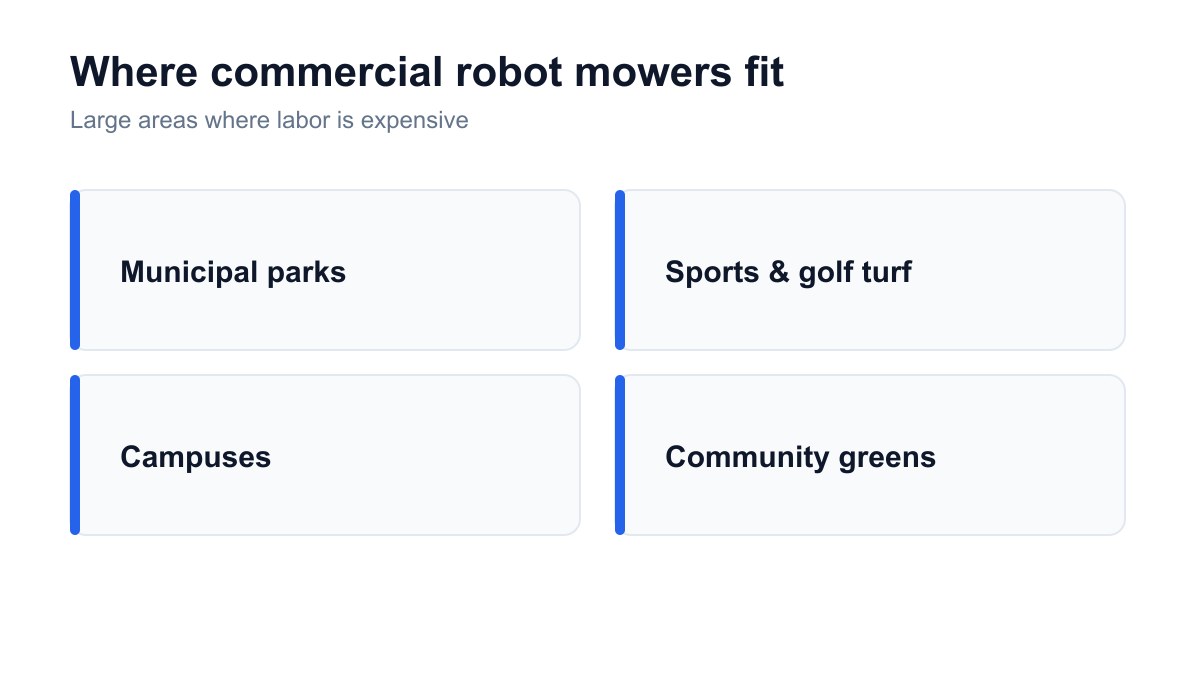
Commercial robot mowers are a labor-multiplier for grounds where area is large and labor is expensive — municipal parks, sports fields, campuses. Chinese brands now field credible large-area, pro-turf machines; prioritize real coverage, cut uniformity, and rugged navigation over sticker price. Compare commercial-grade robotic lawn mowers and suppliers side by side.