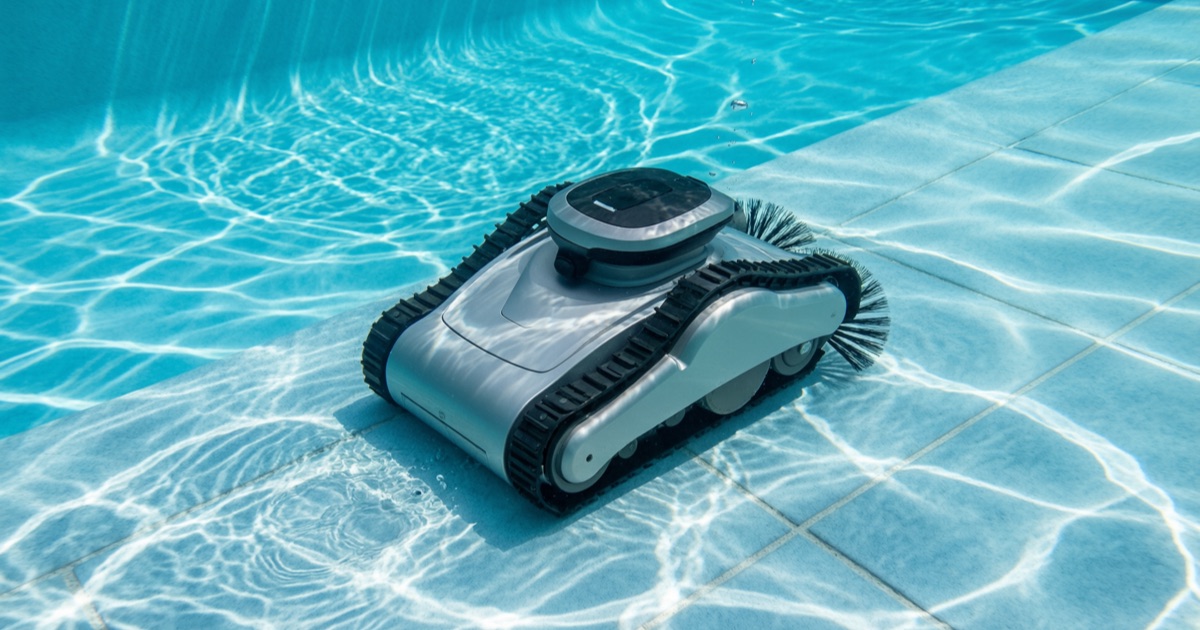
Beatbot arrived in the pool-robot market with an unusual strategy: skip the cheap end entirely and compete at the top on cordless autonomy, app control and AI navigation. Three years in, the range has widened considerably at the bottom, and the pricing has become genuinely confusing. Here is what each model costs in 2026 and the one pricing behaviour every buyer should understand before ordering.
The 2026 lineup and current pricing
Beatbot sells three families: the AquaSense full-clean robots, the Sora value line, and the iSkim surface skimmers.
| Model | Typical current price | Listed original price |
|---|---|---|
| AquaSense X (flagship) | ~$3,999 | ~$4,250 |
| AquaSense 2 Ultra | ~$2,199 | ~$3,150 |
| AquaSense 2 Pro | ~$1,899 | ~$2,299 |
| AquaSense 2 | ~$749 | ~$1,298 |
| Sora 70 | ~$1,149 | ~$1,499 |
| Sora 30 | ~$689 | ~$999 |
| Sora 10 | ~$449 | ~$699 |
| iSkim Ultra (skimmer) | ~$699 | ~$999 |
| iSkim (skimmer) | ~$319 | ~$499 |
Bundles are priced aggressively: an AquaSense 2 paired with an iSkim Ultra runs around $1,078 against a combined list of ~$2,297, and a Sora 30 with an iSkim Ultra around $998. If you want both floor and surface coverage, the bundle is consistently cheaper than buying the two separately — one of the few places where the bundle discount is real rather than notional.
The pricing behaviour you need to know about
Here is the practical finding, and it matters more than any single number above: Beatbot's "original price" is a moving anchor, and the street price moves with it.
Within a single research pass on the AquaSense 2 Ultra, independent reviews published in 2026 cited it at $2,649, at $2,829, and at a $3,550 MSRP — while the brand's own storefront showed $2,199 against a $3,150 list. Four different reference prices for one robot. The AquaSense 2 shows the same pattern, quoted at $849 and $1,300 by reviewers against a $749 current storefront price.
The takeaway is not that anyone is lying. It is that on this brand, the list price is a promotional construct and the discount is close to permanent. Two consequences for buyers:
- Never treat the strikethrough figure as the robot's value. A "42% off" AquaSense 2 is a $749 robot that is sometimes labelled $1,298.
- Never pay list. If you land on a page showing no discount, wait. The cadence of promotions on this brand is frequent enough that patience is worth real money — often several hundred dollars on the upper models.
Any review or comparison table quoting Beatbot prices should be checked against the storefront on the day you buy, including this one.
What the money actually buys as you move up
The range is stratified by coverage and by how much of the pool the robot handles:
- iSkim / iSkim Ultra ($319-$699) — surface only. These are not floor cleaners. They earn their place in tree-heavy yards where debris must be caught before it sinks, which materially reduces how hard the floor robot has to work.
- Sora 10 / 30 / 70 ($449-$1,149) — the value floor-and-wall line. This is where most residential buyers should start looking.
- AquaSense 2 ($749) — currently priced below the Sora 70, which is an artefact of promotion depth rather than a capability statement. Worth checking both lines side by side on the day.
- AquaSense 2 Pro / Ultra ($1,899-$2,199) — larger pools, more complex geometry, waterline and multi-surface work, clarifier dispensing on the Ultra.
- AquaSense X ($3,999) — the flagship, and a price point that puts it against commercial-grade equipment.
The Ultra's stated case is large pools — over roughly 50 feet — and irregular shapes with beach entries, peninsulas or unusual steps, where the navigation genuinely has work to do.
The counterargument worth taking seriously
Cordless is a convenience feature, not a performance feature. At least one independent reviewer running the AquaSense 2 Ultra head-to-head against corded Dolphin units costing a fraction of the price found it could not keep up on cleaning performance.
That is the central trade of this whole category. A cord is annoying — but it delivers unlimited runtime and continuous power, while a battery robot must budget both. If your pool is a simple rectangle within easy reach of an outlet, a corded cleaner at half the price may simply clean better. Cordless earns its premium on awkward pool shapes, no convenient power, and large surface areas where dragging a cable is the actual problem being solved.
How to choose
Work the decision in this order: surface debris load (do you need a skimmer at all?), then pool size and shape (does navigation complexity justify the AquaSense tier over Sora?), then cord tolerance (be honest — if a cord is fine, shop corded and save). Only then look at price, and when you do, look at today's street price rather than the list.
For how these robots navigate and what mapping claims actually mean in practice, see our pool cleaner navigation and mapping guide. For the broader category and competing brands, see pool cleaning robots.