Most drones fight the same enemy: the battery. Twenty to forty minutes of flight, then land, swap, and lose your feed. For jobs that need eyes in the sky for *hours* — a perimeter watch, an incident command post, a stalled inspection — that duty cycle is a dealbreaker. Tethered drones solve it by trading range for endurance, and a wave of capable, competitively priced Chinese systems has made them a practical sourcing option for security integrators, utilities, and emergency services.
How a tethered drone actually works
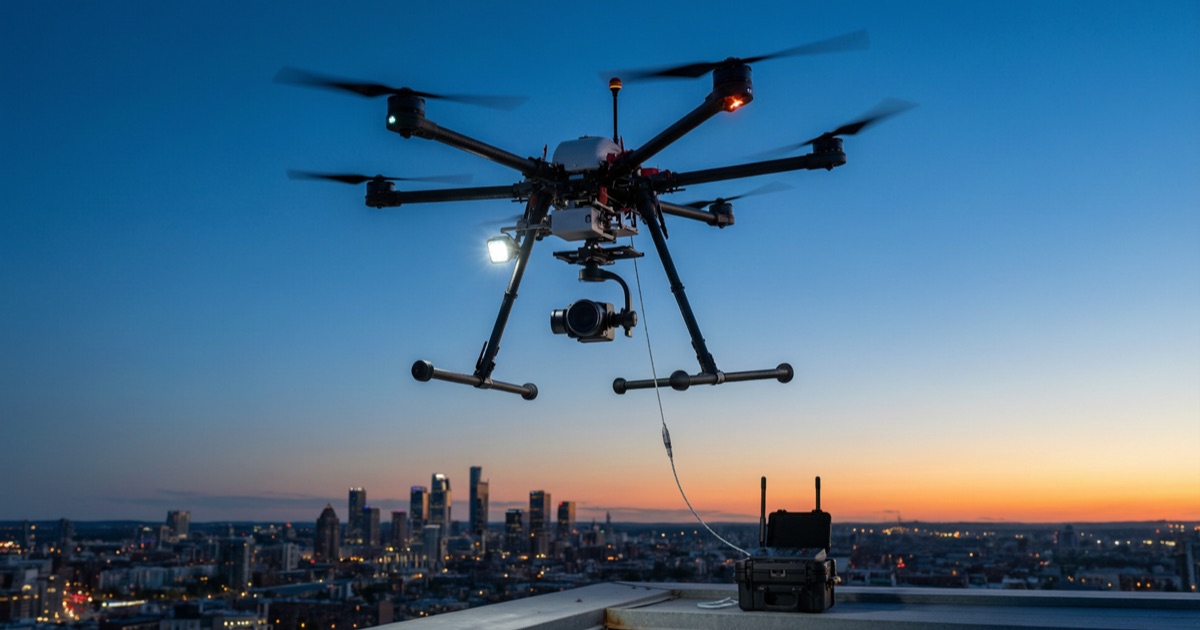
A thin cable runs from the aircraft down to a ground station, delivering continuous power and a hardwired data link. Because the drone never relies on onboard batteries for sustained flight, some tethered systems report staying aloft for up to 24 hours at a fixed position, with published payload capacities reaching 60 kg and operating heights around 500 m on high-end models. The cable also gives you an interference-resistant, high-bandwidth link — useful where GPS or radio is jammed or congested.
The trade-off is mobility: a tethered drone is a persistent *mast*, not a free-flying scout. You get a stable, always-on aerial platform anchored to one spot — think of it as a rapidly deployable 100-meter camera tower.
Where they earn their keep
- Emergency and firefighting — For high-rise fires above 100 m, conventional ground equipment can't reach. Tethered platforms are being deployed as elevated observation and, in some designs, firefighting-support rigs that hold position over an incident for the full duration of a response.
- Security and event coverage — A persistent overhead view for perimeters, crowds, and border zones, running through the night without a feed gap.
- Power, oil, and gas — Continuous monitoring of substations, pipelines, and remote sites where a fixed elevated sensor beats repeated manual patrols.
- Communications relay — Lifting an antenna to altitude to extend coverage over a disaster zone or a temporary work site.
What to check before you source
- Real endurance vs. spec-sheet endurance. Continuous-operation ratings assume a stable ground power supply and moderate conditions. Ask for field-deployment data, not just the lab maximum.
- Payload headroom. Confirm the platform carries your actual sensor stack — thermal camera, zoom gimbal, floodlight, relay — with margin to spare, not just a bare airframe.
- Wind and environmental rating. Persistent platforms live outdoors. Look for a stated wind-resistance grade and proven cold, heat, and electromagnetic tolerance.
- Ground station and cable management. The reel, power conditioning, and rapid-deploy design matter as much as the aircraft. A tangle-prone or slow-to-set-up base kills the value.
- Certification and after-sales. Persistent industrial use demands reliable spares and service. Verify the vendor's track record and the certifications your market and use case require.
Bottom line
If your problem is *coverage over time* rather than *coverage over distance*, a tethered drone is often the more cost-effective answer than a fleet of free-flying units rotating through batteries. Match the platform to your payload and endurance needs, and vet the ground station and support as carefully as the aircraft itself.
Compare specs, payloads, and manufacturers of industrial drones and inspection robots side by side before you contact suppliers.