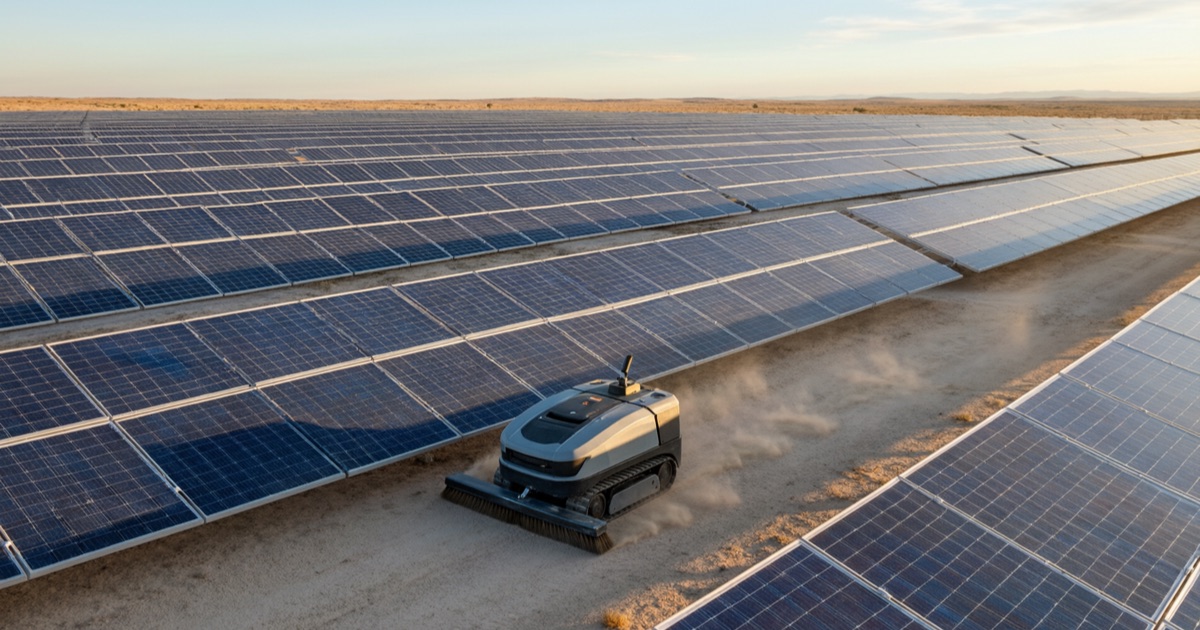
Dust is the quiet tax on every solar farm. A film of soiling can measurably cut a panel's output, and in arid, high-dust regions the loss compounds fast. Manual washing is slow, water-intensive, and increasingly hard to staff for utility-scale sites — which is why solar panel cleaning robots have moved from novelty to standard equipment. With roughly 300 GW of new PV capacity added globally in the past year, the addressable base is enormous. Here's how to source the right system.
Match the robot to the site, not the brochure
There is no single "best" PV cleaning robot — the right form factor is dictated by how your array is built.
- Fixed / rail-mounted systems live permanently on a row of panels and clean on a schedule, often waterless with a rotating microfiber brush. Best for large, uniform, fixed-tilt ground stations where you want fully autonomous daily cleaning with minimal labor.
- Track-mounted (crawler) robots drive on their own treads along and between panel rows, typically able to cross arrays and reposition autonomously. A fit for large sites where a permanent per-row install is uneconomical but soiling is heavy — think desert and high-dust ground stations.
- Portable / semi-automatic units are carried by a technician from row to row. Lowest capital cost and most flexible; best for rooftops, distributed generation, and smaller commercial arrays where full automation doesn't pay back.
Cleaning throughput varies widely by design, but vendors commonly cite figures on the order of 1,500 m²/hour for automated units — treat any single number as a starting point to verify against your row geometry.
The features that actually matter
Beyond raw speed, the specs that separate a reliable deployment from a maintenance headache:
- Waterless vs. water-fed — dry brushing saves scarce water in desert sites and avoids mineral spotting, but heavy caked soiling may still need water. Match to your climate and water access.
- Cross-array mobility — can the robot autonomously move between panel rows and reposition, or does it need manual relocation? This drives your labor line item.
- Obstacle avoidance and edge detection — panels have gaps, junction boxes, and drop-offs. Reliable positioning and anti-fall sensing protect both the robot and the glass.
- Dust and terrain rating — confirm ingress protection and tolerance for the specific dust load and surface (sand, gravel, rooftop) of your site.
- Panel-safe cleaning — soft brushes and controlled pressure to avoid micro-scratches and anti-reflective coating damage over thousands of cycles.
Vetting the supplier
The hardware is only half the purchase. Before you commit:
- Field track record — ask for deployments in a climate and array type like yours, not a generic reference.
- Battery and duty cycle — verify runtime and recharge behavior against your cleaning window and site size.
- Spare parts and service — brushes and tracks are wear items; confirm in-market parts availability.
- Certification and safety marks — the right electrical and safety certification for your operating region.
- ROI model — get the vendor's assumed soiling-loss recovery and water/labor savings, then stress-test it with your own tariff and site data.
Bottom line
A solar cleaning robot pays back by recovering lost generation and slashing water and labor — but only if the form factor fits your array and the supplier can service it locally. Start from your site type (fixed ground station, crawler-friendly desert array, or rooftop), then shortlist on cross-array mobility, water strategy, and after-sales depth.
Compare specs, form factors, and manufacturers of commercial cleaning robots before reaching out to suppliers.