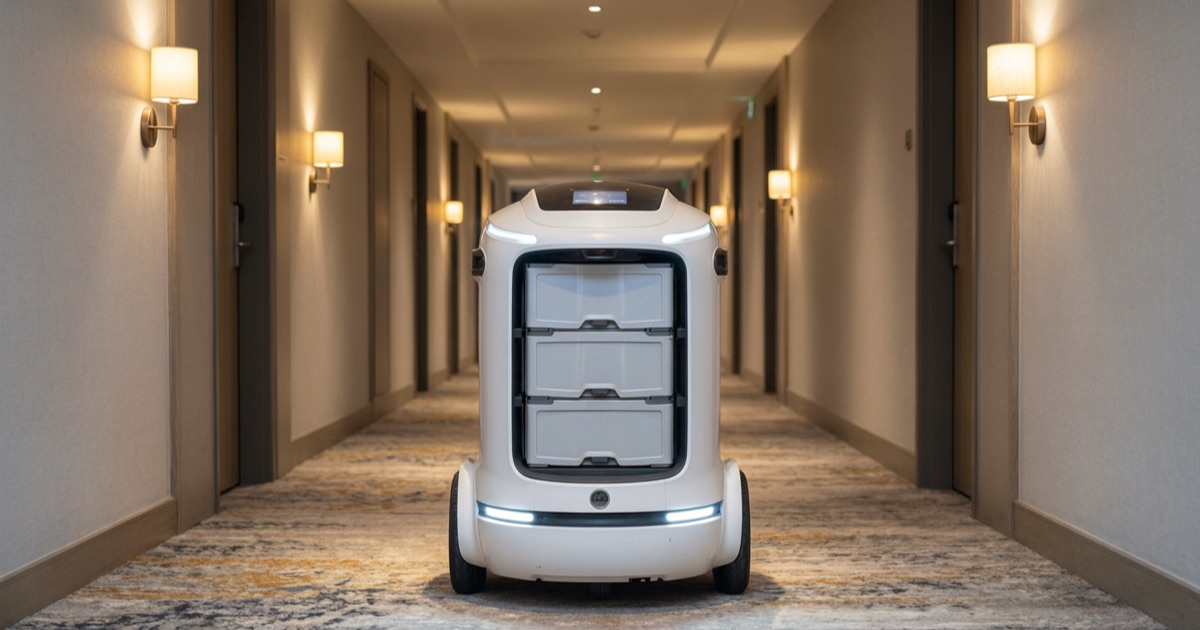
Buying a hotel delivery robot for a brand-new build is easy — corridors are wide, elevators are modern, and the property-management system (PMS) is current. Retrofitting one into an existing or economy hotel is where most sourcing decisions go wrong. The robot that demos beautifully in a showroom can stall in a 2010-era tower with a 90 cm corridor and an elevator that speaks a proprietary protocol. Here's what actually determines whether a deployment succeeds.
1. Form factor comes first, not last
Older and budget properties were never designed for autonomous traffic. Narrow corridors, tight turns near ice machines, and cramped elevator cars all constrain the chassis. Vendors have responded with slim-body models — some now pass through gaps as tight as roughly 55 cm — specifically so they can share a standard-width hallway with a guest and their luggage. Before you shortlist anything, measure your narrowest pinch points and your smallest elevator car. The robot's turning footprint, not its brochure width, is the number that matters.
2. Elevator and door integration is the real project
A delivery robot that can't call the elevator is just an expensive cart. Cross-floor delivery requires the robot to talk to your elevator controller and, often, automatic doors and access gates. This is where retrofits historically bled time: bespoke elevator-control wiring used to add weeks. The 2026 shift is toward low-code IoT middleware that pre-loads common elevator and PMS protocols in a containerized gateway, compressing what was once a multi-month integration into a matter of weeks in typical cases. When you source, ask the vendor exactly which elevator brands and PMS platforms they have pre-integrated — a supported protocol is the difference between plug-and-play and a custom engineering bill.
3. PMS and "ecosystem" tie-in
The market has moved from selling hardware to selling a "robot + cloud management + ecosystem" package. In practice that means the robot links to your PMS so front-desk or in-app orders route automatically, deliveries are logged, and a cloud dashboard tracks fleet utilization across shifts. Natural-language interaction driven by large models has also started replacing rigid command menus, which lowers the training burden on staff. Treat the cloud platform as part of the purchase, not a free add-on — its reporting is what proves ROI to ownership later.
4. Fleet and after-sales reality
Hotel robots are a mature commercial category — industry estimates put 2025 shipments in the range of 120,000 units, led by a handful of Chinese vendors. That maturity cuts both ways: the hardware is proven, but you're buying a multi-year service relationship. For a retrofit, prioritize a supplier with a local service network and spare-parts depth in your market over one with a marginally cheaper unit price. A robot down for two weeks waiting on an overseas part erases its labor savings fast.
Sourcing checklist for a retrofit
- Corridor + elevator survey — measure narrowest passage and smallest car before shortlisting.
- Pre-integrated protocols — confirm your specific elevator brand and PMS are already supported.
- Deployment timeline in writing — get a realistic weeks-not-months estimate tied to your actual building.
- Cloud dashboard access — verify you get utilization and delivery reporting, not just the robot.
- Local after-sales — confirm in-market service and parts availability for 24/7 operation.
Bottom line
For an existing hotel, the winning delivery robot is the one that fits your tightest corridor, already speaks your elevator and PMS, and comes with local support — not the one with the flashiest spec sheet. Nail those three and the labor math takes care of itself.
Compare specs, integration options, and manufacturers of delivery and service robots before you contact suppliers.