Most robot-mower buying advice is written for big, open lawns — the half-acre suburban rectangle where a mower can drive long, clean lines. But a large share of real-world demand looks nothing like that. It's a 300–800 m² city garden with a patio, a flower bed, a tree or two, a narrow side strip barely wider than the machine, and edges that need to look sharp. For buyers sourcing for these customers, the small-and-complex yard is a distinct product category — and picking the wrong platform shows up fast as missed patches and stuck machines.
Why small yards are actually the hard case
Counterintuitively, tight gardens stress a robot mower more than open fields. There's less room to reposition, more obstacles per square meter, and a much higher edge-to-area ratio, so poor perimeter cutting is glaringly visible. Older robot lawn mowers relied on a buried boundary wire and semi-random navigation — fine for a big lawn, frustrating in a small maze where the machine bumps and reverses constantly.
Wire-free is now the default — but not all wire-free is equal
The 2026 shift is decisive: wire-free navigation has moved from premium feature to baseline expectation, with industry coverage reporting strong double-digit sales growth for the segment. For complex small yards, three navigation approaches compete:
- RTK-GPS alone — centimeter-level accuracy on open turf, but satellite signal degrades under tree canopy and near walls, which is exactly where small gardens live.
- Vision / VSLAM — on-board cameras recognize the lawn edge and obstacles without a satellite fix; strong in enclosed, canopy-heavy spaces.
- Fusion (RTK + vision, sometimes LiDAR) — the emerging 2026 standard, blending satellite positioning with on-board perception so the mower keeps working when one signal drops.
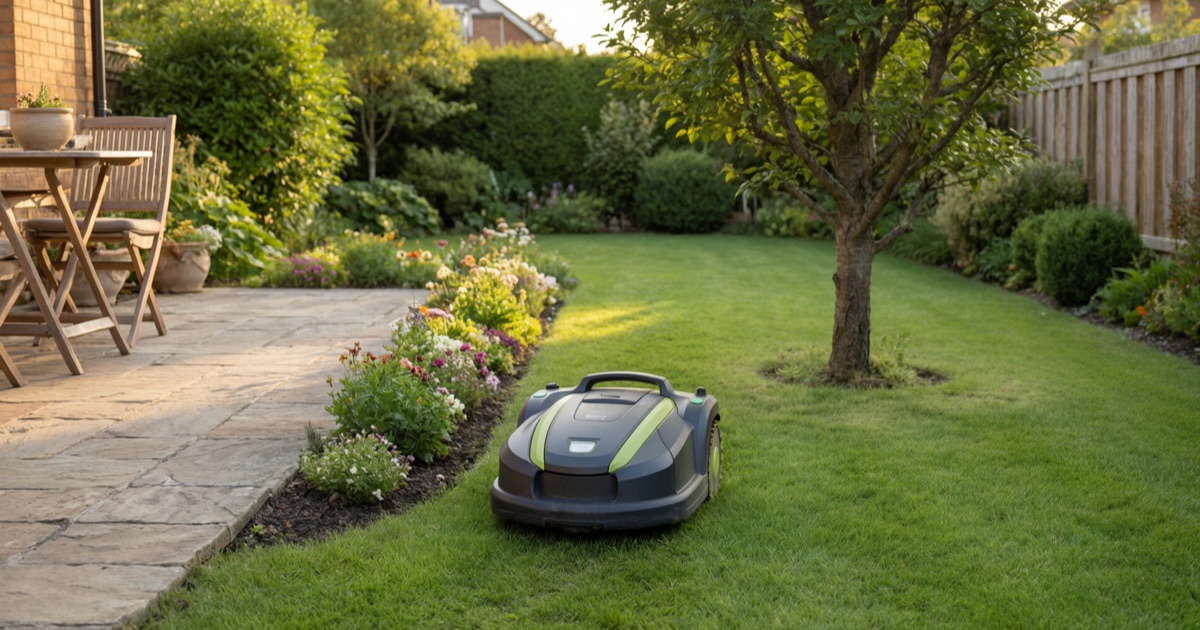
For anything with heavy tree cover, buildings close to the turf, or narrow corridors, a vision-based or fusion system is typically the safer bet than RTK-only. Several Chinese "mini" models are now purpose-built for sub-1,000 m² gardens with steep slopes, tight corridors, and precise edge trimming — a segment that barely existed two years ago.
A sourcing checklist for the small-yard segment
When evaluating models to stock or private-label for compact gardens, weight these over raw coverage numbers:
- Passage width — can it self-navigate corridors around 1 m wide? Many big-lawn models can't turn cleanly in them.
- Edge-cutting behavior — how close to walls and beds does the blade actually reach? This defines perceived quality in a small garden.
- Obstacle handling — vision-based detection of furniture, toys, and hoses matters far more per square meter here.
- Multi-zone support — front, back, and side strips are often separate islands; the mower needs to map and schedule them independently.
- Setup time — the wire-free selling point is app-based setup in well under an hour. Verify it on a cluttered layout, not a demo field.
The takeaway
Don't source small-yard mowers by shrinking a large-lawn spec sheet. The winning machine for a 500 m² obstacle-dense garden is the one that navigates tight corridors, trims edges cleanly, and maps multiple zones — usually a vision or fusion platform, not RTK-only. It's a fast-growing niche with real margin for buyers who spec correctly.
*Compare wire-free and fusion-navigation options among verified suppliers on the robot lawn mower category page, and see our companion guide on how Chinese mowers won the navigation race for the underlying tech.*