
The single biggest shift in robot mowers isn't a sensor — it's the price tag. Chinese wire-free machines have dragged the category from luxury toward mainstream, and that reshapes the buy decision for homeowners, landscapers, and distributors alike. Here's the 2026 cost picture, grounded in real market numbers.
Prices have collapsed toward the mainstream
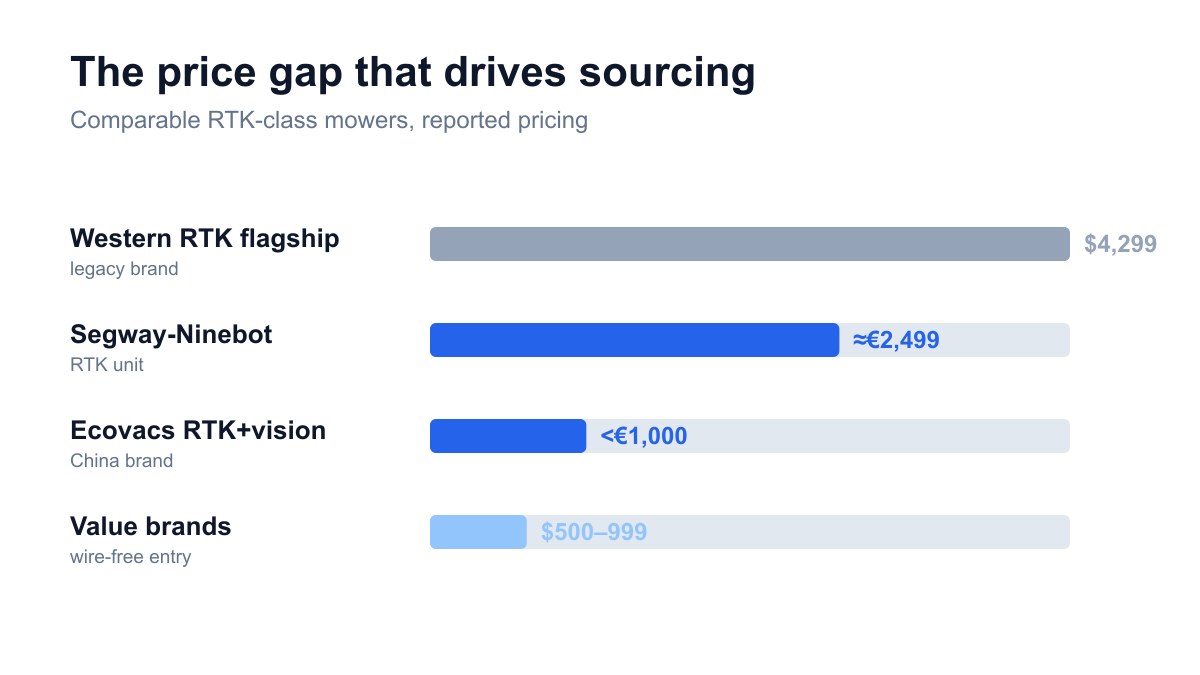
Wire-free robot mowers that once sat in premium territory now start around $1,000, with entry models reportedly dipping toward $500. Crowdfunded and value brands have pushed hard — sub-$600 wire-free units and $999 RTK models are now real. The gap versus legacy brands is stark: reports put a Western RTK flagship near $4,299, a comparable Segway-Ninebot unit around €2,499, and an Ecovacs RTK-plus-vision machine under €1,000. That spread is the whole sourcing thesis.
Where the cost actually sits
The price drop hasn't come from cheap parts — it's come from scale and supply-chain depth. On a mid-to-high-end unit, reported teardowns put navigation, obstacle avoidance, and amortization at more than 60% of the bill of materials. As volumes climb, those costs keep falling, so expect prices to keep easing rather than spike.
The value case: time and labor
For homeowners, the payback is time — one owner reported reclaiming two mowing sessions a week of 30–45 minutes each. For businesses, it's labor: wire-free machines with smart path planning report efficiency gains of 80%+ over old random-collision mowers, letting one machine cover ground that used to tie up a person. That's what turns a mower from a gadget into a capital asset.
A quick buyer screen
- Match the price band to the job — a $500–$1,000 unit fits standard residential; large or pro turf justifies more.
- Weigh total cost, not sticker — blades, batteries, and any connectivity fees over five years.
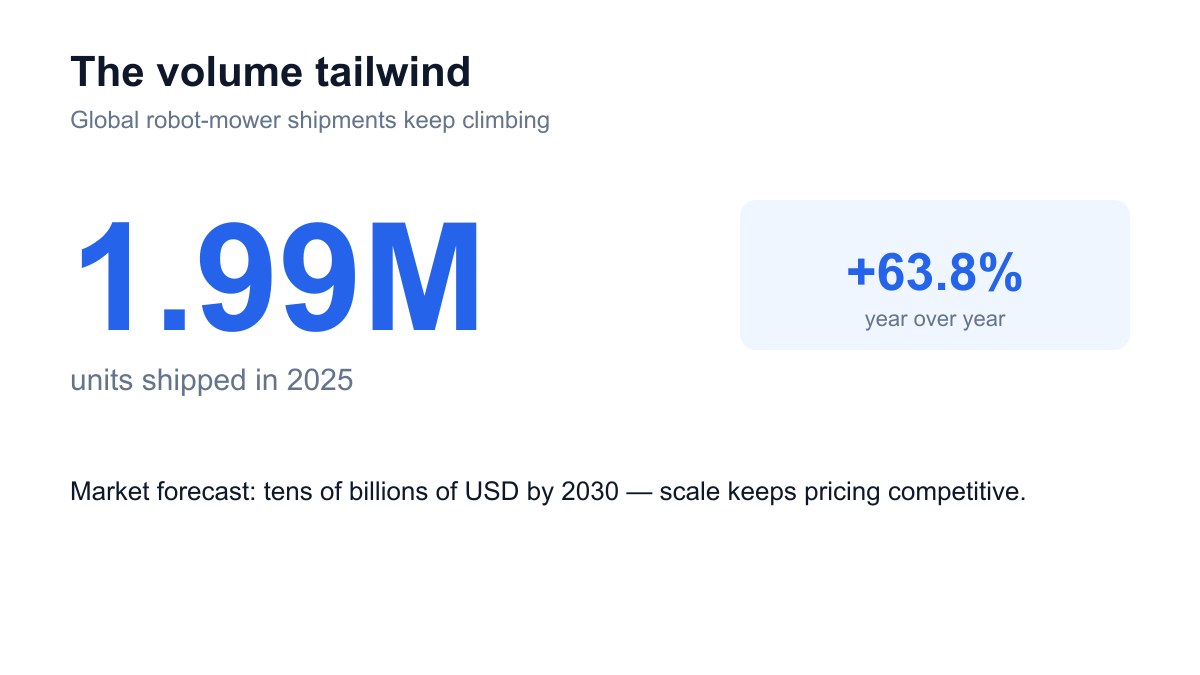
- Volume tailwind — global shipments reportedly hit ~1.99M units in 2025 (up ~63.8%), with forecasts putting the market in the tens of billions of dollars by 2030; scale keeps pricing competitive.
- Terrain fit — flat and open pays back fastest; for hills see our slope guide.
Bottom line
Chinese brands didn't just match Western mowers — they broke the price barrier, often at a fraction of legacy pricing while carrying the same RTK-plus-vision navigation. Buy on total cost and match the machine to the job, and the ROI increasingly speaks for itself. Compare robotic lawn mower pricing and suppliers before you commit.