"How long does it run, and will it finish my lawn?" is the question behind most robot-mower purchases — and the one buyers get wrong most often. Runtime, coverage-per-charge, and charge cycles interact in ways a single spec number hides. Here's how to size a robot lawn mower correctly, whether you're buying one or stocking a range.
Runtime vs coverage: two different numbers
Runtime is how long the mower cuts before returning to charge — commonly around 60–120 minutes per charge for consumer models, though some larger-battery units advertise several hours. Coverage is the lawn area it can maintain, which depends on runtime *plus* how efficiently the machine moves. As a rough public benchmark, a mid-size battery (in the ~4,000–4,400 mAh range) is often quoted at roughly 3,000 sq ft (around 280 m²) per charge, while smaller 5 Ah packs may deliver 70–90 minutes and need a mid-job recharge on bigger lawns.
The critical point: coverage-per-charge is not the same as the lawn area a mower can *manage*. A machine that recharges and resumes automatically can maintain a lawn several times its single-charge coverage — it just makes more trips.
Charge cycles: why total daily capacity matters more
Modern mowers work in cycles: mow until low battery, return to dock, recharge, resume. Fast charging changes the economics — some models restore enough in about 30 minutes to run another ~90 minutes and cover roughly 500 m² per cycle. Over a day, what matters for a large lawn isn't a single charge but cycles per day × coverage per cycle, minus the time parked charging.
This is why manufacturers quote a maximum managed area (e.g., "up to X m²") separately from battery specs. Buy on managed area for the target lawn, then confirm the charge time is short enough to finish within the customer's preferred mowing window.
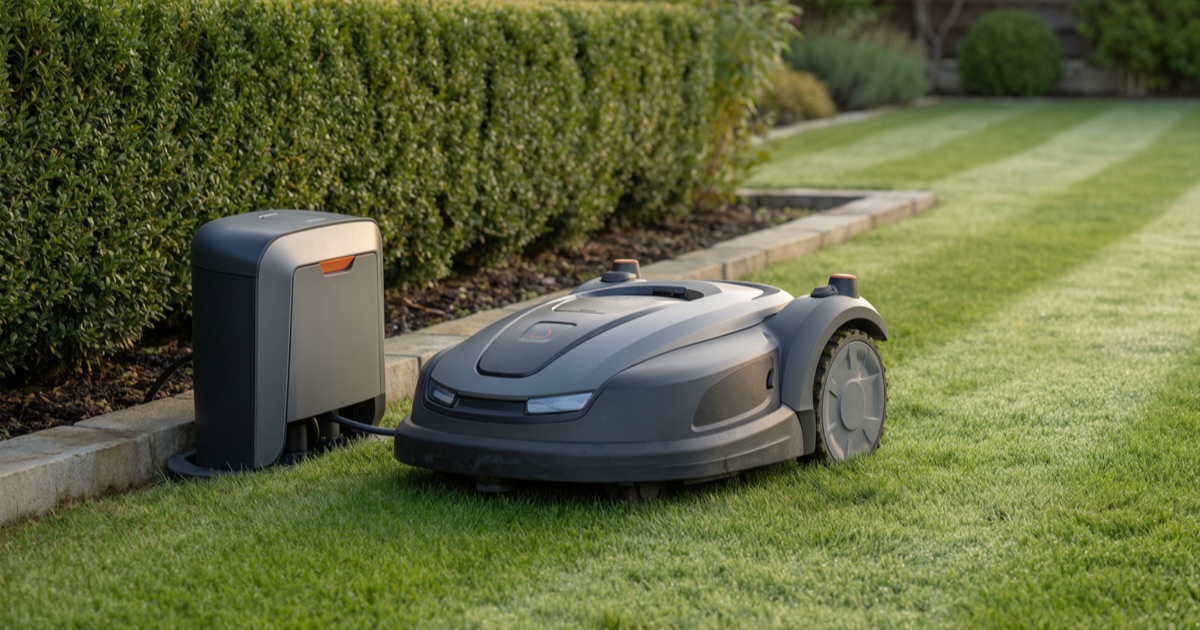
Navigation efficiency quietly changes the math
Two mowers with identical batteries can cover very different areas. Older random-pattern navigation wastes runtime re-cutting the same strips; systematic, mapped navigation (typical of RTK and vision models) covers more lawn per minute of battery. When comparing coverage claims, check whether they assume systematic mowing — a mapped mower can outperform a same-battery random one by a wide margin. For the underlying navigation trade-offs, see our navigation guide.
A sizing checklist for buyers
- Start from managed area, not runtime. Match the mower's rated "up to X m²" to the real lawn, with headroom for fast-growing seasons.
- Check charge time and cycles/day. A shorter charge means more effective coverage in the same window.
- Confirm navigation type. Systematic/mapped mowing stretches every charge further than random patterns.
- Account for slopes and obstacles. Hills and tight turns drain the battery faster than flat-field specs suggest.
- Battery health over time. Ask about pack chemistry and replaceability — capacity fades over seasons, and a serviceable battery extends the product's life.
The takeaway
Don't size a robot mower by runtime alone. The right model is the one whose managed area, charge speed, and navigation efficiency together cover the target lawn comfortably within the owner's schedule. Get those three right and the single-charge number barely matters — the mower simply docks, tops up, and finishes the job.
*See runtime and coverage specs across verified suppliers on the robot lawn mower category page.*