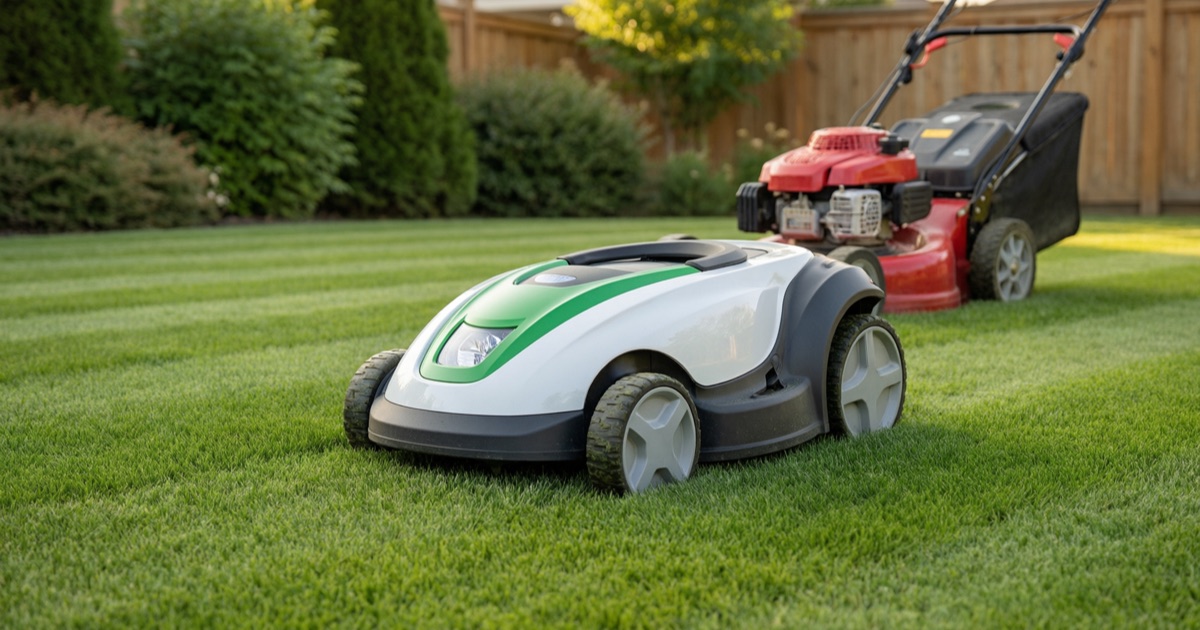
Every year more homeowners ask the same question before buying: does a robot lawn mower really beat the gas mower sitting in the garage? By 2026 the honest answer is "for most typical lawns, yes" — but the trade-offs are worth understanding before you spend. Here is a straight comparison across the things that actually matter.
Upfront cost
This is the one area where gas still wins outright. A decent push or self-propelled gas mower runs a few hundred dollars. Robot mowers span a wide band — roughly $800 to over $5,000 for mainstream residential models, and well past $25,000 for large commercial machines.
The gap has narrowed fast, though. Wire-free RTK-GPS navigation, which used to be a premium feature, dropped below $1,000 in 2026, with entry wire-free units starting under $700 and premium all-wheel-drive models around $3,000+. If you were comparing a robot to a mid-range gas mower two years ago the price shock was large; today it is much smaller.
Running cost
Here the robot pulls ahead. A gas mower keeps costing you fuel, oil changes, spark plugs, air filters, and periodic tune-ups. A robot mower's recurring costs are small and predictable: replacement blades typically run $20–$40 a year, electricity adds only a few dollars a month, and the battery needs replacing roughly every 3–5 years at $150–$400 depending on the model.
For anyone currently paying for lawn-care visits, the math is even clearer. At a common $50–$65 per cut across 20–25 cuts a season, a mid-range wire-free robot can pay for itself within one to two seasons.
Time and labor
This is the real selling point. A gas mower needs you — every week, in the heat, for the whole season. A robot mower works on its own schedule and can remove 20+ hours of seasonal mowing for many households. Instead of one long weekly cut, it mows little and often and returns to its dock automatically.
Lawn health and noise
Mowing frequently and mulching the fine clippings back into the turf tends to produce a denser, healthier lawn over time. Robot mowers are also near-silent and produce no exhaust fumes, so they can run early morning or midday without disturbing neighbors — something no gas mower can claim.
Where a gas mower still wins
Robots are not the right tool for every yard. Very tall, overgrown, or wet grass, heavy leaf cover, and lawns full of fixed obstacles still favor a gas mower's raw power and a human operator. Robots also need an initial setup — mapping or a boundary — and a charging dock location. For a neglected or rarely-cut lawn, a gas mower remains the faster reset tool.
Sourcing note
Most of the wire-free and RTK models driving this shift are manufactured in China, which is why pricing has fallen so quickly. If you are buying for resale or a landscaping fleet, compare current robot lawn mower options and confirm blade and battery spare-part availability before committing to a supplier.
The verdict
For a typical, regularly-maintained residential lawn, a 2026 robot mower wins on running cost, time, noise, and lawn health, and now costs far less upfront than it used to. A gas mower still makes sense for overgrown, oversized, or obstacle-heavy jobs. Match the tool to the lawn, not to the hype.