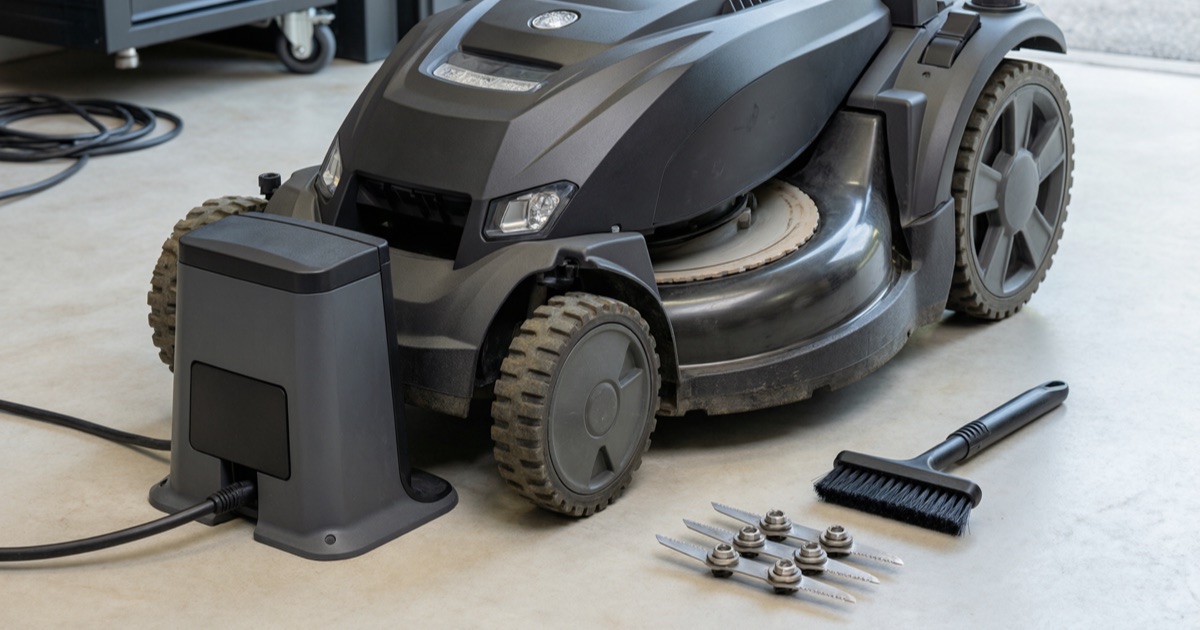
One of the quiet advantages of a robot lawn mower is how little upkeep it needs compared with a gas machine — no oil, no spark plugs, no fuel. But "low maintenance" is not "no maintenance." A few simple habits keep the cut clean, the battery healthy, and the navigation accurate. Here is a practical 2026 routine.
Blades: the one part you will replace regularly
Robot mowers use small, cheap blades that dull faster than a big steel gas-mower blade. As a rule of thumb, replace them after around 200 operating hours, or roughly every one to two months of regular use — more often if you cut coarse or tough grass. A full year of blades typically costs only $20–$40.
Do not skip this. Dull blades tear grass instead of slicing it, which leaves ragged brown tips and makes the motor work harder, draining the battery faster. Fresh blades are the cheapest performance upgrade you can make.
Cleaning: little and often, but gently
Clippings and damp grass build up under the deck and around the wheels. A good schedule:
- After each session: brush loose clippings off the chassis and underside.
- Weekly: unclog the blade disc and wheels, and gently wipe the sensors and any camera lens.
- Monthly: do a deeper clean and inspect the blades and deck for wear.
The one hard rule: do not pressure-wash it. Robot mowers are full of sensitive electronics and sensors — use a damp cloth or dry brush, not a hose jet. Keeping sensors and the RTK antenna clean also matters for navigation accuracy, since a grass-caked sensor can cause erratic movement.
Winter storage: protect the battery
In cold climates the off-season is when mowers quietly die from neglect. Before storing:
- Clean and inspect the housing and deck, and note any worn parts to replace before spring.
- Set the battery to a safe charge level. Many manufacturers recommend storing at a partial charge (commonly around 40–60%) rather than fully drained — but this varies by brand, so check your model's manual, as some advise a full charge before storage.
- Store indoors, dry. Cold, snow, and rain damage the electronics. Keep the mower and its charging station somewhere dry and above freezing.
- Keep firmware updated so it is ready to go when the season restarts.
A sourcing note for buyers and resellers
Long-term ownership cost depends heavily on parts availability. If you are choosing a robot lawn mower to buy in volume or resell, confirm that the supplier can provide a steady stream of replacement blades and batteries, and that documentation covers the maintenance schedule. A cheap unit with no spare-part pipeline becomes expensive the moment a blade disc or battery fails.
The takeaway
Robot mower maintenance comes down to three habits: swap the cheap blades on schedule, clean gently and often without a pressure washer, and store the battery correctly over winter. Do those and a quality 2026 robot mower will stay reliable for years with minimal effort.