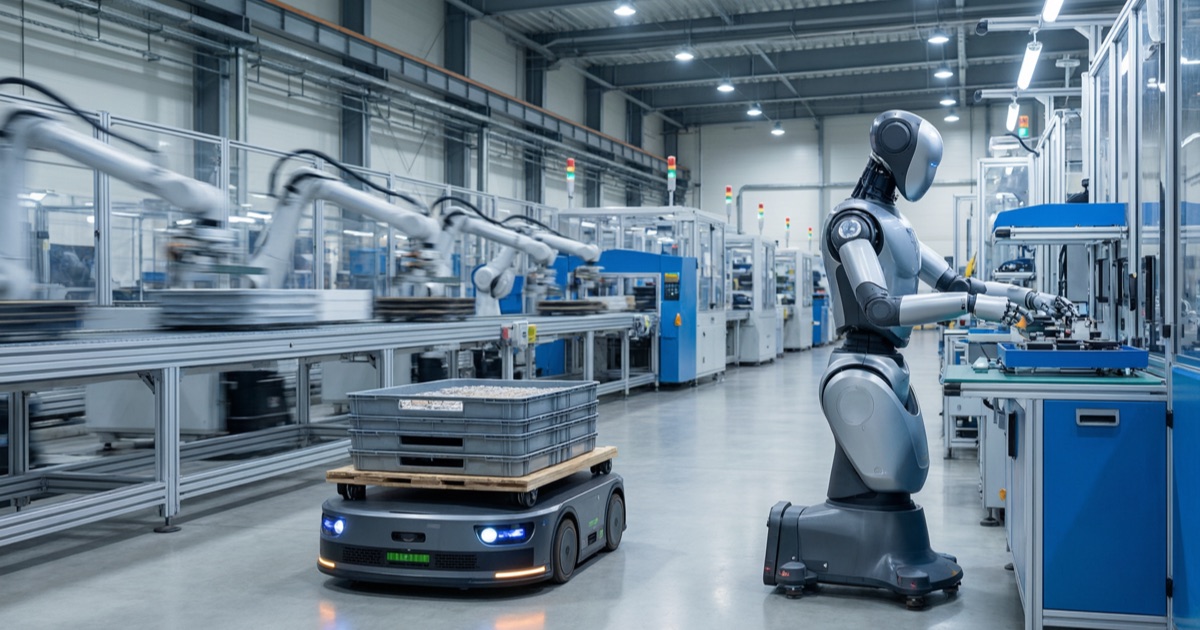
In 2026, two very different robot generations are crowding onto the same factory floors. On one side are the proven workhorses — AGVs, AMRs and other wheeled, navigation-driven mobile robots that have run warehouses and lines for over a decade. On the other are the newcomers: embodied-AI humanoids being piloted on production lines, some with live multi-day, multi-hour transparent broadcasts of their work. For a buyer, the interesting question isn't which is "better" — it's which fits the job you're automating.
Why everyone is pushing into factories at once
Manufacturing and warehousing have always been the biggest market for mobile robots. What changed in 2026 is that embodied-AI vendors decided to plant their flag there too — and the driver isn't purely technical maturity.
Industry data suggests factories aren't even the largest buyer of embodied robots today; data-collection bases, education/research, and rental/exhibition work have absorbed more units, with industrial logistics reportedly around 4% of embodied deployments in 2025. Three forces are pulling humanoids onto the line anyway: policy programs pushing real-world industrial pilots, a fundraising environment that rewards a credible manufacturing narrative, and — most durably — the fact that factories generate the structured, decomposable action data an embodied model needs to improve. As one industry executive framed it, a line with fixed stations and takt time is a far better "data flywheel" environment than the open-ended chaos of a home.
The real advantage: flexibility for high-mix lines
There's a genuine production case, too. Model churn is accelerating — one integrator noted the pace of line changeovers has broken the old "redesign every 3-5 years" rhythm entirely. Traditional rigid automation (PLC programming, fixed jigs, dedicated tooling) has to be re-deployed on every changeover. A general-purpose embodied "brain" promises far more flexibility, which is why hard, high-variability tasks like automotive wire-harness assembly — sub-millimeter precision, flexible cables, complex paths — are being targeted as proving grounds.
The 1.0-to-5.0 ladder: a buyer's selection map
One mobile-robotics co-founder offered a maturity ladder that doubles as a sourcing framework:
- 1.0 — hard-coded industrial arms; every motion scripted.
- 2.0 — collaborative arms and mobile robots; some autonomy, but dedicated hardware (a forklift is a forklift).
- 3.0 — AI layered onto proven hardware; software generalizes, hardware stays specialized.
- 4.0 — general-purpose software *and* hardware; today's humanoid vision.
- 5.0 — the future end-state.
The practical read: 3.0 and 4.0 will coexist, and near-term ROI leans heavily toward 3.0. Established mobile-robot vendors are already retrofitting general-purpose "brains" (VLA-style models) onto proven platforms — wheeled humanoids, or smart forklifts rebuilt for better generalization — pitched as complements to existing warehouse robots, not replacements.
What to source, and when
- Buy 3.0 now for defined, high-volume material flow. Proven AMR/AGV platforms with added intelligence carry the lowest deployment risk and fastest payback.
- Pilot 4.0 humanoids for high-mix, dexterity-heavy stations — assembly, wiring, small-part picking — where rigid automation struggles and changeovers are frequent.
- Don't expect one machine to do everything. As one integrator put it plainly, no single robot today handles both gluing and screwdriving well. Match the platform to the station.
The honest summary: mobile robots are converging with embodied AI in form and use case, but they still earn their keep differently. Source the proven platform for the predictable work, and pilot the humanoid where flexibility is worth the risk.
*GrabaRobot lists verified suppliers of autonomous mobile robots and warehouse robots — compare specs and deployment fit before you commit.*