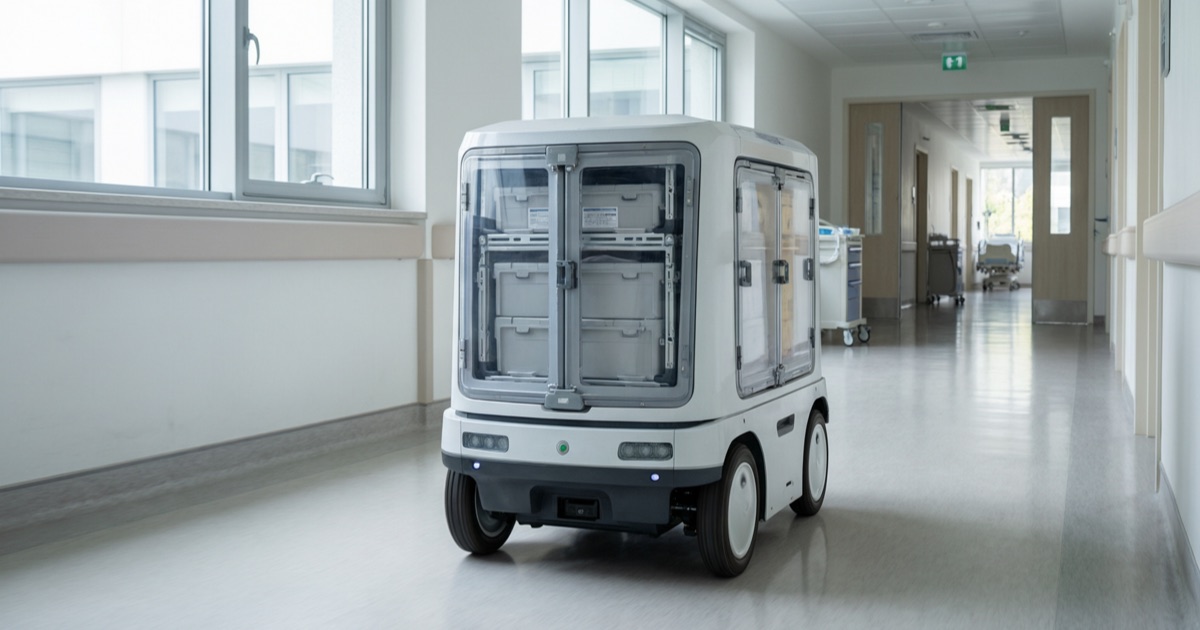
Indoor logistics is where the next wave of delivery robots is heading, and the reason is technical. Outdoor sidewalk delivery robots have largely solved navigation, but hospitals, labs, and multi-floor commercial buildings demand something harder: a machine that can also *manipulate* its surroundings — open a door, call and ride an elevator, drop off a payload — while threading through crowded corridors. Recent consolidation in the sector, including a roughly $29M acquisition that paired an outdoor-delivery specialist with an indoor mobile-manipulation maker, points to navigation and manipulation merging into a single product category.
If you are sourcing indoor or hospital logistics robots in 2026, here is what actually matters.
Why hospitals are the proving ground
Hospitals run thousands of small, repetitive transport tasks a day: medications, lab samples, linens, meal trays. Each trip pulls a nurse or porter away from patient care. An indoor logistics robot that can autonomously fetch and deliver — including operating doors and elevators without human help — directly returns staff hours. Vendors deploying in this environment typically report that the value is less about speed and more about *reliably* absorbing routine trips so people handle the exceptions.
Navigation plus manipulation: check for both
The core split between products is the arm. A mobile base that only carries a bin is cheaper but stalls at any closed door or elevator call button. A base with a manipulator can complete an end-to-end route in a building not purpose-built for robots. When comparing units, ask:
- Elevator and door integration — does the robot physically press buttons, or does it rely on a building API/relay? API integration is cleaner but requires facilities cooperation.
- Payload and hygiene — enclosed, lockable, wipe-down compartments matter in medical settings; confirm cleaning protocols and material certifications.
- People-dense operation — ask for deployment data on how the robot behaves in crowded corridors, not just empty test halls.
See our medical robot category for hospital-specific models and our delivery robot overview for the broader indoor/outdoor range.
The market signal
Third-party market research pegs the global indoor autonomous mobile robot market at roughly 116 billion RMB in 2024, projected to grow at a ~24% CAGR toward the early 2030s. Treat these as directional analyst estimates rather than guarantees, but the trend is clear: indoor AMRs are moving from pilot to fleet.
A sourcing checklist
- Define the route, then the robot. Map the exact door/elevator/handoff sequence a shift requires. That determines whether you need manipulation or just transport.
- Ask for uptime and intervention data. How many trips per human intervention in a live building? This number separates demos from deployable units.
- Fleet software. One operator should monitor many robots; confirm the management platform supports scheduling, exception alerts, and reporting.
- Integration cost. Elevator/door integration, Wi-Fi coverage, and charging dock placement are real line items — budget them alongside hardware.
- Service and spares. For imported units, confirm local support, spare-part lead times, and firmware update paths before committing.
Indoor logistics robots are no longer a novelty — they are becoming infrastructure. The buyers who win are the ones who scope the *route* precisely and buy the least complex robot that completes it end to end.