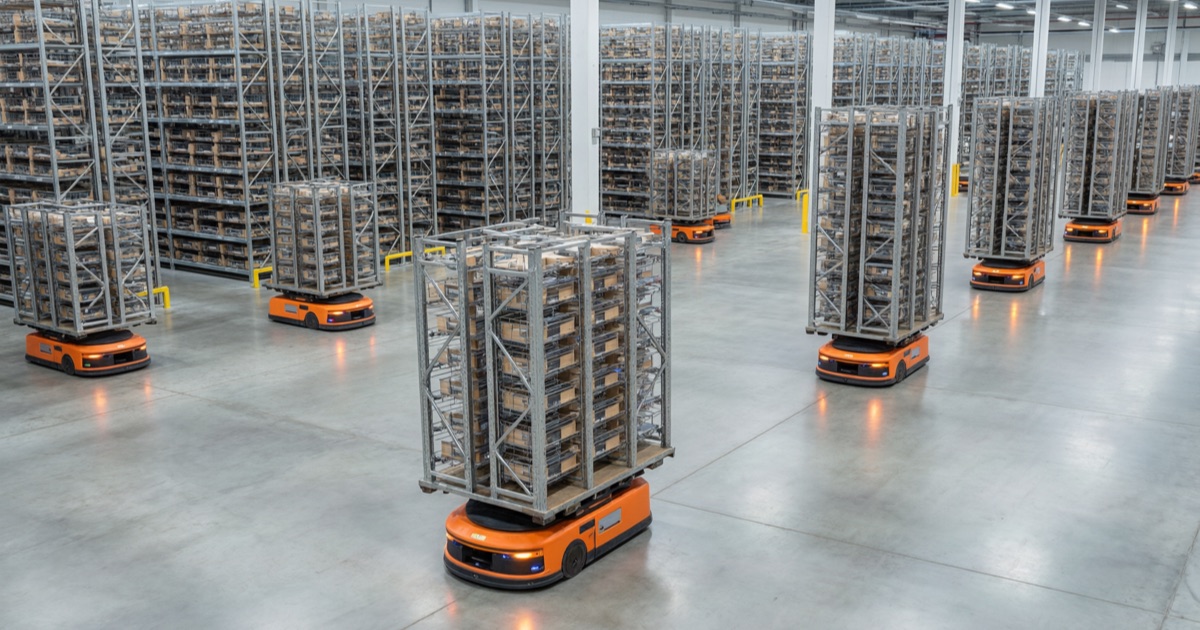
Warehouse-robotics economics are usually argued from vendor decks and pilot press releases. Geek+ (Beijing Geekplus) is the rare case where you can argue them from an audited income statement: it listed on the Hong Kong Stock Exchange in July 2025 — the first pure-play warehouse-AMR IPO anywhere — and its first full year as a public company gives us a clean, disclosed data set. Read closely, the numbers say something the marketing does not.
The headline figures
For the year ended December 31, 2025:
| Metric | FY2025 | Change |
|---|---|---|
| Revenue | RMB 3.171 billion | +31.6% YoY |
| Gross profit | RMB 1.125 billion | +34.4% YoY |
| Gross margin | 35.5% | up from ~34.8% |
| Adjusted net profit | RMB 43.8 million | first-ever profit |
| Operating cash flow | RMB 85.7 million | first-ever positive |
| New orders | RMB 4.137 billion | +31.7% YoY |
Two of those lines had never been positive before. After years of the "grow now, profit later" AMR story, Geek+ crossed into adjusted profitability and positive operating cash flow in the same year — while still growing revenue north of 30%. That combination is what the whole warehouse-robotics sector has been promising investors, and this is the first hard proof point that it can happen at scale.
Where the profit actually comes from: exports, not RaaS
Here is the number that reframes the business. Revenue from outside mainland China was RMB 2.387 billion — over 75% of total revenue — at a gross margin of 46.6%. The blended margin is 35.5%; the overseas margin is more than eleven points higher.
Our view on the data: Geek+ did not become profitable by inventing a new cost structure. It became profitable by shifting its mix toward higher-margin export markets. The domestic Chinese market is where AMR pricing is most brutally competitive; the international business — Europe, North America, Asia-Pacific — is where customers pay for integration, reliability and support. The company's own H1 2025 disclosure showed the same pattern even more sharply, with overseas revenue at 79.5% of the total. For anyone modeling warehouse-robot economics, the lesson is that geography, not technology, is doing most of the work on the margin line.
And note what is *not* carrying the story: Robots-as-a-Service. Geek+ describes its business as "the sales of AMR solutions and providing RaaS," but the disclosed revenue is dominated by solution sales, not recurring lease income. The industry narrative that RaaS would turn warehouse robotics into a subscription business has not shown up in the financials of the sector's largest player. The money is still made selling and integrating systems.
Scale that competitors can't easily copy
The operational base behind the financials:
- 72,000+ robots delivered to more than 40 countries as of end-2025.
- ~950 end customers, including 80+ Fortune Global 500 companies.
- 78% repurchase rate among large customers — the single most important number in the whole disclosure, because it means the installed base keeps buying.
That last figure is the quiet engine. A 78% large-customer repurchase rate turns each initial deployment into a multi-year expansion account, which is exactly how a hardware-heavy business funds R&D and still reaches profitability.
Market position, quantified
Geek+ is not the biggest robotics company, but in its specific niche it is dominant. Per Interact Analysis' 2025 Mobile Robots Market Report, Geek+ held the No. 1 global position in order-fulfillment mobile robots for the seventh consecutive year, with roughly a 23% share — close to the combined total of the second- and third-place vendors. Revenue climbed from RMB 2.409 billion in 2024 to RMB 3.171 billion in 2025, so the share leadership is being defended while the top line grows ~32%.
A useful scale check: even at ~23% of order-fulfillment AMRs, Geek+'s share of *total* warehouse-automation spend is low single digits. The addressable market above it — conveyors, AS/RS, WMS, integration — is enormous, which is the bull case the IPO was sold on.
What buyers should take from this
If you are sourcing warehouse robots, three data-driven takeaways fall out of these numbers:
- The market leader is now profitable and cash-generative. Vendor solvency is a real procurement risk in robotics; the category's biggest player clearing that bar lowers the risk of buying into an orphaned platform.
- You are paying export-market margins for a reason. The 46.6% overseas gross margin is the price of localized integration and support. That is not gouging — it is the cost of the reliability layer, and cutting it by buying grey-market or unsupported units is where deployments fail.
- Don't over-index on RaaS. The sector's largest vendor still makes its money on system sales. If a RaaS quote looks cheaper than buying, model the full multi-year cost before assuming the subscription framing saves money.
For how autonomous mobile robots are priced and specified for a real deployment, see our warehouse robot category and the broader autonomous mobile robot category.
Sources
- Geekplus FY2025 results announcement (PR Newswire) — revenue, gross profit, margin, adjusted net profit, operating cash flow, overseas revenue share and margin, installed base, customers, repurchase rate, new orders
- RoboticsTomorrow — Geekplus 31.6% growth / profitability milestone — corroborating FY2025 figures
- Automated Warehouse — Geek+ H1 2025 results — H1 2025 revenue, margin, overseas 79.5% share
- Robotics & Automation News — Geekplus post-IPO — HKEX listing details, IPO proceeds, business model
- Geekplus — No. 1 AMR market share for seventh consecutive year — Interact Analysis 2025 ranking and ~23% order-fulfillment share
- Robotics 24/7 — Geek+ global market leader in order-fulfillment mobile robots — independent corroboration of market-share leadership