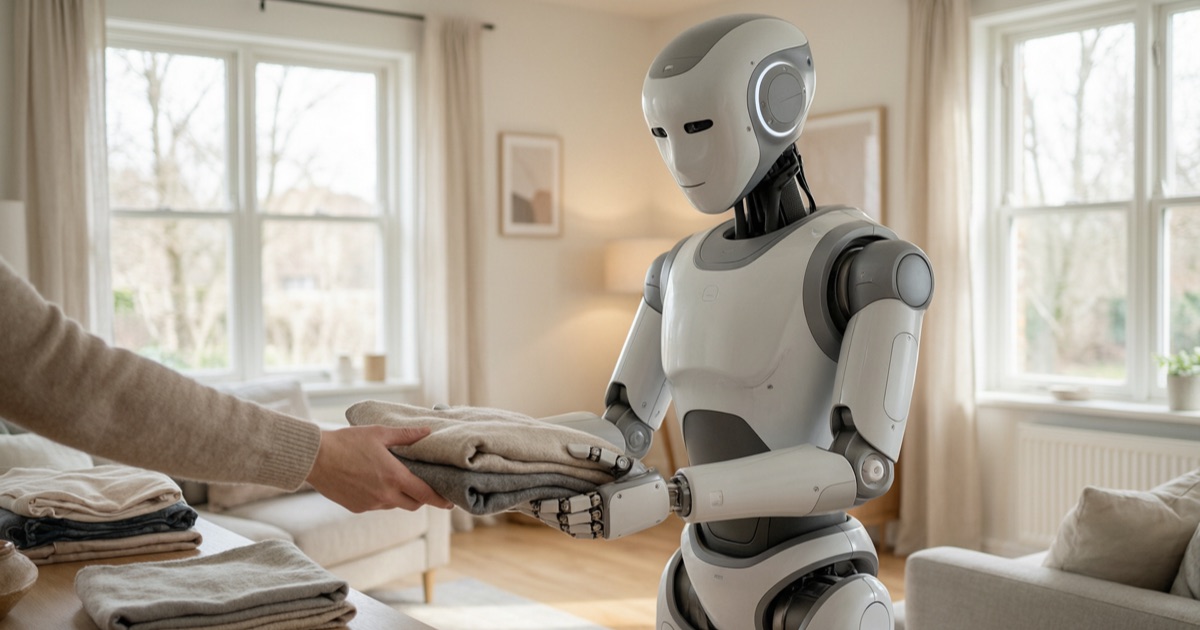
For most of the past decade, "embodied AI" lived in conference demos and viral clips. In 2026 it quietly crossed a more important line: someone was willing to *pay* for a robot to do a real job. In China, an end-to-end embodied-AI developer has reportedly piloted a home-help service priced around the equivalent of a few US dollars per hour, where a robot handles the repetitive lifting, fetching and tidying while a human supervises the fine work (source: OFweek, April 2026). Elsewhere, service humanoids are reportedly running day-to-day in malls and parks rather than trade-show booths.
That shift — from "look what it can do" to "here's the invoice" — is what buyers should actually track. If you source robots for a warehouse, a facility, or a commercial site, the hype cycle matters far less than one question: which use cases have real orders behind them, and which are still riding on funding narratives?
Where the money is landing (and where it isn't)
The capital side is loud. Industry trackers report that Chinese embodied-AI startups disclosed well over 20 billion yuan in funding in Q1 2026, up sharply year over year, with several firms crossing 10-billion-yuan valuations in a matter of months (sources: IT Juzi, 36Kr, 2026). But funding velocity and deployment velocity are not the same curve — and the gap between them is the single most useful signal a buyer has.
Real purchase orders exist. One embodied-robotics vendor reportedly secured a multi-year, thousand-unit-plus production-robot order worth roughly hundreds of millions of yuan (source: industry reports, 2026). Yet across the whole sector, annual funding measured in the tens of billions still maps to headline orders measured in the low hundreds of millions. When valuation growth outruns order growth by that much, the market is pricing expectation, not delivered value.
The three battlefronts, ranked by buyer-readiness
Deployments in 2026 cluster into three environments — each corresponding to work that is expensive or hard to staff:
- Factories. The most order-ready today. Embodied and humanoid robots are reportedly running long-duration autonomous shifts in battery and module production, with material-handling throughput gains cited around 30% over manual lines and precision-task success rates reported above 99% in specific stations. Structured, repeatable, measurable — the easiest ROI to underwrite.
- Commercial service. Mid-readiness. Robots in malls, parks and food delivery target high-churn, hard-to-hire frontline roles. Deployments are real but margins and reliability are still stabilizing.
- The home. Highest demand, lowest readiness. The "hire by the hour" home pilots deliberately keep a human in the loop, which itself tells you a fully autonomous household robot isn't here yet.
A framework you can take to the buying table
Before signing, plot two lines for any vendor you're considering: cumulative funding versus cumulative real orders. The wider the divergence, the more you're buying a story; the more they converge, the more the product has actually landed. Analysts have flagged 2026 as the year the market pivots from technology-breakthrough narratives to hard ROI evaluation — meaning a wave of "story-only, order-light" vendors could get squeezed out through 2027.
For procurement, the takeaway is practical: favor use cases and suppliers with disclosed, repeat production orders; treat valuation as marketing, not a proof point; and pilot in structured environments (a line, a station, a defined task) before betting on open-ended ones. Embodied AI has genuinely arrived — but it arrived unevenly, and the invoice is the only demo that counts.
*GrabaRobot maps verified robotics suppliers across categories. Browse deployment-ready humanoid and service robots to compare specs before you source.*