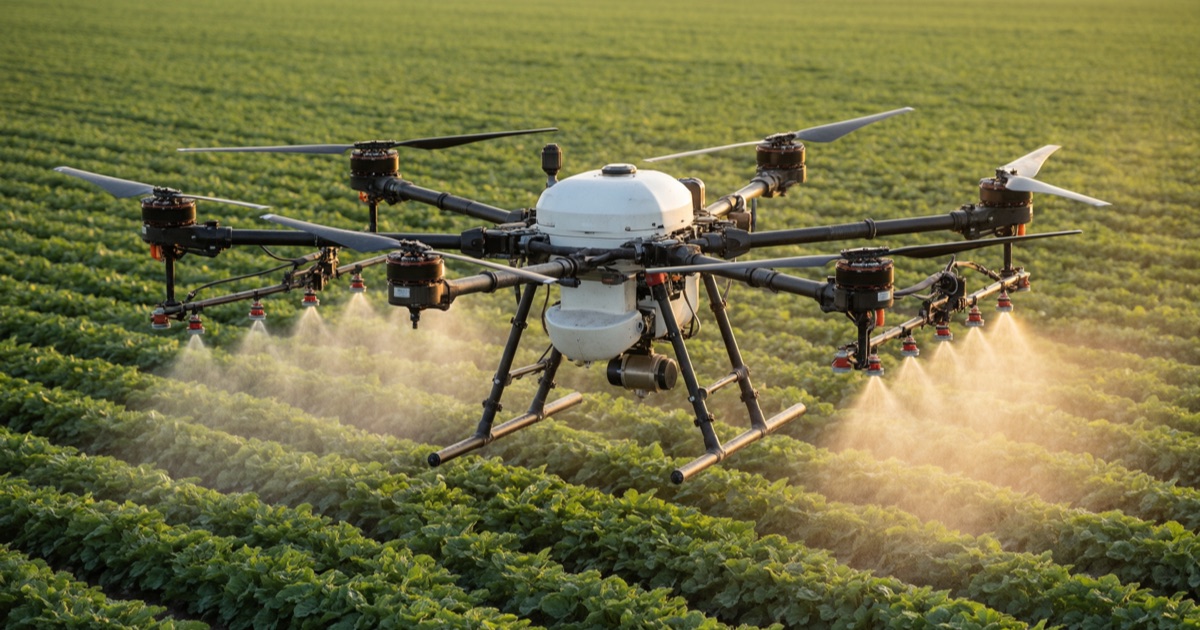
When buyers spec an agricultural spraying drone, they fixate on tank size, spray width, and flight controller. But the subsystem that quietly decides reliability, payload, and long-term cost is the powertrain — the brushless motors, electronic speed controllers (ESCs), and propellers that keep a heavy, sloshing tank in the air. The recent IPO push by a specialist civil-drone motor maker — reportedly a global top-two supplier by volume — is a reminder that the motor, not the airframe, is where much of the hard engineering lives.
Here is what integrators and serious buyers should understand about drone powertrains in 2026.
Why the powertrain is the reliability bottleneck
An agricultural drone carries a shifting liquid load and often flies dozens of sorties a day in dust, heat, and pesticide mist. Motors run near their thermal limits on every takeoff. Under-specced or low-quality motors overheat, lose torque, and fail early — and a motor failure on a loaded ag drone is a crash, not an inconvenience. The powertrain is therefore the component most worth over-specifying relative to nominal payload.
What to check when comparing units
- Continuous vs peak rating. Vendors love to quote peak thrust. For sustained ag work, ask for *continuous* thrust and the motor's rated duty cycle at your typical ambient temperature.
- Thermal management. Sealed, dust- and corrosion-resistant motors matter in agricultural environments; ask about IP rating and pesticide exposure testing.
- ESC matching. Motors and ESCs are a system. A quality motor paired with a marginal ESC still fails. Confirm the ESC current headroom above continuous draw.
- Serviceability. Can motors and props be field-replaced, and what are spare-part lead times? For overseas operators this often matters more than headline specs.
Browse current spraying and mapping platforms on our agricultural drone category page to see how powertrain specs vary across payload classes.
The China supply-chain angle
China dominates civil drone motor manufacturing, and much of the world's ag-drone powertrain hardware — even in Western-branded aircraft — originates there. For buyers, that concentration is a double-edged sword: strong pricing and availability, but also a supply base where quality varies widely between tiers. When sourcing, distinguish the handful of established motor makers (those with automotive-grade process control) from commodity shops. The price gap is real, and so is the failure-rate gap.
A practical buyer checklist
- Match powertrain to *loaded* weight, not empty airframe — include the full tank plus battery.
- Ask for MTBF or field-failure data on the motors specifically, not the whole aircraft.
- Confirm spares strategy before purchase: motor, ESC, and prop availability and lead time.
- Test at your conditions — a demo on a cool morning tells you little about midsummer duty cycles.
- Budget the powertrain as a wear item. Motors and props are consumables on a hard-working ag drone; factor replacement into total cost of ownership.
For agricultural operations, the lesson is simple: the airframe gets the attention, but the powertrain gets the flight home. Spec it like the safety-critical system it is.