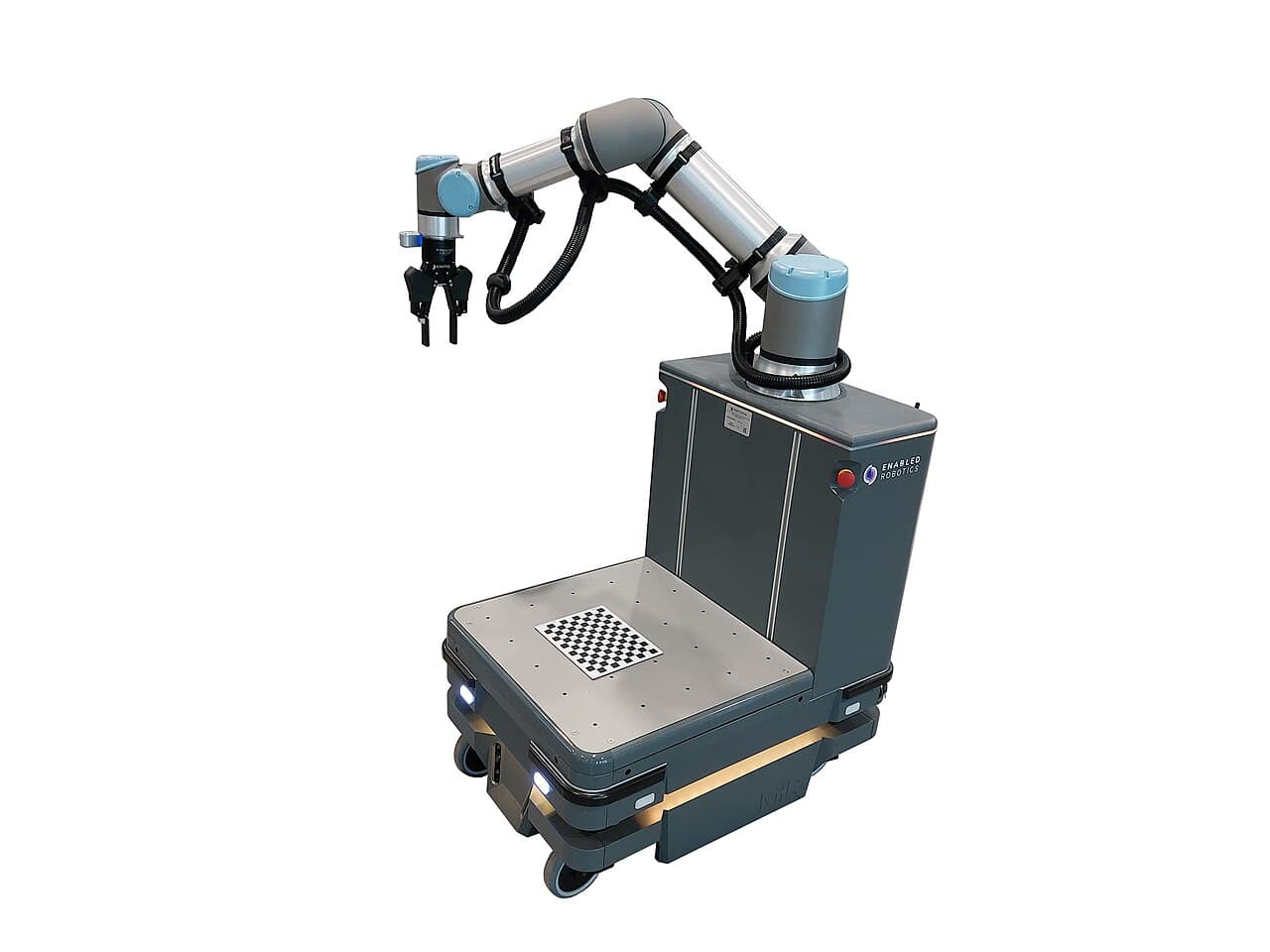
The global mobile manipulator robot market has reached $6.8 billion in 2026, according to a new report from Interact Analysis, representing 34% year-over-year growth and a record for the category. Mobile manipulators — robots that combine autonomous mobile platforms (AMRs) with articulated robot arms capable of picking, placing, and manipulating objects — have emerged as the dominant automation architecture for modern fulfillment operations.
Why Mobile Manipulators Are Dominating Warehouse Automation
The growth reflects a fundamental shift in warehouse automation strategy. First-generation warehouse robots separated the functions of transport (AMRs) and manipulation (fixed robotic arms), requiring human pickers to handle items that AMR-based transport could not grasp. The mobile manipulator architecture eliminates this human bottleneck by integrating both functions in a single robot.
Key capabilities driving adoption:
- End-to-end item handling: Mobile manipulators can pick items from shelves, transport them, and place them into packaging or onto outbound conveyors without human handoff
- Adaptability to SKU variation: Unlike fixed pick-and-place arms, mobile manipulators can navigate to different zones and handle unpredictable item geometries using vision-guided grasping
- Continuous operation: Mobile manipulators operate around the clock in 2-3 shift models, with battery swapping enabling near-continuous throughput
- Dynamic reconfiguration: Unlike conveyor-based automation, mobile manipulator fleets can be reprogrammed and redeployed as warehouse layouts or product mixes change
Market Leaders
The mobile manipulator market is currently led by a mix of pure-play robotics companies and diversified automation players:
Fetch Robotics (now Zebra Technologies): The Freight500 and Freelance series remain the best-selling mobile manipulator platforms, with over 45,000 units deployed globally as of Q1 2026.
Omron: The LD-450 mobile robot with the Omron TM collaborative arm integrated offers one of the most mature mobile manipulator solutions for manufacturing applications.
Mitsubishi Electric: The Meltrac MH series has gained significant traction in Japanese and Southeast Asian e-commerce fulfillment operations.
Geek+: The company's X series mobile manipulators have achieved strong deployment volumes in Chinese e-commerce logistics, with international expansion accelerating in 2026.
Cost Trajectory
Average selling prices for mobile manipulator systems have declined 22% over the past three years, driven by component commoditization (LIDAR sensors, compute modules) and increased competition. The all-in cost for a single mobile manipulator system (hardware + software + initial integration) now ranges from $85,000 to $140,000 depending on arm payload and sensor configuration, down from $120,000-$180,000 in 2023.
What This Means for Robot Buyers
For warehouse operators evaluating automation investments, mobile manipulators now represent the most capable and flexible architecture for item-level fulfillment automation. The declining cost trajectory makes the ROI case stronger than ever for high-SKU, high-volume operations.
Buyers should evaluate total system cost including fleet management software, integration with warehouse management systems (WMS), and ongoing maintenance contracts. Multi-vendor fleet interoperability is an emerging consideration — buyers should ask about OPC-UA or other open protocol support for fleet management.
Buyers new to warehouse automation should explore autonomous mobile robots (AMRs) as an entry point before committing to mobile manipulator systems, as AMR-only deployments can provide incremental automation with lower initial investment.