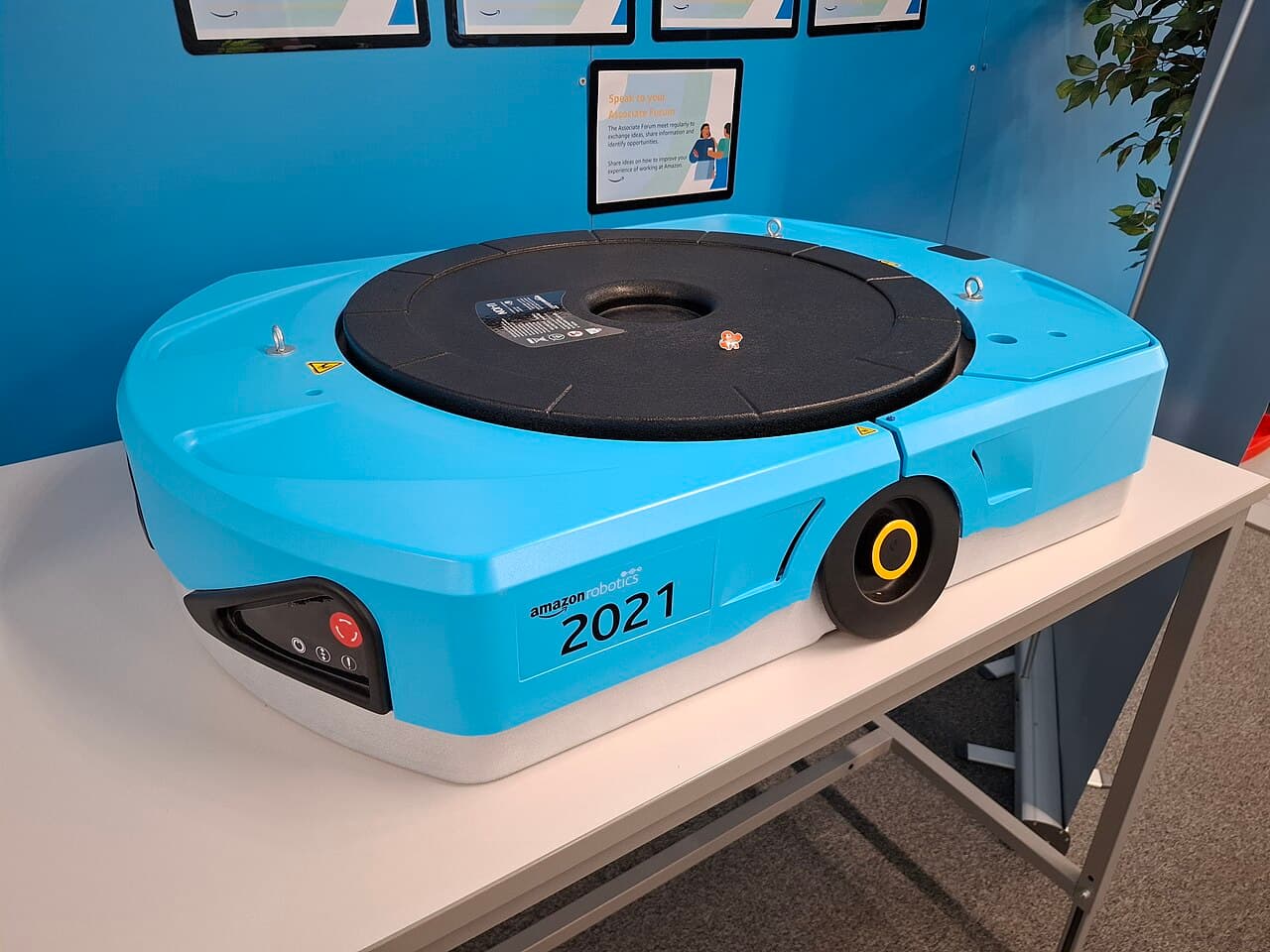
Amazon has completed commissioning of two mega-fulfillment centers — the Irving, Texas Fulfillment Center and the Columbus, Ohio Fulfillment Center — deploying a combined 50,000 autonomous robots across the two facilities. The deployment represents the single largest installation of warehouse robots at a single operator in commercial history, surpassing Amazon's own previous record of 35,000 robots across all facilities as recently as 2024.
What the 50,000 Robots Do
The Amazon deployment integrates three categories of autonomous systems operating in coordination:
Proteus AMR (30,000 units): The latest generation of Amazon's in-house-developed autonomous mobile robot, designed to transport shelving pods and pallets throughout the facility. Proteus uses LIDAR and computer vision for autonomous navigation in shared human-robot environments.
Cardinal robotic arms (12,000 units): Stationary robotic arms deployed at pack stations and sorting zones, handling package picking, box forming, and label application. The 2026 Cardinal units feature 40% faster cycle times compared to the 2024 generation.
Sparrow sample-picking arms (8,000 units): Smaller collaborative arms deployed for item-level picking from totes, handling the "single pick" orders that historically required human pickers. Sparrow uses suction-based end-effectors with adaptive grip force.
Why It Matters at This Scale
Amazon's 50,000-robot deployment demonstrates that fully automated fulfillment at massive scale is operationally viable, not merely theoretically possible. The two mega-centers combined process an estimated 2 million packages per day — roughly equivalent to the entire daily package volume of USPS's first-class mail.
The scale of deployment also changes the unit economics equation: Amazon's internal analysis indicates per-unit robot cost has declined 35% compared to the 2024 generation, driven by in-house manufacturing scale and component standardization.
Implications for the Broader Logistics Industry
Amazon's deployment signals that the ROI threshold for large-scale warehouse robotics has been crossed for high-volume operations. Competitors in 3PL, parcel delivery, and e-commerce fulfillment are now under increased pressure to automate or risk unit-cost disadvantages.
DHL, FedEx, and GXO Logistics have each announced accelerated automation investment plans in response to the Amazon deployment, with procurement cycles for AMR fleets moving into active evaluation phases.
What This Means for Robot Buyers
For enterprise buyers evaluating warehouse robotics, Amazon's deployment provides a real-world benchmark for large-scale AMR ROI. Key metrics to evaluate include total cost of ownership versus labor cost savings, system uptime guarantees, and software integration with existing warehouse management systems.
Buyers exploring warehouse AMR systems should also consider fleet management software interoperability and vendor lock-in risk when evaluating long-term automation investments.