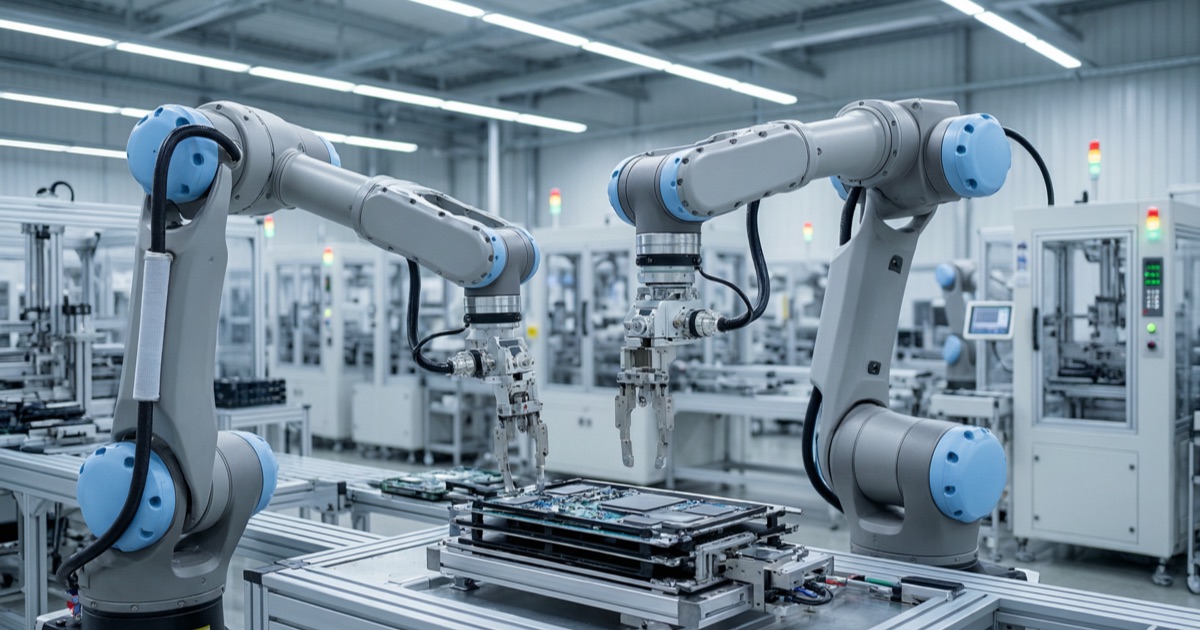
"Chinese cobots are cheaper because labor is cheap" is the lazy explanation, and it is mostly wrong. Labor is a small slice of a collaborative robot's cost. The real reason a Chinese cobot lands 40-70% under a Universal Robots list price is structural, it is durable, and Western brands cannot easily copy it. Here is what is actually going on.
First, separate two very different numbers
The headline gap is real but slippery. On core specs — payload, reach, repeatability — leading Chinese cobots (AUBO, JAKA, UFACTORY, Fairino) now price 40-70% below UR. AUBO's i-series runs roughly $14,000-$38,000 and competes with UR at 40-50% lower price; JAKA entered at 50-70% below UR. A 5 kg Chinese cobot at $7,000-$10,000 maps to a $25,000-$35,000 UR or FANUC system before integration.
But like-for-like, the structural cost gap is smaller. HSBC Qianhai Securities estimates Chinese robots price only 10-15% below comparable foreign models. The difference between "40-70% cheaper on the list" and "10-15% structurally cheaper" is margin, tier positioning and go-to-market strategy — Chinese brands deliberately price aggressively to buy share. Our view: buyers should hold both numbers in mind. The list gap tells you what you will pay; the structural gap tells you how sustainable that price is.
The actual driver: China now makes the parts that set the price floor
Components — servo motors, harmonic and RV reducers, controllers, sensors, encoders — are 50-65% of a robot's ex-factory cost. Labor is not on that list in any meaningful way. So the cost war is a component war, and China has been winning it since about 2021.
The pivotal part is the harmonic reducer. For years, Japanese suppliers (Harmonic Drive, Nidec-Shimpo) set a unit-cost floor that every non-Japanese robot maker had to build above. When domestic Chinese reducer makers — Leaderdrive above all — reached usable quality, that floor broke. Leaderdrive's harmonic gears undercut Japanese imports by 20-30%; a16z estimates Suzhou Green Harmonic's reducers run 30-50% below Sumitomo and Harmonic Drive, and it has taken over 30% of China's domestic market. On the motion-control side, Inovance supplies servo systems 15-25% cheaper than imports and holds about 27% of China's SCARA market — and it sells those servos both to its own robot division and to competing Chinese OEMs, spreading the cost advantage across the whole industry.
Colocation is the multiplier
Cheaper parts are only half of it. The second driver is geography. A Chinese cobot maker can source nearly its entire BOM inside a single manufacturing supercluster — Shenzhen, or the Yangtze Delta in Jiangsu and Zhejiang. That colocation, as a16z describes it, does three things at once: it eliminates import duties on components, it compresses logistics cost and lead time, and it lets the robot maker and the reducer maker co-optimize the whole motion system rather than bolting together discrete parts bought across oceans. A Western brand importing Japanese reducers and European controllers pays the tariff, the freight and the integration penalty on every unit.
And then there is policy
Layered on top is deliberate industrial policy. Made in China 2025 domestic-content targets create what analysts call "de facto price protection" for local component makers, steering procurement toward domestic suppliers and funding capacity expansion. Government programs are estimated to cut effective operating costs by another 5-10%. None of this is temporary market noise — it is a structural subsidy to the component base that feeds every Chinese robot maker.
What this means for buyers
Our view: the moat is not cheap hands on a line, it is a colocated, vertically integrated component industry that reset the price floor for reducers and servos. That is why the gap persists even as Chinese labor costs rise, and why Western brands cannot close it just by squeezing their own factories — they would have to rebuild a domestic reducer-and-servo industry first.
For your purchasing decision, the practical read is this. For R&D, non-critical automation and cost-sensitive lines, Chinese cobots at 50-60% of UR's price are strong value and the reliability gap has narrowed. For safety-critical, high-uptime production, weigh the smaller structural gap against integration, support and service — once you add those, a UR or FANUC system's total cost is closer than the list price suggests. We laid out the model-by-model numbers in our Universal Robots vs Chinese cobots face-off, and the underlying anatomy of these costs in the humanoid bill of materials, which runs on the very same reducers. To browse the field, start with our collaborative robot category.