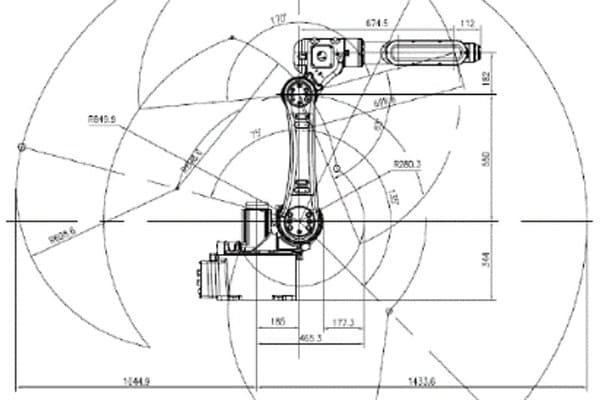
Resistance spot welding (RSW) robots are the most deployed industrial robot application in history. The modern automotive body-in-white (BIW) production line uses 400–800 spot welding robots per vehicle platform. A typical car body requires 3,000–5,000 spot welds; a single automotive spot welding robot performs 1,000–1,500 welds per hour. Outside automotive, spot welding automation serves appliances, HVAC, metal furniture, and electrical enclosure manufacturing. In 2026, complete spot welding robot cells range from $80,000 for a simple appliance application to $250,000+ for automotive-grade high-speed cells.
How Resistance Spot Welding Works
Resistance spot welding joins two or more sheets of metal by:
- Pressing electrode tips against both sides of the metal stack
- Passing high electrical current (8,000–25,000 amps) through the contact point
- Resistance heating melts a "nugget" of metal between the sheets
- Electrode pressure forges the nugget as current stops
- Result: A solid weld nugget 4–12mm diameter
No filler wire, no flux, no shielding gas. Spot welding is fast (0.1–0.3 seconds per weld), clean, and produces repeatable, testable welds.
Spot Welding Robot Specifications
Required Robot Characteristics
| Spec | Requirement | Why |
|---|---|---|
| Payload | 100–350 kg (gun weight) | Spot welding guns weigh 50–200+ kg |
| Reach | 1,600–3,200mm | Access to all weld points on part |
| Repeatability | ±0.1mm | Weld nugget placement accuracy |
| Path speed | 2,000–5,000mm/s | Move between welds rapidly |
| Wrist design | Hollow or external dress | Gun cable management |
| IP rating | IP54 minimum | Weld spatter environment |
Spot welding guns weigh 50–200+ kg — far exceeding the payload of general-purpose robots. Spot welding robots require payload-rated arms, which is why automotive spot welding robots (Fanuc R-2000, KUKA KR C4 QUANTEC) are physically much larger than arc welding robots.
Top Spot Welding Robot Models
Fanuc R-2000iC/210F
- Payload: 210 kg, Reach: 2,655mm
- Industry standard for automotive BIW
- Price: $80,000–110,000
- Cycles/hour: up to 2,100
ABB IRB 6700-235
- Payload: 235 kg, Reach: 2,650mm
- Best-in-class path accuracy for high-density weld patterns
- Price: $85,000–115,000
KUKA KR 210 R2700 ULTRA
- Payload: 210 kg, Reach: 2,706mm
- Strong in European automotive
- Price: $78,000–105,000
Yaskawa MS210
- Payload: 215 kg, Reach: 2,702mm
- Strong in Asian automotive supply chain
- Price: $70,000–95,000
Chinese Brands (Non-automotive)
- Efort ER210: 210 kg — $35,000–55,000 FOB
- Estun ER200: 200 kg — $38,000–60,000 FOB
- Application: Appliance, HVAC, non-automotive metal fabrication
Spot Welding Guns
The welding gun is the most critical component selection after the robot arm itself.
Gun Types
C-type gun: Most common. Electrode tips on parallel arms of a C-shaped frame. Limited access to interior weld points.
X-type gun: Scissor-action gun with better access. More common in automotive BIW for door openings and pillars.
Servo gun: Gun closure driven by servo motor rather than pneumatics. Enables programmable force control, electrode wear compensation, and 30–40% faster cycle time vs. pneumatic guns.
Gun Specifications
| Spec | Typical Range | Notes |
|---|---|---|
| Electrode force | 2–7 kN | Material thickness and type dependent |
| Weld current | 8,000–25,000 A | Via transformer |
| Transformer weight | 50–150 kg | Dominant factor in gun weight |
| Electrode tip material | Copper-chromium-zirconium | Most common |
| Electrode tip life | 500–3,000 welds before dress | Automatic tip dressing stations extend life |
Medium-frequency inverter transformers (MFDC) are now standard in new automotive installations. MFDC units are 70% lighter than line-frequency transformers (15 kg vs. 50 kg for equivalent current), dramatically reducing gun weight and enabling faster robot motion.
Spot Welding Applications Beyond Automotive
Appliance Manufacturing
Washing machines, dryers, dishwasher tubs, refrigerator cabinets use thousands of spot welds. Appliance spot welding differs from automotive:
- Thinner gauge material (0.8–1.5mm vs. 1.0–2.5mm automotive)
- Lower current requirements
- Simpler part geometry
- System cost: $80,000–160,000 per cell
- Common brands for appliances: Fanuc, ABB, Chinese brands (Efort, Estun)
HVAC Ductwork and Sheet Metal
Commercial HVAC manufacturers use spot welding for duct flanges, brackets, and enclosures:
- Light gauge galvanized or stainless steel
- High variety, moderate volume
- Cobot spot welding emerging for flexible production
- System cost: $60,000–120,000
Metal Furniture
Office chairs, shelving, storage systems:
- 1.0–3.0mm cold-rolled steel
- High volume, repetitive patterns
- Good candidate for basic fixed-sequence robot cells
- System cost: $70,000–140,000
Electrical Enclosures
Control panels, server racks, electrical boxes:
- Moderate gauge steel or aluminum
- Medium volume
- Chinese robot brands increasingly competitive here
Complete Cell Cost Guide
| Component | Cost Range |
|---|---|
| Robot arm (high payload) | $35,000–115,000 |
| Spot welding gun (servo, MFDC) | $25,000–60,000 |
| Weld controller | $15,000–30,000 |
| Tip dresser (automatic) | $8,000–18,000 |
| Part fixture/tooling | $15,000–50,000 |
| Part positioner (turntable) | $10,000–30,000 |
| Safety fencing | $5,000–15,000 |
| Integration & commissioning | $15,000–35,000 |
| **Total cell** | **$128,000–353,000** |
Weld Quality Monitoring
Automotive OEMs require 100% weld quality traceability. Modern spot welding systems include:
Process monitoring: Current, voltage, force, and time recorded for every weld. Anomalies trigger alarms and part hold.
Ultrasonic inspection: Handheld or in-line ultrasonic testing verifies nugget formation without destructive testing.
Expulsion detection: Electrode force sensors detect material expulsion ("spatter") which correlates with weld quality degradation.
Electrode wear compensation: Servo gun controller tracks electrode tip length and compensates for tip wear in real time, maintaining consistent electrode force.
Frequently Asked Questions
How many welds per hour can a spot welding robot achieve?
In production conditions with optimized gun positioning: 1,500–2,100 welds/hour for automotive-grade systems. Actual throughput depends on part geometry (travel distance between welds) and weld time (material thickness). Simple flat parts with closely spaced welds achieve the highest rates.
What is the difference between spot welding and arc welding robots?
Spot welding uses resistance heating with electrode pressure — no filler material, very fast (0.1–0.3 sec/weld), ideal for sheet metal. Arc welding uses electric arc to melt and fuse metal with filler wire — slower (3–15 cm/min travel speed), better for structural joints, thick sections, and irregular geometry. Spot welding robots require 10–20× higher payload due to gun weight.
Can spot welding robots be used for aluminum?
Yes, but aluminum spot welding requires 2–3× higher current than steel (aluminum has lower electrical resistance) and is more sensitive to surface contamination. Automotive aluminum spot welding (for hoods, trunk lids, EV battery enclosures) is a growing application using specialized gun designs and carefully controlled electrode maintenance.
What is electrode tip dressing and how often is it needed?
Electrode tip dressing is a mechanical process that removes the mushroomed, contaminated copper from electrode faces, restoring the original tip geometry. Automatic tip dressers integrated into robot cells perform this every 300–800 welds (program-defined). After 5–10 dressing cycles, tips are replaced. Automated tip dressing typically increases tip life by 3–5× versus undressed tips.
