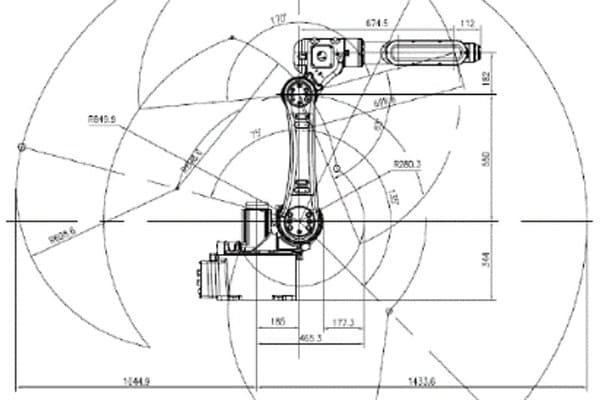
Packaging automation represents the largest segment of industrial robotics deployment by unit volume. Every product that moves from production to consumer passes through a packaging operation — and most packaging operations are still heavily manual. In 2026, the combination of labor shortages, rising wages, and dramatically improved robot vision systems has pushed packaging automation into the economic reach of mid-size manufacturers. Complete packaging robot systems range from $35,000 for a basic labeling robot to $200,000+ for a fully integrated case packing line.
Packaging Robot Categories
Packaging encompasses a wide range of operations, each suited to different robot types:
| Operation | Robot Type | Speed | System Cost |
|---|---|---|---|
| Primary packaging (fill/seal) | Cartesian/SCARA | 30–120 ppm | $40,000–120,000 |
| Pick and place to tray | Delta robot | 80–300 ppm | $60,000–150,000 |
| Case packing | 6-axis or SCARA | 20–60 cases/min | $80,000–200,000 |
| Carton erecting/closing | Dedicated machinery | 20–80 cpm | $50,000–150,000 |
| Palletizing | 4-axis or 6-axis | 600–1500 cyc/hr | $80,000–300,000 |
| Labeling/marking | Linear or SCARA | 50–300 ppm | $30,000–80,000 |
| Shrink wrapping | Conveyorized tunnel | 20–100 ppm | $25,000–80,000 |
| Overwrapping | SCARA | 30–120 ppm | $45,000–100,000 |
Primary Packaging: SCARA and Cartesian Robots
Primary packaging — placing product into its first container (bag, tray, blister pack) — requires high speed, clean-room rated (in food/pharma), and precise placement.
SCARA robots dominate primary packaging:
- 4-axis configuration, top-mounted for space efficiency
- 30–120 picks/minute with payload to 2 kg
- Yamaha, Epson, Mitsubishi, Fanuc all offer food-grade SCARA lines
- Key advantage: compact footprint, easy integration into existing lines
Cartesian robots handle heavier primary packaging:
- 3-axis gantry for bagging and bin-filling operations
- Higher payload (up to 50 kg) for large product packs
- Custom-built for specific product dimensions
Delta Robots for Pick-and-Place Packaging
For high-speed placement of products into trays, blisters, or flowwrap lines, delta robots are unmatched:
- Speed: 80–300 picks/minute (product and vision dependent)
- Vision: 2D camera identifies product position/orientation on conveyor
- Typical applications: Chocolates, cookies, fresh bakery, blisters, capsules
- Leading brands: ABB FlexPicker (IRB 360), Fanuc M-1iA, Omron Quattro
For random-feed food packaging, a delta + vision system is the standard solution. See our delta robot food industry guide for detailed specifications.
Case Packing: 6-Axis and Gantry Systems
Case packing — placing filled product containers into shipping cartons — requires:
Side-load case packers: Robot arm inserts product groups from the side into the open case. Suitable for bags, bottles, cans.
Top-load case packers: Robot places products from above into open-top cases. Better for fragile items, irregular shapes.
Layer packing: Full product layers are assembled and placed simultaneously. Highest throughput for uniform products.
| Configuration | Speed | Best For | System Cost |
|---|---|---|---|
| Side-load, 6-axis | 15–40 cases/min | Bottles, cans | $90,000–160,000 |
| Top-load, 6-axis | 10–30 cases/min | Fragile, irregular | $100,000–180,000 |
| Layer packer | 20–60 cases/min | High-volume uniform | $150,000–280,000 |
| Gantry case packer | 30–80 cases/min | Highest throughput | $200,000–400,000 |
End-of-Line Packaging Automation Stack
A complete end-of-line packaging system integrates multiple automated stations:
```
Product → Case erector → Fill/case pack robot → Case sealer →
Labeler → Checkweigher → Metal detector → Palletizer →
Pallet wrapper → Conveyor to warehouse
```
Full end-of-line systems for a mid-size food manufacturer:
- Equipment cost: $400,000–900,000
- Integration and commissioning: $80,000–150,000
- Total installed: $480,000–1,050,000
- Replaces: 15–30 manual workers
- Annual labor savings: $600,000–1,200,000
- Payback: 6–18 months
Labeling Robot Systems
Labeling is the highest-volume packaging automation segment by unit count. Robotic labeling systems apply pressure-sensitive, wrap-around, top/bottom, and RFID labels.
Print-and-apply systems: Label is printed on demand and applied by pneumatic arm or wipe-on mechanism. Essential for variable data (batch codes, best-before dates, weights).
Vision-verified labeling: Camera confirms label position, readability (OCR), and barcode scan after application. Required for GS1/GTIN compliance in grocery supply chains.
Cost range: $18,000–65,000 for standard print-and-apply; $35,000–90,000 with vision verification.
Leading brands: Zebra, Videojet, Markem-Imaje, ALTech (SATO), Domino.
Pharmaceutical Packaging: Specialized Requirements
Pharmaceutical packaging robots must meet 21 CFR Part 11, EU Annex 1, and serialization requirements (DSCSA, EU FMD).
Blister packaging: SCARA or delta robots place tablets/capsules into blister cavities. Vision inspects for missing/broken pills before sealing.
Bottle filling/capping: Cartesian gantry systems fill, cap, and apply tamper-evident seals at 50–300 bottles/minute.
Serialization: Every saleable unit must carry a unique 2D barcode (GS1 DataMatrix). Vision systems read and verify each barcode, link to aggregated case/pallet codes.
Pharma packaging system cost: $150,000–600,000 depending on throughput and serialization complexity.
ROI Analysis: Bottled Beverage Case Packing
- Application: Packing 12-count cases of 500mL water bottles
- Line speed: 30 cases/minute (1,800 cases/hour)
- Manual operators required: 6 workers per shift × 2 shifts = 12 FTEs
- Annual labor cost: 12 × $36,000 = $432,000
- System investment: $180,000 (6-axis case packer + conveyor integration)
- Annual maintenance: $12,000
- Annual savings: $432,000 - $12,000 = $420,000
- Payback: ~5 months
Selecting a Packaging Integrator
Packaging automation is highly application-specific. Generic robot vendors rarely succeed without a specialized packaging integrator. Key integrator qualifications to verify:
- Industry experience: Ask for references in your specific product category (food, pharma, personal care)
- OEM relationships: Integrator should have certified relationships with robot OEMs (Fanuc, ABB, KUKA)
- Sanitary design expertise: For food/pharma, confirm USDA/3-A sanitary design compliance capability
- Vision capability: In-house vision engineering is essential for random-feed applications
- Line integration scope: Can they integrate with your MES, checkweigher, and upstream equipment?
Explore packaging and palletizing robots or calculate your packaging automation ROI.
Frequently Asked Questions
What is the minimum production volume to justify packaging robotics?
For case packing, the economic threshold is roughly 8–12 cases/minute sustained over 1–2 shifts. Below this, cobot or semi-automatic solutions offer better economics. For high-mix, lower-volume operations, collaborative robots (Universal Robots, Fanuc CRX) with quick-change grippers are increasingly viable.
How long does it take to set up a packaging robot for a new product?
For vision-based systems, a new product recipe requires 30–120 minutes of setup (vision teach, gripper adjustment, pattern programming). High-frequency product changeover should be a primary specification criterion — request changeover time guarantees from your integrator.
What packaging robots work best with flexible packaging (pouches, bags)?
Flexible packaging is challenging due to variability in product shape after filling. Robotic solutions include: servo-driven baggers with vision-guided grippers, delta robots with soft gripper end-effectors, and flow-wrap systems with servo jaw control. Budget 30–50% more for flexible packaging vs. rigid packaging automation.
Can one packaging robot handle multiple SKUs?
Yes, with recipe-based programming and quick-change end-effectors. Modern systems support hundreds of recipes. The limitation is usually gripper change time (2–15 minutes for mechanical change) vs. software-only changeover (under 2 minutes for same-footprint products with different labels/dates).