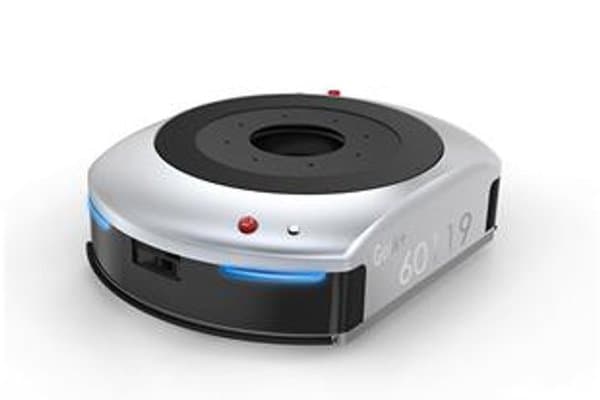
In March 2026, FANUC walked onto the MODEX floor with a robot that most manufacturers weren't ready for: the CRX-30iA mobile manipulator — a CRX collaborative arm mounted on an autonomous mobile platform, moving freely through a live warehouse, picking items from shelves and placing them on conveyors without fixed infrastructure. The crowd stopped. Phones came out. The age of the mobile manipulator had arrived for mainstream manufacturing.
Mobile manipulators have existed in research labs for 20 years. What's changed in 2025–2026 is that several systems have crossed the threshold from impressive demo to deployable industrial product — with price points and reliability profiles that justify serious ROI analysis.
What Is a Mobile Manipulator?
A mobile manipulator combines two technologies:
- AMR (Autonomous Mobile Robot) base: Self-navigating platform that maps its environment, plans routes, and moves throughout a facility without fixed infrastructure
- Robotic arm: Mounted on the AMR platform, capable of reaching, grasping, placing, and manipulating objects
The combination creates a robot that can go anywhere in a facility and do something useful when it gets there — replacing both the transport and the pick/place operation in a single system.
Contrast with:
- Fixed robot + conveyor: Can manipulate but cannot move between workstations
- Pure AMR: Can move anywhere but cannot manipulate objects
- Mobile manipulator: Can both navigate autonomously and physically manipulate objects
Current Market Landscape (2026)
Tier 1: Established Products Available Now
FANUC CRX-30iA Mobile Manipulator
- Unveiled: MODEX 2026, Atlanta, March 2026
- Platform: FANUC AMR + CRX-30iA collaborative arm (30 kg payload arm)
- Key capability: Handles payloads up to 30 kg, designed for kitting, bin picking, and flexible assembly feeding
- Availability: Commercial pilot program Q3 2026, broad availability Q1 2027
- Estimated price: $180,000–$250,000
- Competitive advantage: Deep integration with FANUC's existing factory automation ecosystem (FIELD system, RoboMachine compatibility)
Boston Dynamics Stretch
- Mobile base + custom box-handling arm
- Payload: 23 kg boxes, designed specifically for warehouse depalletizing and truck unloading
- Speed: Up to 800 boxes/hour in optimal conditions, 400–600 boxes/hour in typical deployment
- Price: $300,000+
- Customers: DHL, MSC Industrial, Gap Inc.
- Key limitation: Task-specific (box handling only, not general manipulation)
- Current deployments: 40+ sites worldwide as of Q1 2026
MiR + UR (Universal Robots)
- MiR250 or MiR500 AMR base + UR10e or UR16e arm
- This is a third-party integration, not an official product — system integrators like Hirebotics and Productive Robotics have packaged it
- Price range: $120,000–$180,000 fully integrated
- Limitation: No native joint coordination between AMR movement and arm movement — must stop, then operate
- Use case: Mobile machine tending, flexible inspection, sample transport
OTTO Motors (Rockwell Automation) + Cobot
- OTTO 1500 AMR + FANUC CRX or Universal Robots arm
- Similar approach to MiR/UR — systems integrator packages
- Price: $130,000–$200,000
- Advantage: OTTO platform's industrial reliability (pharmaceutical, automotive deployments)
Tier 2: Emerging Products (2026–2027 Deployment)
Geek+ GiNo Humanoid Warehouse Robot
- Previewed at MODEX 2026
- Bipedal humanoid with two 7-DOF arms
- Target applications: Put-wall operations, bin picking, shelf restocking
- Targeted price: $150,000–$200,000 (Geek+ target)
- Availability: Pilot deployments late 2026, commercial 2027
- Advantage: Humanoid form factor means no infrastructure modification — works in spaces designed for humans
Apptronik Apollo
- Humanoid with 25 kg payload capability
- Mercedes-Benz partnership for automotive assembly
- Price target: $50,000–$80,000 at scale (not yet at scale)
- Current status: Limited commercial deployment
Agility Robotics Digit
- Amazon partnership for warehouse returns processing
- Bipedal, 16 kg payload
- Commercial deployment in Amazon facilities 2025–2026
- Price not disclosed; estimated $80,000–$120,000 at volume
Use Case Breakdown
Kitting and Sub-Assembly
Best fit for mobile manipulators. A kitting operation requires collecting multiple components from different locations and assembling them into a kit. Traditional automation requires either a conveyor/AGV network to bring parts to a fixed robot, or a human to walk the floor.
A mobile manipulator can travel to each component location, pick it, and deposit it in a kit tray — all autonomously. Cycle time improvement over manual: 40–70%. Over fixed-robot + conveyor: 15–30% faster deployment, significantly lower infrastructure cost.
Example ROI: 3 kitting operators at $55,000 fully-loaded = $165,000/year. Mobile manipulator at $180,000 + $40,000 integration = $220,000 investment. Payback: 16 months.
Bin Picking Across Multiple SKUs
Traditional bin-picking requires a robot at each pick station. Mobile manipulators enable one robot to service multiple stations.
Economics: At $150,000 per fixed bin-picking cell, serving 6 SKU bins requires $900,000. One mobile manipulator at $220,000 total cost can serve the same 6 bins sequentially, achieving similar throughput for high-mix/low-volume operations.
Break-even: Mobile manipulator wins when any bin runs at less than 40% of capacity (idle time > 60%).
Mixed Palletizing
Mixed-case palletizing — building pallets with different SKUs in a specific order — requires constant reprogramming of fixed robots or expensive vision + AI systems. A mobile manipulator with a vision-guided arm can handle the task with software updates alone as SKU mix changes.
Boston Dynamics Stretch is purpose-built for this use case. FANUC CRX-30iA targets it as a primary application.
Flexible Assembly Cell Feeding
In job-shop manufacturing (small batches, frequent changeover), fixed robot cells sit idle during setup and changeover. Mobile manipulators can be redeployed across cells dynamically, improving utilization from 40–60% (fixed robot) to 70–85% (mobile manipulator).
Price Comparison Table
| System | Type | Payload | Price | Best For |
|---|---|---|---|---|
| MiR500 + UR16e (integrated) | AMR + cobot | 16 kg arm / 500 kg transport | $140,000–$180,000 | Flexible machine tending |
| OTTO 1500 + FANUC CRX | AMR + cobot | 25 kg arm / 1,500 kg transport | $160,000–$210,000 | Industrial assembly feeding |
| FANUC CRX-30iA Mobile | Dedicated product | 30 kg arm | $180,000–$250,000 | Kitting, bin picking |
| Boston Dynamics Stretch | Dedicated product | 23 kg (boxes) | $300,000+ | Depalletizing, truck unload |
| Geek+ GiNo (2027) | Humanoid | 20 kg | $150,000–$200,000 | Put-wall, picking |
| Agility Digit (limited) | Humanoid | 16 kg | ~$100,000 | Returns processing |
Mobile Manipulator vs. Fixed Automation: Decision Framework
Choose fixed automation when:
- Single high-volume task runs 24/7
- Layout is stable (no expected changes for 5+ years)
- Cycle time is critical (fixed robots cycle faster than mobile)
- Budget is constrained (fixed cells are 40–60% cheaper for single-task)
Choose mobile manipulator when:
- Multiple tasks across multiple locations
- High-mix / low-volume production (frequent changeover)
- Facility layout changes frequently
- Multiple small cells don't justify individual fixed robots
- You need to redeploy automation quickly
Quantified rule of thumb: If utilization of a fixed robot cell would be below 60%, the flexibility of a mobile manipulator likely delivers better economics over 3 years.
Integration Considerations
Navigation and Safety
Mobile manipulators must comply with both AMR safety standards (ISO 3691-4) and robot arm standards (ISO 10218 or ISO/TS 15066 for cobots). The combined system requires safety assessment as a whole — not just the component parts.
Key safety features to verify:
- Emergency stop from both arm and base
- Safe speed and force limits when arm is extended (center of gravity shift affects base stability)
- Area scanning that accounts for arm reach envelope
- Payload limits that account for arm extension position
WMS and MES Integration
The mobile manipulator needs to receive task instructions — typically from WMS (Warehouse Management System) or MES (Manufacturing Execution System). API integration complexity is higher than fixed robots because the system must coordinate navigation tasks with manipulation tasks.
Leading fleet management platforms that support mobile manipulators: FANUC FIELD, MiR Fleet, OTTO Fleet Manager, 6 River Systems Chuck (limited).
Charging Infrastructure
Mobile manipulators have higher power consumption than pure AMRs (arm motors add 200–800W). Battery life: typically 4–8 hours versus 10–14 hours for pure AMRs. Plan for more charging stations or opportunity charging during natural pause points in workflow.
For [warehouse robots](/robots/warehouse-robot/) buyers evaluating automation options, mobile manipulators represent the highest-capability solution currently available. For [humanoid robots](/robots/humanoid-robot/) specifically, the technology is advancing rapidly but most platforms remain in limited deployment in 2026.
ROI Example: Kitting Operation
Scenario: 3-shift automotive kitting, 150 kits/shift, 18 component types
| Manual | Mobile Manipulator | |
|---|---|---|
| Labor | 6 FTEs × $52,000 = $312,000/yr | 1 operator (monitoring) × $52,000 = $52,000/yr |
| Error rate | 1.8% | 0.2% |
| Error cost | $180,000/yr | $20,000/yr |
| Robot investment | — | $240,000 |
| Integration | — | $60,000 |
| **Annual saving** | **—** | **$420,000** |
| **Payback** | **—** | **7 months** |
This scenario is aggressive (high labor count, significant error cost) but realistic for complex kitting operations.
Frequently Asked Questions
Q: Are mobile manipulators safe to operate near workers?
Current systems use multiple safety layers: lidar-based area scanning, force-limited cobots arms (ISO/TS 15066 compliant), emergency stops, and speed reduction in human-occupied zones. That said, mobile manipulators are more complex safety systems than either pure AMRs or fixed cobots — require thorough risk assessment before deployment. FANUC CRX-30iA is designed as a collaborative system; Boston Dynamics Stretch requires a safety perimeter.
Q: What is the typical maintenance requirement for a mobile manipulator?
Budget 4–6% of system cost annually for maintenance (versus 2–3% for fixed cobots). Higher due to additional wear on drive systems, charging contacts, and the complexity of arm-on-mobile-platform mechanics. FANUC provides service contracts; most integrator-built systems require custom service agreements.
Q: Can I retrofit a cobot onto an existing AMR?
Yes, system integrators routinely build MiR + UR or similar combinations. Key engineering challenges: cable routing (arm cables must flex with AMR motion), weight distribution (arm+payload must stay within AMR stability limits), and control system integration. Budget $30,000–$60,000 for engineering on top of hardware costs.
Q: How do mobile manipulators compare to humanoid robots?
Current mobile manipulators (wheeled base + arm) are production-ready now. Humanoid robots are in early commercial deployment with limited availability. Mobile manipulators win on: reliability, payload capacity, speed, and ROI clarity. Humanoids win on: ability to work in spaces designed for humans (stairs, ladders, tight spaces) and public perception. Expect humanoids to become cost-competitive with wheeled mobile manipulators by 2028–2030.
Q: What is the minimum facility size that makes sense for a mobile manipulator?
Mobile manipulators make economic sense when: (1) the robot needs to serve 3+ workstations that are at least 10 meters apart, or (2) tasks are distributed across a facility >2,000 sqm. Below these thresholds, a fixed robot is almost always cheaper and faster.

