# Laser Cutting Robot vs CNC Machine: Which Is Better for Small Manufacturers in 2026?
The choice between a laser cutting system and a CNC machine (router, plasma cutter, or waterjet) is one of the most consequential equipment decisions a small manufacturer can make. Get it right and you have a precision tool that serves your production needs for a decade. Get it wrong and you'll have an expensive machine sitting idle because it doesn't actually fit your workflow.
This guide compares both technologies head-to-head on every dimension that matters for small to mid-size manufacturers.
What Each Technology Does
Laser cutting uses a focused beam of laser light to melt, burn, or vaporize material along a programmed path. The laser head moves on a gantry (flat-bed laser) or the part is manipulated by a robot arm (robotic laser cutting). Produces very clean edges with minimal burr.
CNC machining uses a computer-controlled cutting tool (router bit, drill, plasma torch) that physically removes material through contact. Includes: CNC routers (wood, plastic, aluminum), CNC plasma cutters (steel, stainless, aluminum), CNC waterjets (virtually any material), and CNC mills.
Head-to-Head Comparison
| Factor | Fiber Laser | CNC Router | CNC Plasma | CNC Waterjet |
|---|---|---|---|---|
| Materials | Metals (sheet steel, aluminum, copper, brass) | Wood, plastic, aluminum, composites | Steel, stainless, aluminum | Any material |
| Cutting speed | Excellent (thin sheet) | Good | Good | Slow |
| Precision | ±0.1-0.3 mm | ±0.1-0.5 mm | ±0.5-1.5 mm | ±0.1-0.3 mm |
| Edge quality | Excellent (no finishing needed) | Good (some burr possible) | Moderate (slag, oxidation) | Excellent |
| Max material thickness | 25-40 mm (steel) | 100+ mm (wood) | 50+ mm (steel) | 200+ mm (any) |
| Consumable cost | Low (lens cleaning only) | Medium (bits wear) | Medium (consumables) | High (abrasive) |
| Operating cost/hour | $5-15 (electricity) | $3-10 | $5-15 (gas) | $20-50 (abrasive) |
| Capital cost (small shop) | $40,000-250,000 | $15,000-80,000 | $20,000-100,000 | $80,000-350,000 |
Fiber Laser Cutting: Who It's For
Fiber laser cutting systems have become dramatically more affordable in 2026, with Chinese manufacturers (Bodor, Bystronic-China, Hymson, G.Weike, Thunder Laser) offering capable systems starting at $40,000-80,000 — down from $150,000+ just 5 years ago.
Best applications for laser cutting:
- Precision sheet metal parts (electrical enclosures, brackets, panels)
- Parts requiring clean edges without secondary deburring
- Thin stainless steel, aluminum, and brass
- High-mix, low-volume production where fast changeover matters
- Decorative metalwork and custom fabrication
Fiber laser cutting is NOT the right choice for:
- Thick plate (over 20mm steel) — laser becomes slow and expensive; plasma or waterjet wins
- Wood, stone, ceramics — fiber lasers don't cut these
- Very thick composite materials — waterjet or router is better
- High-volume simple parts where a stamping press would be more economical
Price guide for fiber laser cutters (2026):
| Power level | Best for | Price range |
|---|---|---|
| 1,500W | Up to 10mm mild steel, 3mm stainless | $40,000-70,000 |
| 3,000W | Up to 20mm mild steel, 6mm stainless | $60,000-120,000 |
| 6,000W | Up to 25mm mild steel, 10mm stainless | $90,000-180,000 |
| 12,000W+ | Thick plate, maximum speed | $150,000-350,000 |
CNC Router: Who It's For
CNC routers are the workhorses of woodworking, sign-making, furniture manufacturing, and composite fabrication. They're more flexible in terms of material range than laser cutters but leave cut edges that often require finishing.
Best applications:
- Cabinet and furniture components (wood, MDF, plywood)
- Plastic parts and signage
- Foam cutting (aerospace, packaging tooling)
- Aluminum plate (with proper feeds and speeds)
- 3D carving and relief work
CNC router price range (2026):
| Size / type | Best for | Price range |
|---|---|---|
| 4x8 ft hobby/prosumer | Small shop, part-time use | $3,000-15,000 |
| 4x8 ft professional | Full-time production | $15,000-45,000 |
| 5x10 ft production router | High-volume woodworking | $40,000-90,000 |
| Industrial pod-and-rail | Cabinet/furniture production | $80,000-200,000 |
Robotic Laser Cutting: The 3D Option
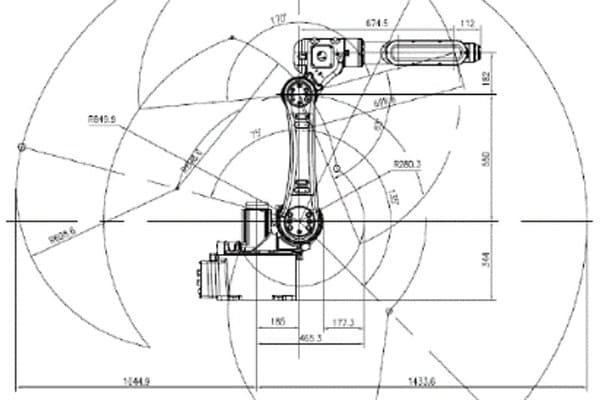
For cutting 3D parts — tubes, formed metal shapes, stampings — a robot-mounted laser head (robotic laser cutting cell) provides 6-axis freedom that a flatbed laser cannot match.
Applications:
- Automotive body parts (trimming formed stampings)
- Tube and pipe cutting with complex profiles
- 3D fabrications requiring cuts at multiple angles
Cost: A robotic laser cutting cell (6-axis robot + fiber laser head + controller) runs $180,000-500,000 installed. This is a serious capital investment, primarily justified for automotive-tier and heavy fabrication shops.
Chinese robotic laser alternatives: Bodor, Hymson, and Han's Laser offer robotic laser cells at $120,000-250,000 — significantly undercutting Western alternatives. Quality has improved substantially and is appropriate for many non-automotive applications.
The Real Decision: Questions to Ask Yourself
What materials are you cutting?
- Metal sheet → laser or plasma
- Wood/MDF/plastic → router
- Anything regardless of material → waterjet (but expensive to operate)
How thick are your typical parts?
- Under 12mm metal → fiber laser wins on speed and quality
- Over 20mm metal → plasma (if quality requirements allow) or waterjet
- Any thickness in non-metals → router
What are your quality requirements?
- Need laser-quality edge, no deburring → fiber laser
- Good enough edge, will finish anyway → plasma for metal, router for non-metals
- Medical/aerospace → waterjet (no heat affected zone)
What's your production mix?
- High-mix, low-volume → laser (fast changeover, no tooling)
- Low-mix, high-volume → consider stamping or punching instead of any cutting technology
ROI Comparison
Fiber laser at $90,000 (3kW, typical small shop installation):
- Outsourced laser cutting cost savings: $40,000-80,000/year for typical small fabricator
- Internal labor reduction: 1 deburring operator saved × $50,000 = $50,000/year
- Payback: 1-2 years for active shops
CNC router at $35,000:
- Outsourced cutting/routing cost savings: $20,000-50,000/year
- Payback: 1-2 years for active woodworking/sign shops
Both technologies have strong ROI when replacing outsourced work. The laser wins on operating cost and edge quality; the router wins on material versatility and lower entry price.
Frequently Asked Questions
Q: Can a fiber laser cut aluminum?
Yes, fiber lasers cut aluminum well. Aluminum is highly reflective, so CO2 lasers struggle with it, but fiber lasers (1070nm wavelength) cut aluminum up to 10mm cleanly. Thick aluminum (over 10mm) is better handled by waterjet.
Q: How much does laser cutting cost per hour to operate?
Electricity for a 3kW fiber laser running at full power: ~$0.40/hour. Plus assistance gas (nitrogen or oxygen) at $2-5/hour. Total operating cost: $3-8/hour. Much lower than waterjet ($20-50/hour for abrasive) or plasma (consumables + gas at $8-15/hour).
Q: Do I need special training to operate a CNC laser or router?
Both require training, but modern controls (Beckhoff, Siemens, Fanuc) have improved dramatically in usability. Most small shop operators can reach productive proficiency in 2-4 weeks. CAD/CAM software (Fusion 360, SolidWorks CAM, Hypertherm ProNest) is the steeper learning curve.
Q: Which brands of fiber laser are reliable for small manufacturers?
For small shops prioritizing reliability and support: Bystronic, Trumpf (premium, European). For value with acceptable quality: Bodor (Chinese, good dealer network in US), G.Weike (Chinese, popular in small shops). Avoid the cheapest Chinese brands with no US service presence — laser systems require local support when they need service.
