# Laser Cutting Robot Guide 2026: Applications, Pricing, and When to Choose Robot vs CNC
A flat-bed CNC laser cutter costs $80,000–$300,000 and cuts sheet metal at 400 inches/minute. A robotic laser cutting cell costs $200,000–$600,000 and cuts complex 3D automotive stampings that a flat-bed can't even load.
These are not competing technologies. They solve different problems. This guide explains which is which.
---
What Robotic Laser Cutting Actually Does
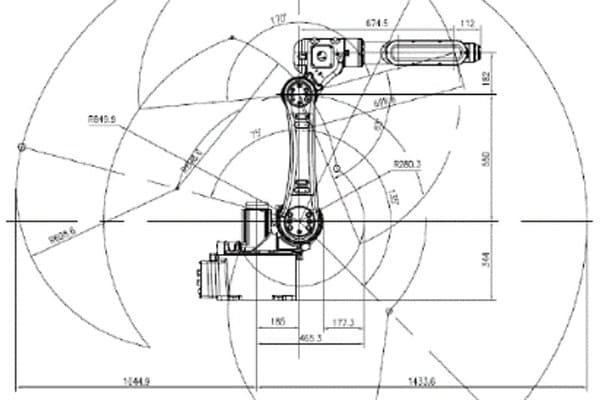
Robotic laser cutting mounts a laser cutting head on the end of a 6-axis industrial robot arm, enabling:
- 3D contour cutting of formed sheet metal parts (automotive body panels, HVAC components, hydroformed tubes)
- Compound angle trimming on injection molded plastic parts
- Remote laser cutting using high-power scanners for ultra-high-speed processing
- Drilling and piercing in difficult-to-access locations on assembled components
The primary market is automotive manufacturing. A single modern vehicle body requires 200–400 laser cut openings, many on complex 3D surfaces where flat-bed processing is impossible.
Secondary markets: aerospace structural components, medical devices, agricultural equipment.
---
Laser Source Technologies
Fiber Laser (1070 nm wavelength)
Now dominant for metals. Key specs for robotic applications in 2026:
- Power range: 1 kW–10 kW for cutting (20+ kW for welding)
- Wall-plug efficiency: 30–40% (vs 10–15% for CO2)
- Cutting speed advantage: 3–5× faster than CO2 for thin metals (<3 mm)
- Maintenance: Solid-state, no gas refills, 100,000+ hour laser source life
- Cost: Fiber source adds $40,000–$120,000 to system cost depending on power
Leading suppliers: IPG Photonics (market leader), nLIGHT, Coherent (II-VI), Raycus (Chinese OEM, 30–40% lower cost)
CO2 Laser (10,600 nm wavelength)
Still used for:
- Non-metals (plastics, wood, composites, textiles, glass)
- Thick stainless steel (>12 mm) where beam quality matters
- Applications requiring wide kerf for heat-affected zone management
Robotic CO2 systems are increasingly rare for new installations — fiber has displaced them in most metal applications.
Disk Laser
Trumpf's TruDisk series. Exceptional beam quality (BPP <2 mm·mrad) for demanding applications: cutting highly reflective materials (copper, aluminum at thickness >6 mm), micro-cutting. Cost premium: 40–60% over equivalent fiber.
---
Robot Platform Selection
Why Not Just Any Industrial Robot?
Laser cutting robots require:
- Hollow wrist for fiber optic cable routing (avoids cable twist)
- High repeatability — typically ±0.05 mm or better
- High wrist speed — remote laser cutting requires >360°/s wrist rotation
- Integrated safety I/O for laser interlock circuits
- Laser-specific firmware — most OEMs offer laser cutting packages
Recommended Platforms
FANUC R-2000iC/165F — workhorse for automotive body laser cutting. 165 kg payload, 2,655 mm reach, ±0.05 mm repeatability. Laser Mate software package for common laser head brands.
KUKA KR QUANTEC — strong in European automotive. KUKA.LaserTech software for path interpolation with laser power control synchronized to speed.
ABB IRB 6700 — 150–300 kg payload options. ABB's SpeedPainter/LaserCut packages. Good WMS integration.
Yaskawa Motoman HP20D — cost-effective, hollow-wrist design standard, popular in tier-2 automotive suppliers.
Remote Laser Cutting (Scanner-Based)
High-power lasers (4–8 kW) combined with galvo scanner heads move the laser beam rather than the robot, enabling 10–30× higher cutting speeds. The robot positions the scanner; the scanner cuts. Applications: ultra-high-volume automotive (e.g., door panels in 8-second takt time).
System cost: $400,000–$800,000. ROI only makes sense above 500,000 parts/year.
---
Complete System Cost Breakdown
Entry-Level Robotic Laser Cutting Cell (1–2 kW fiber, automotive small parts)
| Component | Cost |
|---|---|
| Industrial robot (used/certified) | $35,000–$55,000 |
| Fiber laser source (1–2 kW) | $40,000–$65,000 |
| Laser cutting head | $18,000–$35,000 |
| Robot controller + laser interface | $15,000–$22,000 |
| Safety enclosure + extraction | $20,000–$35,000 |
| Fixturing and part locating | $15,000–$40,000 |
| Integration and programming | $35,000–$60,000 |
| **Total** | **$178,000–$312,000** |
Mid-Range Cell (3–4 kW fiber, medium complexity)
| Component | Cost |
|---|---|
| Industrial robot (new) | $75,000–$110,000 |
| Fiber laser source (3–4 kW) | $80,000–$130,000 |
| Laser cutting head + seam tracking | $35,000–$55,000 |
| Controller, safety, ancillaries | $45,000–$70,000 |
| Integration and programming | $55,000–$90,000 |
| **Total** | **$290,000–$455,000** |
High-End Automotive Cell (6 kW+ with dual robots, conveyor loading)
Complete turnkey: $500,000–$1,200,000. Typically purchased through Tier 1 automotive integrators.
---
Robot Laser vs CNC Flat-Bed Laser: Decision Framework
| Factor | Robotic Laser | CNC Flat-Bed |
|---|---|---|
| Part geometry | 3D formed parts, complex surfaces | Flat sheet or plate only |
| Part size | 0.3 m² to full car body | Standard: up to 4×8 ft sheets |
| Speed (flat sheet) | Slower than flat-bed | Faster for sheet processing |
| Flexibility | High (reprogrammable) | Medium (sheet size limited) |
| Initial cost | $180K–$600K+ | $80K–$350K |
| Footprint | Larger cell | Compact machine |
| Operator skill | Robotics + laser expertise | Easier to operate |
| Best fit | Automotive, aerospace, 3D parts | Sheet metal job shops, fabrication |
Rule of thumb: If your parts are flat sheet metal → buy a flat-bed. If your parts are formed, stamped, or have complex 3D geometry → you need a robotic solution.
---
Cycle Time and Throughput Planning
Cutting speed for 1.5 mm mild steel with 2 kW fiber: approximately 8,000–12,000 mm/minute (315–470 inches/min)
For 3D parts, path planning efficiency matters more than raw speed:
- Complex automotive B-pillar with 45 openings: 95–140 seconds with 6-axis robot + 2 kW laser
- Same part manually trimmed: 8–12 minutes
Cell efficiency targets: World-class automotive laser cells run at 75–85% utilization. Achieve this with:
- Dual-station rotary fixtures (robot cuts one side while operator loads the other)
- Automated part sensing and locating (±0.1 mm locating vs robot's ±0.05 mm repeatability)
- Predictive maintenance for cutting head lens cleaning intervals
---
Key Vendors and Integrators
Laser source: IPG Photonics (US), Trumpf (Germany), nLIGHT (US), Raycus (China — 35% cost savings, growing quality)
Cutting heads: Precitec (Germany, market leader), II-VI (Coherent), Laser Mechanisms (US), Raytools (China)
Robot + laser integration specialists: Lincoln Electric Automation, Genesis Systems, Servo Robot, SLTL Group (India for emerging markets)
Full turnkey OEM: Trumpf TruLaser Robot (premium, 6-axis cell), FANUC RoboCut Laser, Yaskawa Motoman (custom cells)
---
Checklist Before Buying
- [ ] Part geometry audit: Are any parts 3D/formed? Measure actual deviation from flat.
- [ ] Volume threshold: What's your annual part count? ROI improves sharply above 100,000 parts/year.
- [ ] Existing programming resources: Can you support a 6-axis robot in-house?
- [ ] Fiber diameter selection: 50 µm core for precision (<1 mm features); 100–200 µm for standard production
- [ ] Assist gas infrastructure: Nitrogen and oxygen at 20 bar for cutting; dedicated generator or cylinders?
- [ ] Fume extraction compliance: OSHA 1910.252(c) for metal fumes; local exhaust ventilation required
For broader robotics investment context, use our Robot ROI Calculator and review the robot integration cost guide before finalizing your budget.