Injection molding machine (IMM) automation is one of the clearest ROI propositions in industrial robotics. A sprue picker removes molded parts in 1–3 seconds, runs 24/7 without fatigue, and prevents the most common plastics defects caused by inconsistent manual removal: gate vestiges, warpage from delayed extraction, and contamination. In 2026, injection molding robot systems range from $8,000 for a basic 3-axis take-out robot to $150,000+ for a full 6-axis cell with insert molding and downstream automation.
Injection Molding Robot Types
3-Axis Cartesian Take-Out (Sprue Picker)
The simplest and most common IMM automation. A Cartesian (X-Y-Z) robot enters the mold space after opening, grips the part/sprue runner system, removes it, and deposits on conveyor or drop chute.
- Speed: 1–3 second extraction time
- Cost: $8,000–25,000
- Payload: 1–20 kg
- Best for: Single-cavity, simple part geometry, high-volume commodity molding
- Leading brands: Star Seiki, Yushin, Wittmann, Sepro
Take-out robots are mounted on the machine tie bar — no additional floor space consumed. This is the preferred configuration for space-constrained molding floors.
5-Axis Cartesian (Servo Take-Out with Articulation)
Adds articulating wrist to 3-axis system for angled extraction and complex part orientation.
- Speed: 2–5 seconds extraction
- Cost: $18,000–45,000
- Best for: Multi-cavity molds, gate trimming, stacking operations
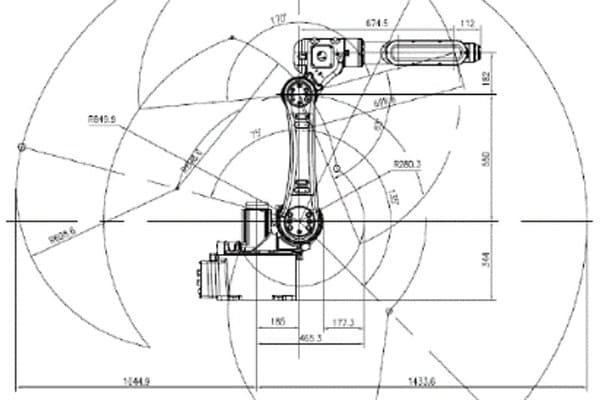
6-Axis Industrial or Collaborative Robot
Full 6-axis articulated arm for maximum flexibility. Required for insert molding, over-molding, and complex downstream assembly.
- Speed: 3–8 seconds extraction cycle (slower than Cartesian)
- Cost: $40,000–150,000 installed
- Best for: Insert molding, post-mold assembly, inspection integration, high-mix operations
- Leading brands: Fanuc, ABB, Yaskawa, KUKA — all offer IMM packages
IMM Automation by Operation Type
Part Removal (Standard Automation)
Basic take-out and deposit. The entry point for all molding automation:
- Robot enters mold, grips part, removes on mold open
- Drops part on conveyor, chute, or placement tray
- System cost: $12,000–35,000
- ROI: Typically 6–18 months from labor savings alone
Insert Molding Automation
Metal inserts (brass threads, contacts, pins) placed into mold cavity before injection. Manual insert placement is slow, inconsistent, and error-prone.
Automated insert loading:
- Bowl feeder or tray presents inserts in correct orientation
- 6-axis robot picks inserts and places precisely in cavity locating pins
- Vision system verifies insert presence/position before mold close
- Cost premium vs. basic take-out: $25,000–60,000
Insert molding error consequences: A missing insert means a scrapped part (or worse, a damaged mold if the cavity closes on a misplaced insert). Vision-verified insert placement prevents $5,000–50,000 mold repair costs.
Over-Molding Automation
A substrate part is placed in the mold and then over-molded with a second material. Robot handles substrate loading and final part removal.
- Substrate feeder + robot = $30,000–70,000 premium
- Reduces cycle-to-cycle variation in substrate placement
In-Mold Labeling (IML)
Pre-printed labels placed inside the mold cavity before injection; plastic encapsulates the label during molding. Eliminates secondary labeling operation.
- High-speed label placement: 0.8–2 seconds
- Specialized IML robots: $40,000–90,000
- Cost justification: Eliminates post-mold labeling line entirely
- Common in: Thin-wall packaging (dairy, deli containers)
Post-Mold Secondary Operations
Operations performed on molded parts before final packing:
| Operation | Automation Cost Premium | Notes |
|---|---|---|
| Gate trimming/degating | $5,000–15,000 | Blade or laser trim station |
| Cooling/quench station | $3,000–8,000 | Reduces warpage |
| CMM/vision inspection | $15,000–35,000 | 100% part inspection |
| Assembly/snap fit | $10,000–25,000 | Part joining automation |
| Pad printing/marking | $8,000–20,000 | In-cell marking |
| Boxing/packing | $15,000–40,000 | Counted deposit to boxes |
Machine Interface and Control
IMM robots must communicate with the injection molding machine controller via:
EUROMAP 12 (older standard): 13-pin electrical interface for mold open/close signals and robot permission. Supported by virtually all IMM brands.
EUROMAP 67 (current standard): 34-signal interface with expanded handshaking. Required for complex multi-robot cells.
OPC-UA (EUROMAP 77/83): Digital protocol for Industry 4.0 data exchange. Production data, cycle times, and quality data flow from IMM to MES.
All major take-out robot suppliers (Yushin, Sepro, Wittmann) include EUROMAP 67 as standard. Verify compatibility with your specific IMM controller before purchasing.
Complete Automation Cell Cost
Scenario 1: Basic Take-Out Cell
| Component | Cost |
|---|---|
| 3-axis Cartesian take-out robot | $15,000 |
| Part deposit conveyor | $5,000 |
| Integration/programming | $5,000 |
| **Total** | **$25,000** |
Scenario 2: Multi-Cavity Production Cell
| Component | Cost |
|---|---|
| 5-axis servo take-out robot | $28,000 |
| Gate trimming station | $10,000 |
| Vision inspection | $15,000 |
| Conveyor + counter/packer | $20,000 |
| Integration/programming | $15,000 |
| **Total** | **$88,000** |
Scenario 3: Insert Molding Automation Cell
| Component | Cost |
|---|---|
| 6-axis robot (Fanuc M-10iD) | $40,000 |
| Bowl feeder (inserts) | $12,000 |
| Vision system (insert verification) | $18,000 |
| Part removal end-effector | $8,000 |
| Integration/programming | $20,000 |
| **Total** | **$98,000** |
Leading IMM-Specific Robot Brands
Yushin (Japan): Dominant in Asian markets, strong in North America. Tie-bar mounted 3-axis and 5-axis take-out. Direct EUROMAP integration. Price: $10,000–40,000.
Sepro (France): European market leader. Visual 3 platform with graphical programming. Wide payload range. Price: $15,000–55,000.
Wittmann (Austria): Strong integration with Wittmann-Battenfeld IMM equipment. Also compatible with all major IMM brands. Price: $12,000–45,000.
Star Seiki (Japan): Fastest take-out robots in production; 0.8-second extraction time. Price: $12,000–35,000.
Chinese Brands: Alfa Automation, Huayan (华研) offer 3-axis take-out robots at $4,000–15,000 FOB. Growing in Asia, beginning to export. Quality is improving but after-sales support outside China is limited.
ROI: Multi-Cavity Closure Cap Molding
- Application: 8-cavity cap mold, 25-second cycle time, 3 shifts/day
- Manual operation: 3 workers per shift × 3 shifts = 9 FTEs for part removal and packing
- Annual labor cost: 9 × $35,000 = $315,000
- System investment: $65,000 (5-axis take-out + conveyors + packing station)
- Annual maintenance: $5,000
- Annual net savings: $315,000 - $5,000 = $310,000
- Payback: ~2.5 months
For high-volume commodity molding, machine tending ROI is among the fastest of any robot application.
Frequently Asked Questions
What IMM size robot do I need?
Robot payload must exceed the total weight of parts + runner system + end-effector. For a 100-ton IMM producing 50g parts in an 8-cavity mold: parts (400g) + runner (100g) + gripper (500g) = ~1 kg — a 3 kg rated robot provides adequate margin. Match robot stroke to machine tie-bar spacing and mold dimensions.
Can one robot serve multiple injection molding machines?
Yes, with a floor-mounted 6-axis robot positioned between two machines, or a rail-mounted system. The economic case requires machines with similar cycle times and proximity. Two-machine servicing is common; three-machine is possible but cycle time coordination becomes complex.
What are the most common causes of IMM robot downtime?
In order of frequency: (1) End-effector wear/failure — vacuum cups and gripper fingers wear from heat and cycle repetition; maintain spare sets. (2) Part position variation — if the mold isn't ejecting consistently, robot picks fail; usually a mold maintenance issue. (3) EUROMAP communication errors — typically cabling or controller firmware. Planned PM every 1,000 hours prevents most downtime.
Is IML (in-mold labeling) automation worth the extra investment?
For container production (dairy pots, deli tubs, ice cream containers) running > 500,000 cycles/year, IML almost always pays off by eliminating the post-mold labeling line, reducing label inventory complexity, and producing a premium-looking fused label that consumers prefer. For lower volumes or premium packaging, the capital cost doesn't justify the label quality improvement alone.