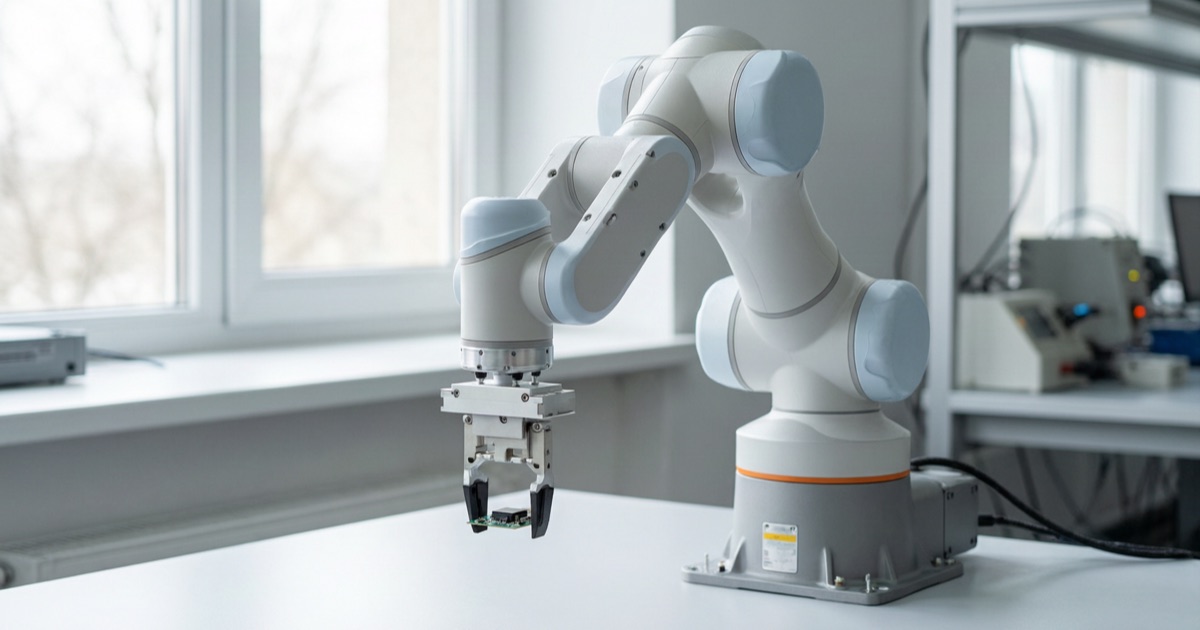
Almost every cobot on the market is quote-only. You fill in a form, wait for a distributor, and discover the price after you have already invested a week. The German motion-plastics company igus takes the opposite approach with its ReBeL cobot: the number is printed on the page. That alone makes it worth understanding, because a published price is a rare fixed point in a category built on opaque quoting.
This guide covers what the ReBeL costs, what you get for it, and — just as importantly — the payload ceiling that decides whether it belongs on your shortlist at all.
What the ReBeL costs
| Configuration | Typical list price | Notes |
|---|---|---|
| ReBeL 4 DoF | from ~€4,250 (EU list) | Fewest axes, simplest pick-and-place |
| ReBeL 5 DoF | from ~€4,650 (EU list) | Middle configuration |
| ReBeL 6 DoF | from ~€4,970 (EU list) | Full articulation |
| ReBeL 6 DoF (US) | **$7,499** | US list price as published by igus |
The headline US number is $7,499, listed publicly by igus for the ReBeL. For context on how stable that has been: igus announced the ReBeL in 2022 at $7,455, so the price has moved only marginally across four years — unusual in a category where flagships routinely lose a third of their value in a season.
The European catalog is where the tiering shows up, with published list pricing running from roughly €4,250 for the 4 DoF version to about €4,970 for the 6 DoF. The gap between the EU and US figures is normal for imported automation once freight, duty, and regional distribution margin are layered on; treat each region's list as its own number rather than converting one into the other.
One planning note: configurations with and without the control unit are sold separately, so confirm which one a given price covers before you budget. igus bundles its own robot control software (iRC) at no extra license cost, which removes a line item that is rarely free elsewhere.
The specs that decide everything
The ReBeL's spec sheet is short, and one line on it will disqualify the robot for most industrial shortlists:
- Payload: 2 kg (max)
- Reach: 664 mm maximum (400 mm nominal)
- Net weight: 8.2 kg
- Repeatability: ±1 mm
- Throughput: minimum 7 picks/min at 500 g
Read those together and the robot's identity is obvious. A 2 kg payload over a 664 mm reach is a tabletop-class machine — that is a small gripper plus a light part, not a machine-tending arm swapping steel blanks. And ±1 mm repeatability is roughly an order of magnitude looser than the ±0.03 mm typical of conventional industrial cobots. For assembly into a tight fixture or precision dispensing, that tolerance is a hard stop.
The reason for both numbers is the same design decision: the ReBeL is built from igus's engineering plastics rather than machined metal, including what the company describes as the first industrial-grade cobot gearbox made of plastic. That is what gets the arm to 8.2 kg — light enough for one person to reposition it by hand — and what gets the price to a four-figure number. You are trading rigidity and precision for weight and cost, deliberately.
Who should buy one — and who shouldn't
Good fit: light assembly, quality inspection, lab and service-robotics work, education and research, and any application where a human moves the robot between tasks. The low mass is a genuine functional advantage in those settings, not just a shipping saving. Individually replaceable joints also mean a failure is a part swap rather than an arm replacement.
Bad fit: anything above 2 kg at the tool, anything needing sub-millimeter placement, and high-duty-cycle production work. The 7 picks/min floor at 500 g is honest but modest; if throughput is your metric, price a conventional cobot instead.
A note on the wider igus lineup: the older robolink arm range is being discontinued, with the ReBeL positioned as its successor. If you find robolink pricing in an old comparison, treat it as historical.
How it compares, and how to buy
At $7,499, the ReBeL undercuts essentially every conventional cobot — mainstream 5–10 kg cobots generally start several times higher. But that comparison is only fair if your application genuinely fits inside 2 kg and ±1 mm. If it doesn't, the ReBeL isn't a cheaper version of those robots; it's a different tool. The honest way to shop this segment is to fix your payload and tolerance requirements first, then see which price band you land in — not the reverse.
One structural warning that applies to any low-cost arm: the arm is typically only about half of a deployed cell's real cost, with the rest in integration, tooling, and service. We broke that math down in the hidden costs of a cheap cobot, and it applies with full force here. A $7,499 arm does not produce a $7,499 automation project.
igus sells the ReBeL through its own site and the RBTX marketplace, where compatible grippers, vision, and other components from a stated 40-plus partner ecosystem are matched to it — useful, because a 2 kg budget at the tool disappears fast once you add a gripper.
For the broader landscape of arms in this class, see our collaborative robot category page, and for how the low-cost imports stack up on spec and price, our UR vs Chinese cobots face-off.
Prices are igus list prices as published in 2026 and are quoted here for orientation; configuration, control unit, and regional distribution all move the final number. Confirm current pricing with igus before budgeting.