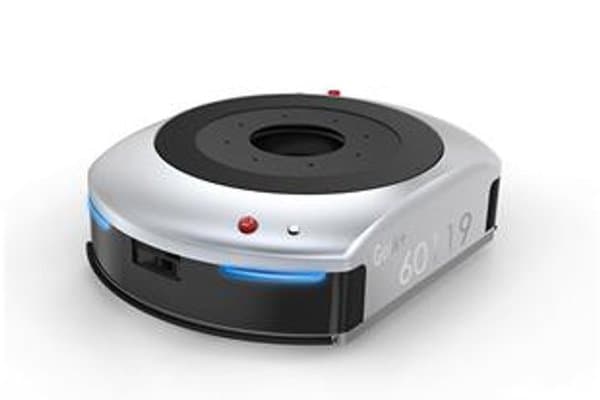
DHL Supply Chain committed to deploying 5,000 AMRs across its North American network by the end of 2026. At the same time, a major automotive parts distributor in Germany spent $4.2 million on forklift AGVs in 2023 — and is now tearing them out in favor of AMRs after a plant layout change made the fixed infrastructure cost-prohibitive. Both decisions were correct for their context. Choosing the wrong one can cost you millions.
This guide cuts through the marketing to give you a clear decision framework based on operational reality.
The Fundamental Difference
AGV (Automated Guided Vehicle): Follows fixed, predefined paths using physical infrastructure — magnetic tape, QR codes on the floor, laser reflectors, or embedded wire. Navigation is deterministic and highly reliable, but changing the route requires physical modification.
AMR (Autonomous Mobile Robot): Maps its own environment using LIDAR, cameras, and AI-based SLAM (Simultaneous Localization and Mapping). Creates routes dynamically, avoids obstacles in real time, and adapts to environment changes without physical reconfiguration.
The practical implication: AGV is a conveyor system you can drive. AMR is a robot that can navigate independently.
Specifications Comparison
| Specification | Forklift AGV | Standard AMR |
|---|---|---|
| **Price range** | $50,000–$200,000 | $30,000–$100,000 |
| **Payload capacity** | 500 kg–5,000 kg | 100 kg–1,500 kg |
| **Navigation** | Fixed paths | Dynamic routing |
| **Infrastructure needed** | High (tape, reflectors, network) | Low (Wi-Fi, fleet management SW) |
| **Obstacle handling** | Stops, waits, or alerts | Navigates around obstacles |
| **Speed** | 1.5–2.5 m/s | 1.2–2.0 m/s |
| **Battery life** | 6–12 hours (lead-acid) | 8–14 hours (Li-ion) |
| **Charging** | Manual or inductive | Autonomous docking |
| **Deployment time** | 3–6 months | 2–6 weeks |
| **ROI timeline** | 18–36 months | 12–24 months |
| **Layout flexibility** | Very low | Very high |
Price Deep Dive
AGV Price Breakdown
Entry-level pallet AGV (1,000 kg payload): $50,000–$80,000
Mid-range counterbalance AGV (2,000 kg payload): $80,000–$130,000
Heavy-duty reach truck AGV (3,000 kg+ payload): $130,000–$200,000+
But AGV infrastructure multiplies the unit cost:
| Infrastructure Component | Cost per AGV | Cost for 10-AGV Fleet |
|---|---|---|
| Floor preparation (tape/markers) | $2,000–$15,000 | $5,000–$30,000 |
| Laser reflector network | $8,000–$25,000 | $8,000–$25,000 (shared) |
| Fleet management software | $20,000–$80,000 | $20,000–$80,000 (shared) |
| WMS integration | $15,000–$50,000 | $15,000–$50,000 (shared) |
| Site survey and commissioning | $5,000–$20,000 | $5,000–$20,000 |
| **Total infrastructure** | **~$50,000–$200,000** |
For a 10-AGV fleet at $80,000/unit: $800,000 in robots + $150,000 infrastructure = $950,000 total.
AMR Price Breakdown
Small payload AMR (100–300 kg): $30,000–$55,000
Mid-size AMR (300–600 kg): $45,000–$75,000
Heavy AMR (600–1,500 kg): $65,000–$100,000
AMR infrastructure is significantly lighter:
| Infrastructure Component | Cost |
|---|---|
| Wi-Fi network upgrade (if needed) | $0–$30,000 |
| Fleet management software (SaaS) | $500–$2,000/month |
| WMS integration | $10,000–$40,000 |
| Site mapping and commissioning | $3,000–$10,000 |
| **Total infrastructure** | **~$15,000–$80,000** |
For a 10-AMR fleet at $60,000/unit: $600,000 in robots + $50,000 infrastructure = $650,000 total.
On a same-fleet-size basis, AMR typically runs 25–35% cheaper total. The gap widens further if your layout changes — AMR reconfiguration costs near zero; AGV reconfiguration can run $20,000–$80,000.
MODEX 2026 Highlights: The State of the Market
At MODEX 2026 in Atlanta (March 2026), several key announcements shaped the AGV/AMR landscape:
OMRON OL-450S AMR: Launched with 450 kg payload, 12-hour battery life, and native integration with SAP WM and Manhattan Associates WMS. Price: approximately $65,000. Standout feature: multi-fleet coordination allowing OMRON AMRs to share floor space with other vendors' robots.
FANUC CRX-30iA Mobile Manipulator: Not a pure AMR, but a watershed product — FANUC's AMR platform carrying a CRX collaborative arm. Enables autonomous pick-and-place across the warehouse floor without fixed infrastructure. Targeted at kitting, bin picking, and flexible assembly. Price: not yet published, estimated $180,000–$250,000 for the full system.
Locus Robotics 1 Billion Picks Milestone: Announced at MODEX 2026, Locus Robotics' fleet has now completed 1 billion collaborative picks. Average productivity improvement: 2–3× versus human-only operations. Customer base expanded to 110+ sites.
Geek+ GiNo Humanoid: Geek+ previewed its humanoid warehouse worker at MODEX, targeting bin-picking and put-wall tasks. Not commercially available, but signals where the market is heading post-2027.
When to Choose AGV
Choose AGV when:
- Payload exceeds 2,000 kg. AMRs currently top out around 1,500 kg. For heavy automotive or industrial materials, AGV is the only automated option.
- Routes are fixed and high-volume. If you're moving pallets from Point A to Point B 500 times per day on the same route, AGV's deterministic reliability and higher throughput wins.
- You need predictable timing. AGVs can be scheduled to the minute. AMR routes vary based on traffic and obstacles. In just-in-time production environments, predictability may matter more than flexibility.
- Clean, controlled environment. AGVs require smooth floors, no random obstacles, and disciplined traffic management. If your facility already operates this way, AGV's simplicity is an advantage.
- Union environment with specific automation agreements. In some unionized facilities, AGVs are classified differently than AMRs for labor agreement purposes.
Typical AGV applications: Automotive assembly line feeding, cold storage pallet movement, high-bay warehouse horizontal transport, heavy manufacturing material handling.
When to Choose AMR
Choose AMR when:
- Layout changes frequently. E-commerce warehouses reconfigure seasonally. AMR handles this with a software update. AGV requires physical infrastructure changes.
- Mixed human-robot environment. AMRs are designed to operate alongside humans. AGVs require segregated paths or complex traffic management.
- Fast deployment needed. AMRs can be operational in 2–4 weeks. AGVs take 3–6 months to fully commission.
- Scalability matters. Adding an AMR to a fleet is straightforward. Adding an AGV requires route replanning and potentially additional infrastructure.
- Payload under 1,500 kg. For goods delivery, order fulfillment, and hospital logistics, AMR payload range covers 90%+ of use cases.
- Justifying ROI to management. AMR's faster deployment and lower infrastructure cost makes financial modeling cleaner.
Typical AMR applications: E-commerce order fulfillment, hospital medication and supply delivery, retail distribution, manufacturing line feeding (light materials), goods-to-person systems.
Head-to-Head: Total 3-Year Cost
Scenario: 10-unit fleet, mid-range payload (1,000 kg), distribution center
| Cost Component | AGV Fleet | AMR Fleet |
|---|---|---|
| Robot units (10×) | $900,000 | $620,000 |
| Infrastructure | $150,000 | $45,000 |
| Installation | $80,000 | $25,000 |
| Software (3 years) | $60,000 | $72,000 |
| Maintenance (3 years) | $135,000 | $90,000 |
| Reconfiguration (assume 1) | $45,000 | $5,000 |
| **3-Year Total** | **$1,370,000** | **$857,000** |
| Annual labor replaced | $840,000 | $780,000 |
| **3-Year Net Position** | **+$1,150,000** | **+$1,483,000** |
AMR wins on 3-year economics by $333,000 in this scenario. The margin narrows or reverses when payload requirements exceed AMR capabilities or volume throughput favors AGV.
For more on warehouse robots, see the complete buying guide. For last-mile applications, explore delivery robots.
Hybrid Approach: When You Need Both
Some large distribution centers deploy both: AGVs on high-volume fixed routes between storage and shipping dock, AMRs for goods-to-person picking within storage zones. The split typically falls:
- AGV: Dock-to-zone transport (high payload, fixed route)
- AMR: Zone picking and person-following (flexible, human-collaborative)
This hybrid approach maximizes the strengths of each technology. Manufacturers like Geek+ and 6 River Systems offer fleet management platforms that coordinate both vehicle types.
Key Questions Before You Buy
For AGV:
- What is my floor's load capacity and flatness tolerance?
- How often do routes change? (Even once per year makes AGV reconfiguration cost significant)
- What are lead times for maintenance parts in my region?
- Does my WMS support the AGV vendor's integration API?
For AMR:
- Is my Wi-Fi infrastructure adequate for real-time fleet communication?
- What is my peak concurrent AMR density? (AMR coordination degrades above 1 unit per 500 sqm in dense environments)
- Will AMRs share space with forklifts? (Requires traffic management protocol)
- What is the vendor's fleet management software uptime SLA?
Frequently Asked Questions
Q: Can AMRs replace all forklifts?
Not yet. AMRs max out around 1,500 kg payload and cannot perform vertical racking operations (stacking). For heavy-load horizontal transport and racking, you still need manned or AGV forklifts. AMR is best positioned for horizontal goods movement and person-following picking.
Q: How long does AMR deployment typically take?
From purchase order to operational: 4–8 weeks for standard AMR systems. This includes site survey (1 week), mapping (2–3 days), WMS integration (1–3 weeks), and staff training (1 week). Compare to 3–6 months for AGV systems.
Q: What is the typical AMR uptime?
Top AMR vendors (MiR, Geek+, 6 River, Locus) report 95–99% uptime in deployed fleets. Most downtime comes from battery management, not mechanical failure. Li-ion batteries in modern AMRs typically last 3–5 years before replacement.
Q: Are AGVs cheaper to buy than AMRs?
For equivalent payload capacity, AGV unit prices are similar or slightly higher than AMR, but AGVs are available in much higher payload configurations. The key cost difference is infrastructure: AGV infrastructure adds 15–25% to fleet cost, while AMR infrastructure adds 5–8%.
Q: Can I buy AMRs from Chinese manufacturers?
Yes. Geek+, Quicktron, and HIK Robot (Hikrobot) are strong Chinese AMR brands with global installations and CE/UL certification. Prices run 30–45% below Western equivalents for comparable specifications. See Buy from China for import guidance.
Q: What safety standards apply to AGVs and AMRs?
AGVs: ISO 3691-4 (industrial trucks, automated functions). AMRs: ISO 3691-4 + ISO 15066 (collaborative robots, for human-collaborative AMRs). Both require CE marking for EU markets. The key difference: AMRs are inherently safer in mixed environments because they can detect and avoid humans dynamically.

