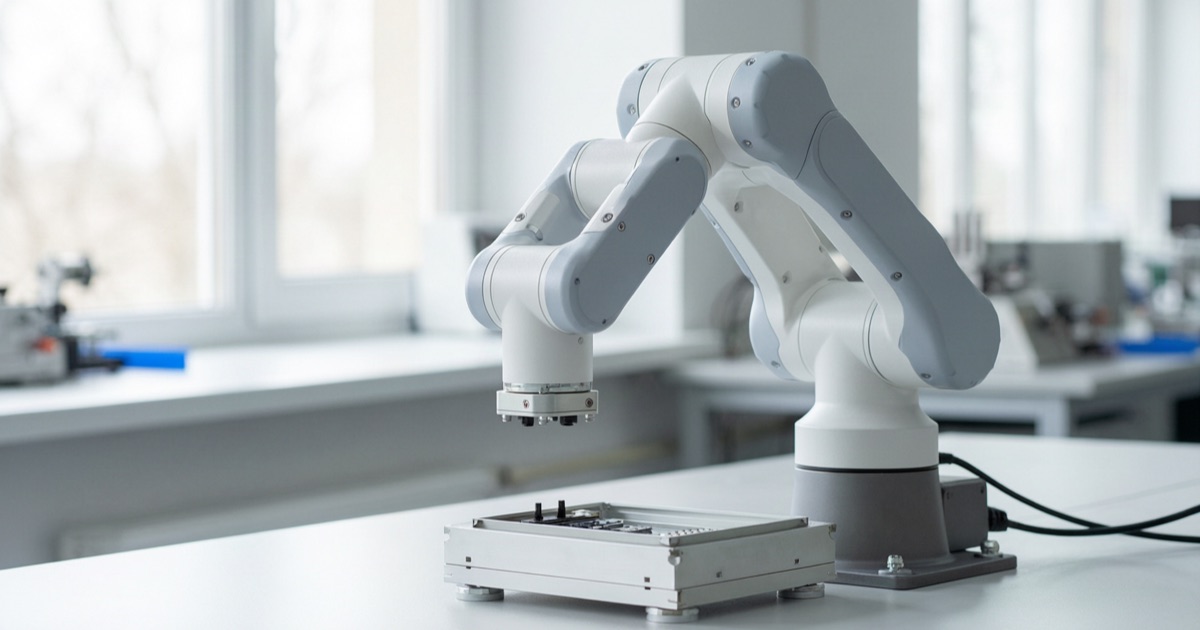
Dobot is unusual among robot-arm makers in that it publishes real prices online — you can put most of its lineup in a cart without a sales call. That transparency is exactly why it dominates classrooms, maker labs, and small-batch benches: buyers can budget before they commit. The catch is that "a Dobot" spans a $995 desktop teaching arm and a $33,000 industrial cobot, so the brand name alone tells you almost nothing about cost. The bands below reflect publicly listed 2026 US pricing from Dobot's own store and major distributors; individual units swing with education discounts and bulk MOQs, so treat each figure as a typical street price rather than a fixed quote.
How Dobot's lineup is organized
Dobot splits into three practical tiers, and knowing which one you're in saves you from massively over- or under-buying:
- Magician series — desktop education and light prototyping. Small 4-axis arms, USB/tablet programming, block-coding curriculum. Payloads under 750g. This is a teaching tool, not a production machine.
- Desktop industrial (MG400, M1 Pro) — compact 4-axis SCARA-style arms built for real small-batch pick-and-place, assembly, and testing on a bench. Faster, stiffer, and rated for duty cycles the Magician isn't.
- Collaborative robots (Magician E6, Nova, CR series) — full 6-axis cobots with force sensing and safety-rated collaborative operation, priced and specified to compete with Universal Robots and the Chinese cobot field.
Dobot robot price bands (2026, USD)
| Tier | Representative models | Typical price | What you get |
|---|---|---|---|
| Education desktop | Magician Lite, Magician (Basic/Educational) | ~$995 – $1,995 | 4-axis teaching arm, block coding, STEM kits, <750g payload |
| Desktop industrial | MG400, M1 Pro | ~$2,890 – $5,000 | Compact 4-axis for bench pick-and-place / small-batch assembly |
| Entry cobot | Magician E6 | ~$6,995 | 6-axis collaborative arm, education-to-light-industry bridge |
| Mid cobot | Nova 2, Nova 5 | ~$12,790 – $13,790 | 2–5kg payload 6-axis cobots for real cells, force sensing |
| Industrial cobot | CR5A, CR10A | ~$24,320 – $33,380 | 5–10kg payload, longer reach, factory-grade collaborative work |
One useful signal buried in distributor pricing: bulk MOQs cut cobot cost sharply. The CR10, listed around $33,000 as a single unit, has been quoted near $18,800 per unit at a one-dozen minimum order. If you're deploying a line rather than a single cell, the per-arm economics change enough that it's worth asking every distributor for volume pricing before you standardize on a competitor.
Which tier is right for you
- Schools, universities, maker spaces → Magician series. At $995–$1,995 you get a safe, well-supported teaching platform with a real curriculum behind it. Don't pay cobot money to teach fundamentals. See how it compares in our educational robot sourcing guide.
- Small shop, bench automation, R&D testing → MG400 / M1 Pro. Under $5,000 gets you a genuine industrial 4-axis arm for pick-and-place, screwdriving, or test handling — far more capable than a Magician, far cheaper than a full cobot.
- Light-industry cells on a budget → Magician E6 or Nova 2. Around $7,000–$13,000 buys a 6-axis collaborative arm that can sit next to a worker without a cage, suitable for machine tending, packaging, and inspection at modest payloads.
- Production deployment → CR5A / CR10A. The $24k–$33k band (less in volume) is where Dobot competes head-on with Universal Robots and Chinese cobot rivals on payload and reach. Buy here only when you actually need the reach and duty cycle.
A practical rule: match the payload, reach, and duty cycle to the job before you pay up. Many buyers over-spec into a Nova or CR when an MG400 would run the bench task for a quarter of the price — and just as many try to force a $1,000 Magician into production and burn it out.
Buying and importing notes
Dobot is a Shenzhen-based manufacturer with an established US and EU distribution network, so most buyers should purchase through authorized regional distributors to keep warranty and support intact rather than importing gray-market units. If you're sourcing cobots for a cell or evaluating Dobot against the wider Chinese collaborative-robot field, the factors that actually decide landed cost and uptime are controller/software licensing, gripper and end-effector compatibility, spare-parts lead time, and local integration support — not the headline payload figure. For a side-by-side on the broader category, see our collaborative robot sourcing guides.
Bottom line
Dobot's 2026 pricing is a clean ladder: $995–$1,995 for education arms, roughly $3,000–$5,000 for desktop-industrial 4-axis, $7,000–$14,000 for entry-to-mid cobots, and $24,000–$33,000 for CR-series industrial cobots — with meaningful volume discounts on the cobots. Buy the tier that matches your duty cycle, not the brand's flagship, and always ask for MOQ pricing if you're deploying more than one arm.