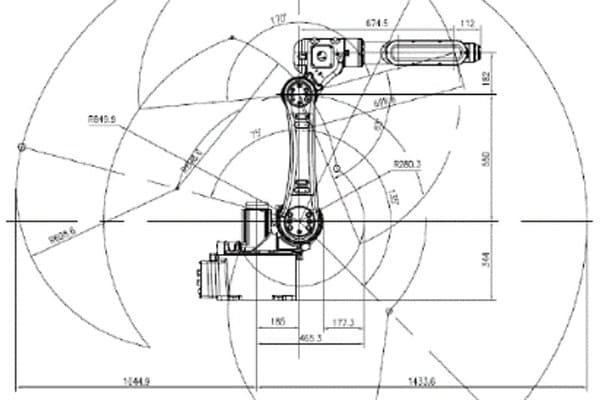
CNC machine tending — loading raw parts into a CNC lathe or machining center, waiting for the cycle to complete, and unloading finished parts — consumes an estimated 30–50% of operator time in precision machining environments. A skilled CNC machinist earning $55,000–75,000/year spends half their time on a task a robot can perform around the clock. Machine tending robots convert partially-attended machines to true lights-out capability, typically delivering payback in 12–24 months for a single machine and under 9 months for multi-machine tending.
The Machine Tending Opportunity
Most CNC shops operate on one of three models:
Operator-attended (1 machinist per machine): Machine sits idle when operator is away (breaks, other tasks, end of shift). Utilization: 60–75%.
Partially attended (1 machinist per 2–3 machines): Better utilization but still constrained by human presence. Night shift requires additional staffing.
Lights-out (robot-tended): Machine runs unattended 16–24 hours/day. Utilization: 85–95%. Robot never leaves for breaks.
The difference between 70% and 90% utilization on a $250,000 machining center is $50,000–80,000/year in additional capacity output — often more valuable than the labor cost savings.
Cobot vs. Industrial Robot for Machine Tending
| Factor | Cobot (UR, Fanuc CRX) | Industrial Robot |
|---|---|---|
| Payload | 5–25 kg | 10–200 kg |
| Part weight limit | Up to 25 kg | No effective limit |
| Safety fencing | Not required (speed limited) | Required |
| Floor space | Compact, cell-less | Larger cell required |
| Integration complexity | Low (plug-and-play kits) | Moderate to high |
| System cost | $55,000–100,000 | $80,000–160,000 |
| Best for | Job shops, medium parts | Production, heavy parts |
| ROI timeline | 14–28 months | 9–20 months |
Cobots dominate new machine tending deployments for parts under 10 kg. Universal Robots, Fanuc CRX, and KUKA LBR cobots now have machine tool-specific integration packages that reduce setup time to 1–3 days.
System Components
Robot Arm Selection
For parts < 5 kg:
- Universal Robots UR5e: 5 kg, 850mm reach — $30,000–35,000
- Fanuc CRX-5iA: 5 kg, 1,000mm reach — $32,000–38,000
- KUKA LBR iisy 11: 11 kg, 1,310mm reach — $35,000–45,000
For parts 5–20 kg:
- Universal Robots UR10e: 12.5 kg, 1,300mm reach — $38,000–45,000
- Fanuc CRX-25iA: 25 kg, 1,889mm reach — $45,000–55,000
- ABB GoFa CRB 15000: 22 kg, 1,500mm reach — $42,000–52,000
For parts > 20 kg or lights-out high-volume:
- Fanuc M-20iB: 25 kg, 1,811mm reach — $42,000–55,000
- ABB IRB 2600: 20 kg, 1,650mm reach — $45,000–60,000
- Yaskawa MH24: 24 kg, 1,730mm reach — $40,000–52,000
End-Effector: The Critical Decision
The gripper must handle raw material (often unmachined, rough surface) and finished parts (precision surface finish) without damage.
| Gripper Type | Part Type | Cost | Notes |
|---|---|---|---|
| 2-finger parallel | Round bar, regular geometry | $3,000–8,000 | Most common |
| 3-jaw chuck style | Turned parts | $5,000–12,000 | Mirrors machine chuck |
| Dual gripper | Load raw + unload finished simultaneously | $8,000–18,000 | Minimizes cycle time |
| Soft touch fingers | Precision finished surfaces | $6,000–14,000 | No marking |
| Magnetic | Ferrous parts | $2,000–5,000 | Simple, low cost |
| Vacuum suction | Flat parts, plates | $2,000–6,000 | For planar parts |
Dual gripper (one jaw holds raw stock, other holds finished part) eliminates the raw→finished swap step, cutting machine door-open time by 40–60%. For high-volume parts, this improvement alone can justify the cost premium.
Raw Part Supply
| Storage Method | Capacity | Cost | Notes |
|---|---|---|---|
| Simple tray | 10–50 parts | $500–3,000 | Basic; requires frequent reloading |
| Vibratory bowl feeder | Continuous | $5,000–20,000 | For small, regular parts |
| Stack magazine | 50–200 parts | $4,000–12,000 | Bar/disk parts |
| Drawer/shelf system | 100–500 parts | $8,000–25,000 | Mixed part sizes |
| Conveyor infeed | Continuous | $10,000–30,000 | High-volume lines |
| Vision-guided random bin picking | Unlimited (refill as needed) | $15,000–35,000 | Bin-pick from bulk |
For overnight lights-out operation, minimum 8–10 hours of raw material supply without operator intervention is required. Drawer systems with 200–500 parts are the most common solution for job shops.
CNC Machine Tool Interface
The robot must communicate with the CNC machine controller to:
- Know when a cycle is complete (door safe to open)
- Command the automatic door to open/close
- Know machine status (alarm, cycle running, etc.)
- Optionally: trigger cycle start after loading
M-code interface: Robot sends M-code output to CNC, CNC returns signal when cycle complete. Most CNC machines (Fanuc, Mitsubishi, Siemens, Heidenhain) support this. Cost: minimal (wiring only).
Ethernet/IP or OPC-UA: Digital communication for full machine status visibility. Requires machine controller support and software configuration.
Automatic door: Pneumatic or servo door actuator, typically $2,000–8,000. Eliminates operator door-opening and is required for fully autonomous operation.
Complete System Cost
| Component | Cost Range |
|---|---|
| Robot arm (cobot) | $30,000–55,000 |
| End-effector (dual gripper) | $8,000–18,000 |
| Part storage system | $5,000–25,000 |
| Machine interface (M-code) | $1,000–3,000 |
| Automatic door | $2,000–8,000 |
| Part wash/blow-off | $2,000–6,000 |
| Integration & programming | $10,000–25,000 |
| Safety assessment | $1,000–3,000 |
| **Total** | **$59,000–143,000** |
Lights-Out Manufacturing: What It Actually Requires
"Lights-out" means the machine runs unattended overnight or across multiple shifts. This requires more than just a robot:
Part quality monitoring: Every finished part must be measured (in-process gauging or post-process CMM) to detect tool wear before scrap accumulates. Options: in-spindle probing ($8,000–20,000) or post-process gauge station integrated into robot cell.
Tool life monitoring: CNC must predict and manage tool wear. When a tool reaches its life limit, the machine should stop rather than produce scrap. Modern CNC controllers (Fanuc, Siemens) have built-in tool life management.
Chip management: Chip accumulation over an overnight run can jam the machine or contaminate finished parts. High-pressure coolant and chip conveyor are essential.
Remote monitoring: Cell status visible remotely (ERP integration or standalone monitoring). Shop floor manager can receive SMS/email alarms for robot faults, machine alarms, or part supply depletion.
ROI: Turning Shop, Single VMC
- Machine: Okuma M-560V, 3-shift requirement
- Current: 2 machinists covering 2 shifts; machine idle overnight
- Machine utilization: 67% (16/24 hours)
- After robot: Robot runs night shift autonomously; utilization increases to 92% (22/24 hours)
- Additional capacity value: 6 hours/day × $120/hour = $720/day × 250 days = $180,000/year
- Labor saving (1 machinist): $65,000/year
- System investment: $115,000 (UR10e + dual gripper + drawer system + integration)
- Annual maintenance: $8,000
- Annual total benefit: $180,000 + $65,000 - $8,000 = $237,000
- Payback: ~6 months
Frequently Asked Questions
Can a single robot tend multiple CNC machines?
Yes — robot-on-track (linear track or floor-mounted mobile base) configurations allow one robot to serve 2–4 machines. Track-mounted systems cost $20,000–50,000 more than single-machine cells but multiply the labor savings. Best ROI when machines are closely spaced (< 3 meters apart) with similar cycle times.
What CNC machine types are most suitable for robotic tending?
CNC lathes (turning centers) and vertical machining centers (VMC) are the most common. Both have defined load/unload points and predictable cycle times. CNC grinding machines, EDM, and CMMs are also automated. Horizontal machining centers (HMC) are more complex due to pallet systems but are increasingly automated in production environments.
Do cobot machine tending systems require programming expertise?
Modern cobot machine tending kits (Universal Robots + Robotiq, Fanuc CRX + partner packages) target setup by non-programmers. Tablet-guided wizard setup for standard applications: 4–8 hours for a CNC machinist with no prior robot experience. Complex cells with vision, gauging, or multiple machine interfaces still require experienced integration.
How many parts can a robot tend overnight without refilling?
Depends on part size and storage configuration. A 200-slot drawer system running 5-minute machine cycles yields 40 hours of unattended capacity — easily covering an overnight shift plus weekend. For smaller parts with faster cycles, vision-guided bin picking from large bins (several hundred parts) provides 12–24 hours of unattended capacity.