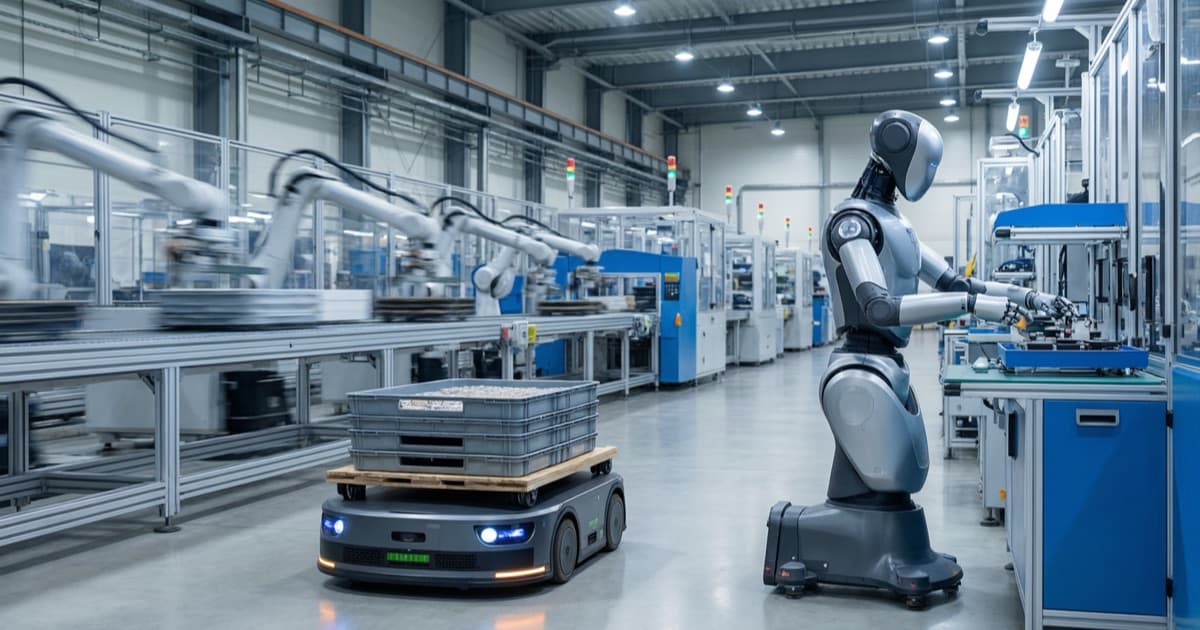
Autonomous forklift robots represent the fastest-growing segment of warehouse automation. While traditional AGVs (Automated Guided Vehicles) have operated in factories for decades, modern autonomous forklift robots — combining LiDAR, SLAM navigation, machine vision, and AI — are capable of operating safely and efficiently in dynamic warehouse environments alongside human workers.
In 2026, the global autonomous forklift market is projected to exceed $6.5 billion, driven by e-commerce growth, labor shortages in logistics, and declining sensor costs. This guide covers everything procurement managers, warehouse operations directors, and automation engineers need to know before investing.
Understanding the Market: AGV vs. AMR Forklifts
Before diving into specific products, it's important to understand the distinction:
AGV Forklifts (Automated Guided Vehicles)
Follow fixed routes using buried wires, magnetic tape, or fixed beacons. Cheaper but inflexible — route changes require physical infrastructure modifications. Best for fixed, high-volume, repetitive routes.
AMR Forklifts (Autonomous Mobile Robots)
Navigate dynamically using onboard sensors and SLAM (Simultaneous Localization and Mapping) technology. Can reroute in real time, avoid obstacles, and adapt to changing layouts. Higher capability, higher price. Now the dominant category for new installations.
Key Capabilities to Evaluate
Navigation System
The brain of any autonomous forklift. Key options:
- LiDAR SLAM: Industry standard. 2D LiDAR for floor-level navigation, 3D LiDAR for obstacle detection above floor level
- Visual SLAM: Camera-based navigation, lower cost but affected by lighting conditions
- Sensor fusion: Combines LiDAR + cameras + IMU for robust performance in varied lighting and floor conditions
- Pre-mapping requirement: Most systems require initial warehouse mapping (4–48 hours depending on size) before operation
Safety System
Autonomous forklifts must meet stringent safety standards:
- EN 1525 (Europe) and ANSI B56.5 (US) for automated guided vehicles
- 3D safety scanners that create protective zones around the vehicle
- Emergency stop systems that meet ISO 13850
- Audible and visual alerts for nearby human workers
- Collision avoidance using predictive path modeling
Lift Height and Capacity
Autonomous forklift configurations:
- Counterbalance forklifts: 1,000–5,000 kg capacity, lift heights to 6–9m
- Reach trucks: 1,200–2,500 kg, lift heights to 10–13m (very common in AMRs)
- Pallet jacks: 1,500–3,000 kg, lift heights to 2–3m (low-level picking)
- Very narrow aisle (VNA) trucks: 1,000–1,500 kg, lift heights to 14–16m
Battery and Charging
- Lithium-ion: Dominant choice for new AMRs. 4–8 hour charge, opportunity charging supported
- Lead-acid: Lower cost, longer charge time, being phased out
- Automated charging: Most AMRs support automatic docking and charging, enabling lights-out operation
- Battery swap: Some systems offer 2-minute battery swap vs. 1–2 hour charging
Top Autonomous Forklift Robot Manufacturers 2026
Seegrid (USA)
Pioneer in autonomous mobile robots for material handling. Strong presence in automotive and e-commerce.
Key models:
- Palion Lift: Autonomous forklift with 3,000 kg capacity, 9m lift height. 3D LiDAR + stereo vision navigation.
- Palion Tow Tractor: Up to 13,600 kg towing capacity
- Price: $85,000–$140,000 depending on configuration
OTTO Motors (Canada, now part of Rockwell Automation)
Backed by Rockwell, OTTO offers a full AMR portfolio including forklifts.
Key models:
- OTTO 1500 Lift: 1,500 kg capacity, 6m lift height
- OTTO 2500: 2,500 kg capacity, 3m lift height
- Price: $70,000–$120,000
Balyo (France)
Develops autonomous driving kits that can be installed on standard Toyota, Linde, and Hangcha forklifts, converting them to AMRs.
Key advantage: Lower cost by using standard lift truck chassis
Price: $35,000–$65,000 (kit + conversion)
Hyster (USA)
Major forklift OEM offering autonomous versions of their popular warehouse trucks.
Key models:
- Hyster Robotics: Available on Rider Stacker, Reach Truck, and Counterbalance platforms
- Price: $65,000–$110,000
Jungheinrich (Germany)
German engineering, strong in the European market.
Key models:
- EKXa: Autonomous narrow-aisle truck, up to 1,600 kg, 16m lift
- EREa: Autonomous end-rider pallet truck, up to 2,500 kg
- Price: $80,000–$150,000
Autonomous Forklift Specs Comparison
| Model | Manufacturer | Type | Capacity | Lift Height | Navigation | Battery | Price (USD) |
|---|---|---|---|---|---|---|---|
| Palion Lift | Seegrid | Counterbalance | 3,000 kg | 9m | LiDAR + Vision | Li-ion | $110,000–$140,000 |
| OTTO 1500 Lift | OTTO Motors | Reach | 1,500 kg | 6m | LiDAR SLAM | Li-ion | $85,000–$105,000 |
| Balyo Kit | Balyo | Various | 1,000–3,000 kg | Various | LiDAR SLAM | Various | $35,000–$65,000 |
| EKXa | Jungheinrich | VNA | 1,600 kg | 16m | LiDAR SLAM | Li-ion | $120,000–$150,000 |
| Hyster Robotics | Hyster | Various | 1,500–4,500 kg | Up to 9m | LiDAR | Li-ion | $75,000–$110,000 |
Warehouse Applications for Autonomous Forklifts
Inbound Pallet Receiving
Autonomous forklifts can continuously unload trucks and place pallets in rack storage, operating 20–22 hours/day with automated charging.
Put-Away and Replenishment
AGVs navigate to rack locations, retrieve pallets, and deliver to picking zones. Can operate in freezer environments (-30°C) with appropriate battery and sensor packages.
Order Picking Support
Autonomous forklifts bring pallets or containers to pick stations, reducing picker walking time by 40–60%.
Outbound Loading
Autonomous forklifts build outbound pallets and load trucks, especially valuable for night shifts with limited staffing.
Cross-Docking
Fast, reliable pallet movement between inbound and outbound docks without human forklift operators.
Pricing Breakdown: Total Cost of Ownership
Single Autonomous Reach Truck (Example: $60,000 FOB Chinese unit to US warehouse)
| Cost Item | Amount |
|---|---|
| Robot FOB (1 unit) | $60,000 |
| Sea freight | $1,500–$2,500 |
| Import duty (HS 8427.90) | $3,000–$5,000 |
| Site survey and mapping | $5,000–$15,000 |
| System integration (WMS/WCS) | $8,000–$25,000 |
| Staff training | $2,000–$4,000 |
| First-year maintenance | $4,000–$6,000 |
| **Total landed cost** | **$83,500–$117,500** |
5-Unit Fleet (Economies of Scale)
| Cost Item (per unit, 5 units) | Amount |
|---|---|
| Robot FOB | $52,000 (volume discount) |
| Installation & integration | $6,000–$10,000 |
| Fleet management software | $3,000–$5,000/year |
| **Total landed cost per unit** | **$61,000–$67,000** |
ROI Analysis: When Does Autonomous Forklift Make Sense?
Break-Even Scenarios
Scenario: High-Volume E-Commerce Warehouse (100,000+ pallets/year)
- Labor savings: $55,000–$75,000/year per driver (fully loaded cost)
- With 2 shifts, one autonomous forklift replaces 1.5 FTE equivalents (lights-out operation)
- 5-year ROI: 180–250%
- Payback period: 18–28 months
Scenario: Mid-Size 3PL Warehouse (30,000 pallets/year)
- Labor savings: $35,000–$50,000/year per driver
- 1 autonomous forklift replaces 0.8 FTE (blended human/robot operation)
- 5-year ROI: 80–120%
- Payback period: 30–45 months
Scenario: Low-Volume Storage Facility (under 10,000 pallets/year)
- Autonomous forklifts unlikely to achieve positive ROI
- Consider semi-automated solutions or AGV if routes are fixed
Pros and Cons of Autonomous Forklift Robots
Advantages
- Continuous operation: 20+ hours/day vs. 6–8 hours human shift coverage
- Consistent throughput: No fatigue, breaks, or shift change slowdowns
- Labor cost savings: Particularly impactful in high-wage markets ($25+/hour)
- Safety improvement: No human forklift accidents from fatigue or error
- Data and traceability: Every pallet movement logged with timestamp and location
- Scalability: Add robots without hiring, training, or managing more people
- Cold storage suitability: Operates in -30°C freezers without heated cabs
Disadvantages
- High upfront capital: $45,000–$150,000 per unit vs. $20,000–$35,000 for conventional forklift
- Infrastructure requirements: May need facility modifications (floor marking, rack alignment, Wi-Fi)
- Not fully lights-out initially: Setup and exception handling require human oversight
- Limited flexibility for unusual loads: Custom pallets, odd shapes may require human assistance
- Integration complexity: Connecting to WMS systems is non-trivial
- Space requirements: May need wider aisles than human-operated narrow-aisle trucks
Implementation Guide
Phase 1: Assessment (2–4 weeks)
- Warehouse layout mapping and measurement
- Pallet flow analysis and peak volume identification
- Infrastructure assessment (floor flatness, rack condition, Wi-Fi coverage)
- Identify top 3–5 applications for autonomous forklifts
Phase 2: Pilot (4–8 weeks)
- Deploy 1–2 units in controlled application
- Map facility and configure routes
- Test with representative pallet mix
- Measure baseline performance (throughput, accuracy, uptime)
- Tune and optimize
Phase 3: Fleet Expansion (8–16 weeks)
- Scale to full fleet based on pilot results
- Implement fleet management software
- Integrate with WMS
- Train operations team
- Go live with full autonomous operations
Frequently Asked Questions
How accurate are autonomous forklifts at placing pallets in racks?
Modern AMRs achieve horizontal positioning accuracy of ±10–20mm and vertical accuracy of ±5–10mm at height, sufficient for standard pallet rack placement. Some high-precision models achieve ±5mm accuracy for very narrow aisles.
Can autonomous forklifts work in existing racks without modifications?
Generally yes, but standard rack specifications help. Beam clearances should be adequate for truck width. Floor should be clean and reasonably flat. Some VNA applications require precision rack guiding.
What happens if the robot encounters an obstacle it cannot navigate around?
Quality AMRs will stop, reassess, and attempt an alternative route. If no route is found, the robot alerts the operator via dashboard and waits for clearance — the design intent is to stop rather than risk contact.
Do autonomous forklifts need special floor markings or infrastructure?
No magnetic tape or wires needed for SLAM-based AMRs. However, reflective targets at known positions can improve mapping accuracy. Floor should be clean, with painted aisle markings helpful for visual landmarks.
How do autonomous forklifts handle freezer environments?
Many AMRs offer cold-storage packages with insulated battery enclosures, heated sensors, and special lubricants. Operating in -30°C environments is now standard capability from major vendors. Cold storage operation may reduce battery efficiency by 15–25%.
What WMS systems do autonomous forklifts integrate with?
Most vendors offer pre-built connectors for major WMS platforms including Manhattan Associates, Blue Yonder (JDA), SAP EWM, Oracle WMS, and Zetes. Custom API integration is available for proprietary systems.
What is the typical fleet size for a large warehouse?
E-commerce fulfillment centers typically deploy 20–100 autonomous forklifts. Large automotive plants may operate 50–200+. Most operations see optimal results with 5–20 units before requiring dedicated fleet management.
Conclusion
Autonomous forklift robots have crossed the threshold from experimental to practical for mid-to-large warehouse operations. With compelling ROI in high-wage markets and proven technology from established vendors, 2026 is an excellent time to evaluate autonomous forklifts for your warehouse.
Start with a pilot in your highest-volume application, measure carefully, and scale based on results.