The terms AMR and AGV are often used interchangeably by vendors, which creates real confusion for buyers trying to evaluate warehouse automation options. They are not the same technology. They solve different problems, at different costs, with different flexibility profiles. Getting the distinction wrong can result in a six-figure investment that solves the wrong problem.
What Is an AGV?
An Automated Guided Vehicle (AGV) follows a fixed path defined by physical infrastructure — magnetic tape on the floor, wire loops embedded in concrete, or reflective strips that laser sensors track. The AGV cannot deviate from this path. If an obstacle appears, it stops and waits for the obstruction to clear.
Defining characteristics:
- Fixed navigation routes
- Requires physical infrastructure installation
- Low software complexity
- High reliability for predictable routes
- Cannot adapt to layout changes without physical reconfiguration
Typical cost: $30,000–$80,000 per unit for standard load carriers. Heavy-duty tugger AGVs: $80,000–$150,000.
What Is an AMR?
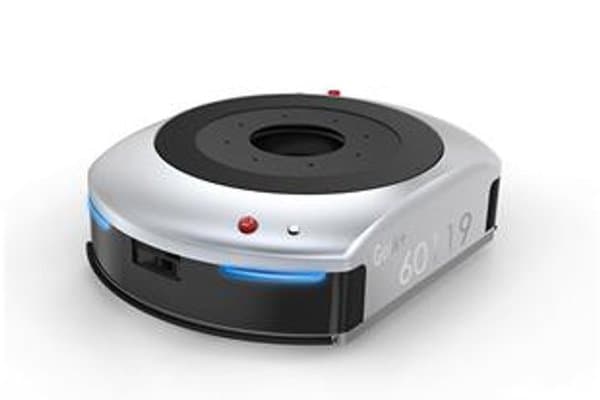
An Autonomous Mobile Robot (AMR) uses onboard sensors — LiDAR, cameras, ultrasonic — plus real-time mapping software to navigate its environment dynamically. It builds a map of the facility, plans its own routes, and reroutes around obstacles without stopping.
Defining characteristics:
- Dynamic route planning
- No floor infrastructure required
- Higher software complexity
- Adapts to layout changes via software update
- Can be redeployed to different facilities more easily
Typical cost: $40,000–$100,000 per unit for goods-to-person models. Heavy payload AMRs: $100,000–$200,000.
Head-to-Head Comparison
| Factor | AGV | AMR |
|---|---|---|
| Navigation method | Fixed tape/wire/reflectors | Dynamic SLAM mapping |
| Infrastructure needed | Yes (tape, wire, or markers) | No |
| Obstacle response | Stop and wait | Reroute autonomously |
| Flexibility | Low (requires reconfiguration) | High (software update) |
| Speed | 0.5–1.5 m/s typical | 0.5–2.0 m/s typical |
| Payload capacity | Up to 10,000 kg (heavy AGV) | Typically up to 1,500 kg |
| Fleet management software | Basic (route-based) | Advanced (AI optimization) |
| Upfront cost | Lower | Higher |
| Maintenance complexity | Low | Medium |
| ROI timeline | 2–4 years | 1.5–3 years |
| Best fit | Predictable, repetitive routes | Dynamic environments |
When to Choose an AGV
AGVs remain the right choice in specific scenarios:
Highly predictable routes: If materials always move from Point A to Point B on the same path, an AGV's simplicity is an advantage, not a limitation. Manufacturing lines that run the same product mix for years benefit from AGV stability.
Heavy payloads: AGVs can handle loads from 500 kg to 10,000 kg — ranges that exceed most AMR capabilities. Automotive stamping facilities, steel warehouses, and paper mills regularly use heavy-duty AGVs.
Budget constraints: The lower software overhead and simpler hardware make AGVs 20–30% cheaper than equivalent AMRs for simple transport tasks.
Facilities with established infrastructure: If your facility already has magnetic tape guidance from a previous automation generation, upgrading AGVs is often more economical than ripping out infrastructure for AMR deployment.
When to Choose an AMR
Dynamic environments: E-commerce distribution centers, retail backrooms, and facilities that frequently change layout or SKU mix. AMRs adapt to these changes via software; AGVs require physical reconfiguration.
Shared human-robot spaces: AMRs' dynamic obstacle avoidance makes them significantly safer in environments where workers move unpredictably. This is the primary reason e-commerce adoption has shifted sharply toward AMRs.
Multi-facility operations: A fleet of AMRs can be redeployed between facilities with minimal reconfiguration. AGVs are essentially fixed assets of the specific facility they're installed in.
Scalability: AMR fleets scale by adding units to the software platform. AGV scaling often requires infrastructure extension.
Real Deployment Data
Locus Robotics recently completed the one billionth pick in DHL Supply Chain operations using a fleet of AMRs — a milestone that represents roughly 50,000 robot-hours of operation. DHL has expanded their global partnership with Locus to deploy 5,000 units across their network.
At MODEX 2026, OMRON showcased the OL-450S AMR designed specifically for autonomous cart transport in hybrid human-robot warehouse environments. An OTTO AMR deployment at a major automotive OEM delivered a 20% production rate increase, cited as among the strongest single-facility ROI results reported in 2026.
Total Cost of Ownership Analysis (5 Years, Fleet of 10 Units)
AGV Fleet (10 units, simple transport task)
- Hardware: $500,000 ($50,000/unit)
- Infrastructure installation: $80,000
- Software/WMS integration: $30,000
- Annual maintenance: $20,000/year
- 5-year TCO: $710,000
AMR Fleet (10 units, equivalent task)
- Hardware: $700,000 ($70,000/unit)
- Software/fleet management: $50,000
- WMS integration: $40,000
- Annual maintenance: $25,000/year
- 5-year TCO: $915,000
The AGV fleet is cheaper over 5 years in this scenario — but the AMR fleet can be redeployed if the facility changes layout, handles exceptions without stopping, and requires no floor infrastructure investment. The calculus changes significantly in dynamic environments.
For further ROI modeling, use the robot ROI calculator.
The Hybrid Approach
Many large warehouses use both. Fixed transport corridors where predictability is high get AGVs. Variable picking aisles and goods-to-person areas get AMRs. This isn't fence-sitting — it's rational optimization of each technology's strengths.
Leading Manufacturers in 2026
AMR leaders: MiR (Mobile Industrial Robots, owned by Teradyne), Locus Robotics, 6 River Systems, Geek+, Hai Robotics, Quicktron
AGV leaders: Dematic, JBT Corporation, Seegrid, Elettric80, VisionNav
For pricing and sourcing comparison, visit the warehouse robot category.
Frequently Asked Questions
Q: Can AMRs work in cold storage environments?
Yes. Several manufacturers offer cold storage variants rated to -25°C. Battery performance and sensor reliability are the primary challenges at low temperatures; check manufacturer specifications for specific temperature ratings.
Q: What is the minimum facility size for AMR deployment?
AmR deployments have been successful in facilities as small as 5,000 square feet. The economics improve significantly above 50,000 square feet where route optimization generates meaningful savings.
Q: How long does an AMR fleet take to deploy?
Small deployments (5–10 units): 8–12 weeks from contract to operation. Enterprise deployments (50+ units): 6–12 months.
Q: Do AMRs work with existing WMS systems?
All major AMR platforms offer pre-built integrations with SAP, Oracle WMS, Manhattan Associates, and Blue Yonder. Custom integrations via REST API are available for proprietary systems, typically adding 4–8 weeks to deployment.