Buying AMRs is the easy part. Managing a fleet of 20, 50, or 200 autonomous mobile robots across a large distribution center — coordinating routes, managing charging cycles, allocating tasks, handling traffic conflicts, and integrating with WMS and ERP systems — is where most warehouse automation projects succeed or struggle.
Fleet management software (FMS) is what makes AMR fleets work at scale. This guide covers the software landscape, key capabilities, integration requirements, and how to evaluate the ROI of fleet optimization.
What AMR Fleet Management Software Actually Does
A fleet management system performs several functions simultaneously:
Traffic management: Routes multiple robots through shared spaces without collisions or deadlocks. At fleet sizes above 10 robots, manual route management is impossible — the FMS handles real-time conflict resolution.
Task allocation: Assigns incoming tasks (pick requests, material movements, charging orders) to the optimal available robot based on position, charge level, current task queue, and priority.
Charging optimization: Ensures robots charge proactively (returning to charging stations before battery depletes) while maintaining throughput. Poor charging management is one of the most common causes of underperforming AMR deployments.
Performance analytics: Tracks KPIs (picks per hour, utilization rate, wait time, distance traveled) that identify bottlenecks and optimization opportunities.
WMS integration: Connects AMR operations to warehouse management systems so picks are driven by actual warehouse orders rather than manual task assignment.
Fleet Management Software Landscape 2026
Proprietary FMS (Built into AMR Brand)
Most major AMR manufacturers include their own FMS:
MiR Fleet (Mobile Industrial Robots):
Handles MiR robot fleets up to 100+ units. Strong traffic management, good reporting. Limited to MiR robots — cannot manage robots from other brands.
Locus LocusONE:
Locus's warehouse execution platform. Handles multi-bot coordination, warehouse-specific task logic. Tightly integrated with Locus robots. Reference deployments at DHL show 30–180% productivity improvement.
Geek+ Robotic Engine:
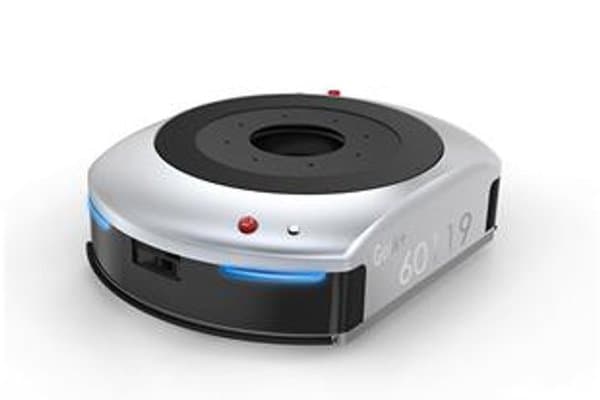
AI-based fleet coordination with cloud analytics. Strengths in high-density environments (goods-to-person picking). Limited to Geek+ ecosystem.
Advantages of proprietary FMS: Simpler integration, vendor support, optimized for specific robot types.
Disadvantages: Robot brand lock-in; if you add a second robot brand, you need a separate FMS or a multi-vendor platform.
Multi-Brand FMS Platforms
For facilities using multiple AMR brands, or those wanting vendor flexibility:
Fetch Robotics / Zebra (Fetch.ai):
Zebra Technologies acquired Fetch Robotics and is integrating its software platform with broader Zebra warehouse management tools. Supports multiple robot brands through standardized APIs.
Interoperability standards (VDA 5050):
The VDA 5050 interface standard, developed by the German automotive industry, enables multi-brand robot coordination on a common FMS platform. Adoption is growing rapidly — most European AMR manufacturers support it; North American adoption is increasing.
OSARO, RoboDNA, and similar:
Third-party FMS platforms designed for multi-brand environments. Higher integration cost but maximum flexibility.
Advantages: Robot brand flexibility, potentially better negotiating position with AMR suppliers, future-proofing against single-vendor dependency.
Disadvantages: Higher integration complexity and cost; performance may be slightly below tightly integrated proprietary platforms.
Key AMR Fleet KPIs
| KPI | Description | Target Range |
|---|---|---|
| Robot utilization rate | % of operating time spent on productive tasks | 75–90% |
| Picks per hour (PPH) | For picking applications | Varies by application; track vs. baseline |
| Charge cycle efficiency | Avg. charge level when returning to station | 25–40% remaining |
| Traffic wait time | Avg. time robots wait due to traffic conflicts | <3% of operating time |
| Task assignment latency | Time from task creation to robot assignment | <30 seconds |
| Fleet availability | % of fleet operational at any given time | >95% |
Utilization below 70% typically indicates FMS configuration issues — robots waiting unnecessarily for task assignments or stuck in traffic. Utilization above 92% often means the fleet is undersized for demand peaks.
Traffic Optimization Techniques
Zone segmentation: Divide the warehouse into traffic zones with controlled entry/exit. Limits the number of robots that can enter any given aisle simultaneously, preventing deadlocks.
Bidirectional vs. unidirectional aisles: Unidirectional aisle configurations (robots always travel in one direction in a given aisle) reduce traffic conflicts at the cost of some flexibility. Most large deployments use unidirectional configurations.
Dynamic speed control: FMS reduces robot speed in high-traffic areas and near intersections, increasing throughput by reducing collision events and the associated recovery time.
Predictive charging: FMS predicts when robots will need charging based on current task queue and routes them to charging stations proactively, avoiding unplanned mid-task battery depletion.
WMS Integration Architecture
The typical integration architecture:
```
ERP (SAP, Oracle) → WMS (Manhattan, Blue Yonder) → FMS → AMR Fleet
```
WMS provides task priorities and warehouse logic; FMS translates these into robot task assignments and routes. The WMS-FMS interface is typically via REST API or a message queue (MQTT, RabbitMQ).
Integration complexity and cost vary significantly:
- Simple WMS with standard APIs: $20,000–$40,000 integration
- Complex multi-system integration (ERP + WMS + FMS + MES): $60,000–$150,000
- Custom legacy WMS without APIs: $80,000–$200,000+
ROI of Fleet Optimization
The difference between well-optimized and poorly optimized AMR fleets is significant:
| Metric | Poor Optimization | Good Optimization | Difference |
|---|---|---|---|
| Robot utilization | 55% | 82% | +49% throughput |
| Picks per hour | 65 | 98 | +51% |
| Fleet size for same throughput | 20 robots | 13 robots | -35% CapEx |
| Annual labor saving | $480,000 | $720,000 | +50% |
Source: Compiled from operator data at 3+ distribution center deployments.
The ROI of proper fleet management software often exceeds the ROI of adding more robots — optimizing what you have is typically cheaper than buying capacity.
For the AMR category guide, or to understand total warehouse automation cost, see our Warehouse Robot Guide.
Frequently Asked Questions
Q: How many AMRs do you need before fleet management software matters?
Fleet management software is valuable from the first robot but becomes critical at 5+ robots. Below 5, manual task assignment and simple traffic rules may suffice. At 10+ robots, proper FMS is mandatory for safe, efficient operation.
Q: What does AMR fleet management software cost?
Proprietary FMS bundled with AMR purchases is typically included or has a $5,000–$15,000/year maintenance cost. Third-party enterprise FMS platforms cost $30,000–$100,000 in implementation plus $10,000–$30,000/year licensing. WMS integration adds $20,000–$150,000 depending on complexity.
Q: What is VDA 5050 and why does it matter?
VDA 5050 is an open interface standard that allows AMRs from different manufacturers to be managed on the same FMS platform. It matters for facilities that use or plan to use AMRs from multiple vendors. It reduces vendor lock-in and simplifies multi-brand deployments. Support is mandatory for many European enterprise procurement requirements.
Q: How long does AMR fleet deployment take?
A typical mid-scale deployment (20–50 robots): 8–16 weeks from hardware delivery to full production. Includes site mapping, FMS configuration, WMS integration, traffic optimization, and operator training. Larger deployments (100+ robots) require 6–18 months of phased deployment.