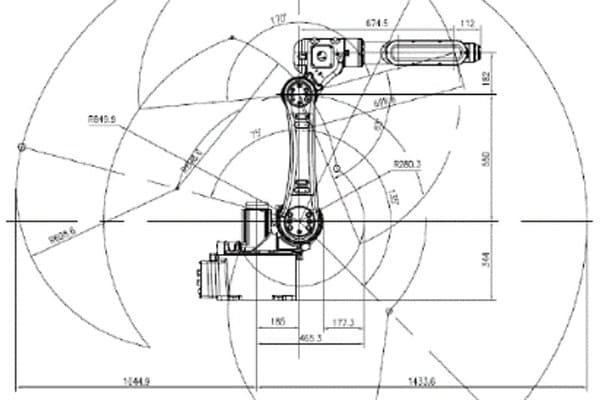
Welding robots represent the largest application segment of industrial robotics, and China is both the biggest market and a rapidly growing manufacturer. Chinese welding robots from Estun, EFORT, and Siasun offer 40-60% cost savings vs FANUC, ABB, and KUKA, with increasingly competitive quality.
Welding Robot Types and Pricing
Arc Welding Robots (MIG/MAG/TIG)
| Payload Class | Application | China Price | Japan/Europe Price |
|---|---|---|---|
| 3-6 kg | Light fabrication, sheet metal | $12,000 - $20,000 | $35,000 - $55,000 |
| 6-10 kg | Medium fabrication, structural | $15,000 - $28,000 | $40,000 - $65,000 |
| 10-20 kg | Heavy fabrication, thick plate | $20,000 - $35,000 | $50,000 - $80,000 |
Spot Welding Robots
| Payload Class | Application | China Price | Japan/Europe Price |
|---|---|---|---|
| 80-120 kg | Automotive BIW (Body-in-White) | $30,000 - $50,000 | $70,000 - $120,000 |
| 120-200 kg | Heavy spot welding | $40,000 - $70,000 | $90,000 - $150,000 |
Complete Welding Cell Pricing
A complete welding cell includes the robot, welding power source, positioner, torch, wire feeder, and safety equipment.
| Configuration | China | Japan/Europe |
|---|---|---|
| Single robot + positioner (MIG) | $25,000 - $50,000 | $70,000 - $130,000 |
| Dual robot + dual positioner | $60,000 - $120,000 | $150,000 - $280,000 |
| Spot welding cell (automotive) | $50,000 - $90,000 | $120,000 - $200,000 |
Top Chinese Welding Robot Manufacturers
Estun (埃斯顿)
- Specialty: Arc welding, acquired German welding specialist Cloos
- Key models: ER6-1400-HW, ER6-1600-HW (hollow wrist for cable routing)
- Strength: Cloos welding expertise integrated into Chinese manufacturing cost structure
EFORT (埃夫特)
- Specialty: Automotive spot welding, acquired Italian robot maker Evolut
- Key models: QJR6-1450-HW, QJR165-2650
- Strength: Proven in Chinese automotive OEM factories
Panasonic Robot & Welding (China)
- Note: Panasonic manufactures welding robots in China (Tangshan factory)
- Key models: TAWERS TM-1800WG3, TM-1400WG3
- Strength: Integrated robot + welding power source, seamless arc control
Welding Quality Considerations
What Makes a Good Welding Robot
- Path accuracy — ±0.05 mm or better for consistent weld quality
- Hollow wrist — Routes torch cables internally, prevents cable interference
- Arc sensing — Real-time seam tracking during welding
- Integrated welding control — Robot controller communicates directly with power source
- Thermal stability — Maintains accuracy during multi-hour production runs
Chinese vs Japanese/European Welding Robots
| Aspect | Chinese | Japanese/European |
|---|---|---|
| Path accuracy | ±0.05-0.08 mm | ±0.02-0.05 mm |
| Arc stability | Good (improving) | Excellent |
| Hollow wrist | Available on premium models | Standard |
| Software features | Basic to good | Advanced (multi-layer, adaptive fill) |
| Reliability (MTBF) | 25,000+ hours | 35,000+ hours |
| Best for | Standard MIG/MAG welding | High-precision TIG, multi-pass |
Sourcing Tips
- Always request weld samples — Send your parts or drawings for trial welding
- Check the welding power source — Fronius, Lincoln, or Miller sources are preferred even with Chinese robots
- Inspect cable dress — Poor cable routing causes 80% of torch maintenance issues
- Verify offline programming — Ensure the robot supports major offline programming software
- Plan for fixtures — Welding fixture quality matters as much as robot quality
Frequently Asked Questions
Can Chinese welding robots match FANUC quality?
For standard MIG/MAG welding of carbon steel and stainless steel, top Chinese brands deliver comparable results. For critical TIG welding on thin materials or aerospace applications, FANUC and ABB maintain an edge in arc control algorithms.
Should I buy the welding power source from the same manufacturer?
Not necessarily. Many factories pair Chinese robots with premium welding sources (Fronius TPS/i, Lincoln PowerWave) for the best combination of cost and quality. GrabaRobot can source complete cells with mixed-brand components.
What is the ROI for a welding robot?
A single welding robot typically replaces 2-3 manual welders and achieves payback in 12-18 months in high-labor-cost countries. In lower-cost markets, payback is typically 18-30 months.