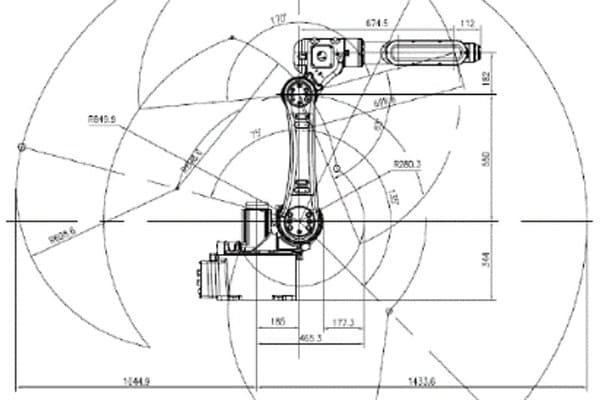
Welding robots are one of the fastest-growing segments in industrial automation. With labor shortages driving manufacturers to automate, the first question is always: how much does a welding robot cost?
The answer depends heavily on where you source. A Chinese welding robot from Estun or STEP costs $15,000 – $30,000 for the robot arm alone, while a comparable FANUC or ABB unit runs $45,000 – $80,000. But the robot arm is only part of the picture — a complete welding cell with positioners, torch, wire feeder, and integration can run $40,000 – $200,000+.
This guide breaks down every cost component so you can budget accurately.
Welding Robot Cost Summary
| Component | Chinese Brand | Japanese/European Brand |
|---|---|---|
| Robot arm (6-axis) | $15,000 – $30,000 | $45,000 – $80,000 |
| Welding power source | $3,000 – $8,000 | $8,000 – $20,000 |
| Welding torch (robot) | $1,500 – $3,000 | $3,000 – $6,000 |
| Wire feeder | $800 – $1,500 | $1,500 – $3,000 |
| Positioner (1-axis) | $3,000 – $6,000 | $8,000 – $15,000 |
| Positioner (2-axis) | $6,000 – $12,000 | $15,000 – $30,000 |
| Safety fencing | $2,000 – $4,000 | $3,000 – $6,000 |
| Integration / programming | $5,000 – $15,000 | $15,000 – $40,000 |
| **Complete cell total** | **$35,000 – $80,000** | **$100,000 – $200,000** |
Robot Arm Pricing by Brand
Chinese Welding Robot Brands
| Brand | Popular Model | Payload | Reach | Price (FOB) | Weld Types |
|---|---|---|---|---|---|
| Estun | ER20-1780 | 20 kg | 1,780 mm | $15,000 – $22,000 | MIG, TIG, Spot |
| STEP | SD20-1780 | 20 kg | 1,780 mm | $14,000 – $20,000 | MIG, TIG |
| EFORT | QJR20-1 | 20 kg | 1,750 mm | $16,000 – $24,000 | MIG, TIG, Laser |
| GSK | RB20 | 20 kg | 1,800 mm | $12,000 – $18,000 | MIG, TIG |
| SIASUN | SR20C | 20 kg | 1,750 mm | $18,000 – $28,000 | MIG, TIG, Spot |
| Han's Robot | Elfin W | 12 kg | 1,300 mm | $20,000 – $30,000 | Collaborative welding |
Global Brand Comparison
| Brand | Popular Model | Payload | Reach | Price | Origin |
|---|---|---|---|---|---|
| FANUC | ARC Mate 100iD | 12 kg | 1,437 mm | $45,000 – $60,000 | Japan |
| ABB | IRB 1520 | 4 kg | 1,500 mm | $40,000 – $55,000 | Sweden |
| KUKA | KR CYBERTECH | 20 kg | 1,813 mm | $45,000 – $65,000 | Germany |
| Yaskawa | AR2010 | 12 kg | 2,010 mm | $40,000 – $55,000 | Japan |
| OTC/Daihen | FD-B20 | 20 kg | 1,720 mm | $35,000 – $50,000 | Japan |
Complete Welding Cell Cost Breakdown
A welding robot alone cannot weld. You need a complete welding cell. Here is what a typical cell includes and costs.
Budget Cell — $35,000 – $50,000 (Chinese)
Suitable for small to medium manufacturers doing repetitive MIG welding on simple parts.
| Component | Cost |
|---|---|
| Estun ER20-1780 robot arm | $18,000 |
| Megmeet welding power source | $4,000 |
| Binzel-compatible robot torch | $2,000 |
| Wire feeder system | $1,000 |
| Single-axis positioner | $4,000 |
| Safety fencing and curtains | $2,500 |
| Programming and integration | $5,000 |
| Shipping (FOB to US) | $2,000 |
| **Total** | **$38,500** |
Mid-Range Cell — $60,000 – $90,000 (Chinese, Full-Featured)
For manufacturers needing multi-position welding, seam tracking, and higher throughput.
| Component | Cost |
|---|---|
| Estun or EFORT 20kg robot | $22,000 |
| Fronius or Lincoln power source | $10,000 |
| Robot welding torch with TCP | $3,000 |
| Wire feeder with buffer | $1,500 |
| 2-axis positioner (H-frame) | $10,000 |
| Laser seam tracking system | $8,000 |
| Safety system (light curtains) | $3,500 |
| Offline programming software | $3,000 |
| Integration and commissioning | $10,000 |
| Shipping and customs | $3,000 |
| **Total** | **$74,000** |
Premium Cell — $120,000 – $200,000 (Japanese/European)
| Component | Cost |
|---|---|
| FANUC ARC Mate robot | $55,000 |
| Lincoln or Fronius power source | $15,000 |
| FANUC-integrated torch | $5,000 |
| Wire feeder | $2,500 |
| 2-axis servo positioner | $25,000 |
| Servo Robot seam tracking | $15,000 |
| Safety system | $5,000 |
| ROBOGUIDE offline software | $5,000 |
| System integration | $30,000 |
| **Total** | **$157,500** |
Welding Robot ROI Analysis
The ROI case for welding robots is straightforward: one robot replaces 2–3 welders, works 20+ hours/day, and produces more consistent quality.
Cost Comparison: Robot vs Manual Welder
| Factor | Manual Welder | Welding Robot |
|---|---|---|
| Annual labor cost | $50,000 – $75,000 | N/A |
| Working hours / day | 6–8 effective | 20+ (with breaks for loading) |
| Arc-on time | 20–30% | 60–80% |
| Defect rate | 5–15% | 1–3% |
| Material waste | Higher (rework) | Lower |
| Workers replaced | — | 2–3 welders |
Payback Period Calculation
Scenario: Small manufacturer, 2 welders at $55,000/year each, switching to a Chinese welding robot cell.
| Item | Value |
|---|---|
| Current annual welding labor | $110,000 |
| Robot cell cost (mid-range Chinese) | $74,000 |
| Annual robot operating cost | $8,000 (maintenance, wire, gas, power) |
| Annual savings | $110,000 - $8,000 = $102,000 |
| **Payback period** | **~9 months** |
Even with the premium Japanese/European cell at $157,500, payback is under 2 years.
Chinese vs Japanese Welding Robots: Honest Comparison
Chinese welding robots have improved dramatically since 2020, but differences remain.
Where Chinese Brands Excel
- Price: 50–70% cheaper for comparable specifications
- Customization: Chinese integrators are more flexible with custom cell designs
- Delivery time: 4–8 weeks vs 12–20 weeks for Japanese brands
- Basic welding tasks: For straightforward MIG/MAG welding, performance is comparable
Where Japanese/European Brands Still Lead
- Path accuracy: FANUC and Yaskawa achieve ±0.02 mm vs ±0.05–0.08 mm for Chinese brands
- Software ecosystem: More mature offline programming, simulation, and industry-specific packages
- Reliability data: 80,000+ hour MTBF vs 30,000–50,000 hours for Chinese brands
- Service network: Global service centers vs reliance on distributors
- Complex welding: Multi-pass thick plate, aerospace-grade TIG — Japanese still dominates
Recommendation
Use Chinese: For standard MIG welding of steel/aluminum parts, repetitive tasks, budget-conscious operations, and where ±0.05 mm path accuracy is acceptable.
Use Japanese/European: For aerospace, automotive Tier 1 suppliers, critical safety welds, and when you need guaranteed uptime with local service.
Top Chinese Welding Robot Manufacturers
Estun (南京埃斯顿)
- Market leader in Chinese welding robots
- Acquired Cloos (German welding specialist) in 2019
- Best balance of price and quality
- Strong integrator network
STEP (时代科技)
- Known for value pricing
- Popular in small/medium Chinese factories
- Growing international presence
EFORT (埃夫特)
- Invested heavily in welding-specific R&D
- Laser welding capabilities
- Mid-range positioning
Browse Welding Robots on GrabaRobot
GrabaRobot lists welding robots from Estun, STEP, EFORT, SIASUN, and other Chinese manufacturers. Compare models, view detailed specifications, and request factory-direct quotes.
Need a complete welding cell quote? Tell us your welding requirements and we will connect you with qualified integrators.
Frequently Asked Questions
How much does a welding robot cost?
A welding robot arm alone costs $15,000 – $30,000 (Chinese) or $40,000 – $80,000 (Japanese/European). A complete welding cell with positioner, power source, and integration runs $35,000 – $200,000.
What is the cheapest welding robot?
GSK (Guangzhou CNC) offers welding robot arms starting around $12,000 FOB China. A complete budget welding cell from Chinese manufacturers starts at approximately $35,000.
How fast is the ROI on a welding robot?
Most manufacturers see payback in 6–18 months when replacing 2+ manual welders. The exact timeline depends on your labor costs and production volume.
Can a welding robot do TIG welding?
Yes. Most 6-axis welding robots support MIG, TIG, spot welding, and laser welding with the appropriate torch and power source. TIG welding robots require higher path accuracy.
Do I need a robot integrator?
For most applications, yes. While the robot arm is standard, the welding cell (positioner, fixtures, safety, programming) needs to be designed for your specific parts. Chinese integrators typically charge $5,000 – $15,000 for integration.