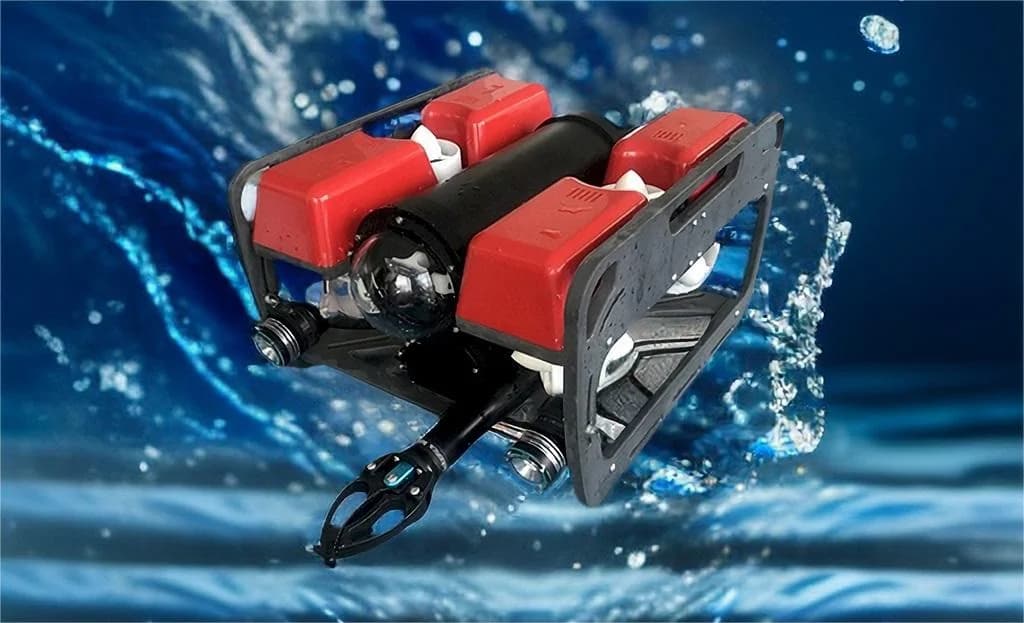
Underwater drones — also known as remotely operated vehicles (ROVs) — have become accessible tools for a wide range of industries and applications. What was once limited to oil companies with million-dollar budgets is now available to aquaculture farms, inspection firms, filmmakers, and even hobbyists thanks to Chinese manufacturers who have driven prices down dramatically.
This guide covers the full spectrum of underwater drones, from $1,500 consumer models to $100,000+ professional ROVs, with a focus on Chinese brands that offer the best value in 2026.
Underwater Drone Categories
Consumer Underwater Drones ($1,500–$5,000)
Consumer models are designed for recreational diving, fishing, underwater photography, and light-duty inspection. They are compact, easy to use, and require no specialized training.
| Typical Specs | Range |
|---|---|
| Depth rating | 50–150 m |
| Camera | 4K, 12MP photo |
| Battery life | 1–3 hours |
| Thrusters | 4–6 |
| Tether length | 100–200 m |
| Weight | 3–6 kg |
| Manipulator arm | No |
Best for: Hobbyists, fishermen (fish finding), yacht owners, shallow water filming, basic hull inspections.
Prosumer Underwater Drones ($5,000–$25,000)
Prosumer models bridge the gap between recreational toys and professional tools. They offer better cameras, more power, deeper ratings, and optional accessories like robotic arms and additional sensors.
| Typical Specs | Range |
|---|---|
| Depth rating | 150–350 m |
| Camera | 4K 60fps, 20MP+, low-light optimized |
| Battery life | 2–5 hours |
| Thrusters | 6–8 |
| Tether length | 200–500 m |
| Weight | 6–15 kg |
| Manipulator arm | Optional |
| Additional sensors | Optional (sonar, DVL, USBL) |
Best for: Aquaculture, search and rescue, filmmaking, infrastructure pre-inspection, marine research, small inspection businesses.
Professional ROVs ($25,000–$100,000+)
Professional ROVs are ruggedized systems designed for commercial inspection, survey, and light intervention work.
| Typical Specs | Range |
|---|---|
| Depth rating | 300–1,000+ m |
| Camera | 4K+ with pan/tilt, scaling lasers |
| Battery/Power | Topside power supply (unlimited runtime) |
| Thrusters | 6–8 vectored |
| Tether | Fiber-optic, 500–3,000+ m |
| Weight | 15–100+ kg |
| Manipulator arm | Yes (1–2 arms) |
| Sensors | Multibeam sonar, DVL, USBL, CP probe, UT gauge |
Best for: Oil and gas inspection, subsea pipeline survey, dam inspection, offshore wind farm maintenance, port and harbor security, scientific research.
Pricing by Model
Chinese Brands
| Brand | Model | Depth | Key Features | Price |
|---|---|---|---|---|
| Chasing | M2 | 100 m | 4K, 8 thrusters, modular | $2,000–$3,000 |
| Chasing | M2 Pro | 150 m | 4K, EIS, 200m tether | $3,000–$4,500 |
| Chasing | M2 Pro Max | 200 m | 4K, detachable battery | $4,000–$5,500 |
| QYSEA | Fifish V6 | 100 m | 4K, 6 DOF, compact | $2,500–$3,500 |
| QYSEA | Fifish V6 Expert | 150 m | 4K, modular accessories | $4,000–$6,000 |
| QYSEA | Fifish V-EVO | 100 m | AI vision, 4K 60fps | $3,000–$4,500 |
| QYSEA | Fifish Pro W6 | 350 m | Professional, robotic arm | $15,000–$25,000 |
| Geneinno | Titan | 150 m | 4K, 6 thrusters | $2,000–$3,500 |
| Geneinno | T1 Pro | 200 m | Modular, interchangeable cameras | $4,000–$6,500 |
| CHZING | Swordfish-MAX | 300 m | Pro inspection, sonar | $12,000–$20,000 |
| Shenzhen Vxfly | Deep Pro | 500 m | Professional survey ROV | $25,000–$50,000 |
Western Brands (for Comparison)
| Brand | Model | Depth | Price |
|---|---|---|---|
| Blue Robotics | BlueROV2 | 100–300 m | $5,000–$10,000 |
| Blue Robotics | BlueROV2 Heavy | 300 m | $8,000–$15,000 |
| Deep Trekker | DTG3 | 200 m | $10,000–$20,000 |
| Deep Trekker | Revolution | 305 m | $20,000–$35,000 |
| VideoRay | Mission Specialist | 305–1,000 m | $50,000–$150,000 |
| Saab Seaeye | Falcon | 300–1,000 m | $80,000–$250,000 |
Price Comparison Summary
| Category | Chinese Brands | Western Brands | Savings |
|---|---|---|---|
| Consumer (100m) | $1,500–$3,500 | $3,000–$6,000 | 40–50% |
| Prosumer (150–350m) | $4,000–$25,000 | $8,000–$35,000 | 40–50% |
| Professional (300m+) | $25,000–$80,000 | $50,000–$250,000 | 50–70% |
Chinese Brand Deep Dive
Chasing Innovation (Shenzhen)
Chasing is the leading Chinese consumer/prosumer underwater drone brand, having shipped tens of thousands of units globally.
Strengths:
- Excellent build quality and reliability
- Strong modular accessory ecosystem (robotic claw, laser scaler, external camera, GPS)
- Good customer support with global distribution
- Active user community
Product range: M2 series from $2,000 to $5,500, covering the consumer to prosumer segment.
QYSEA (Shenzhen)
QYSEA is Chasing's primary competitor and has earned a reputation for innovative design and strong underwater performance.
Strengths:
- Unique 6-degrees-of-freedom movement (omnidirectional)
- Compact, hydrodynamic design
- AI-powered underwater vision and tracking
- Professional W6 model with robotic arm for commercial applications
Product range: Fifish V6 series ($2,500–$6,000) for consumer/prosumer, W6 ($15,000–$25,000) for professional use.
Geneinno (Shenzhen)
Geneinno focuses on the mid-range market with competitively priced models.
Strengths:
- Affordable entry point
- Modular design with interchangeable components
- Decent camera quality
Product range: Titan and T1 series from $2,000 to $6,500.
BlueROV2 (Blue Robotics, US) — The Open-Source Option
While not Chinese, the BlueROV2 deserves mention as it is the most popular open-source ROV platform. Many Chinese manufacturers offer compatible accessories and components, and it can be customized extensively. It occupies the mid-point between Chinese prosumer drones and professional Western ROVs.
Comparison Table: Top Models
| Feature | Chasing M2 Pro | QYSEA V6 Expert | Deep Trekker DTG3 | BlueROV2 |
|---|---|---|---|---|
| Depth | 150 m | 150 m | 200 m | 100 m |
| Camera | 4K 30fps | 4K 30fps | 4K 30fps | 1080p (upgradable) |
| Thrusters | 8 | 6 | 4 | 6 |
| DOF | 5 | 6 | 3 | 5 |
| Battery | 2 hr | 1.5 hr | 8 hr | 2–4 hr |
| Tether | 200 m fiber | 200 m | 250 m | 100 m |
| Weight | 5.5 kg | 4.5 kg | 7.5 kg | 11 kg |
| Arm option | Yes (claw) | Yes | Yes | Yes |
| Open source | No | No | No | Yes |
| Price | $3,000–$4,500 | $4,000–$6,000 | $10,000–$20,000 | $5,000–$10,000 |
Applications
Infrastructure Inspection
The largest commercial application for underwater drones. Key use cases include:
- Dam and reservoir inspection: Check dam faces, intake structures, and spillways without draining
- Bridge pier inspection: Examine underwater foundations, scour patterns, and structural integrity
- Port and harbor: Inspect quay walls, sheet piling, berth structures
- Ship hull inspection: Survey hull condition, propeller, rudder, and sea chests without dry-docking
- Pipeline and cable: Follow and inspect subsea pipelines, power cables, and telecommunications lines
Recommended models: QYSEA W6 or professional-grade ROV for critical infrastructure. Chasing M2 Pro for lighter inspection tasks.
Aquaculture
Fish farms and shellfish operations use underwater drones to:
- Inspect net cages for holes and damage
- Monitor fish behavior, health, and feeding
- Check anchor points and mooring lines
- Observe environmental conditions (visibility, growth on structures)
- Remove mortalities (with robotic arm equipped ROVs)
Recommended models: Chasing M2 Pro or QYSEA V6 Expert — $3,000–$6,000 range with sufficient depth and camera quality.
Search and Rescue
Police, fire, and coast guard agencies deploy underwater drones for:
- Locating drowning victims in lakes, rivers, and harbors
- Evidence recovery
- Vehicle and wreckage location
- Victim recovery in hazardous underwater environments
Key advantage: Rapid deployment — an underwater drone can be operational in minutes, vs. hours for a dive team.
Recommended models: Chasing M2 Pro or Deep Trekker DTG3 with sonar attachment.
Filming and Content Creation
Underwater drones have opened underwater filming to creators who are not certified divers.
- Documentary and wildlife filming
- Real estate (waterfront property)
- Tourism and destination marketing
- Marine biology and education
Recommended models: QYSEA V6 Expert (best stabilization) or Chasing M2 Pro (best value).
Scientific Research
Marine scientists use underwater drones for:
- Reef monitoring and coral health assessment
- Species surveys and population counting
- Sediment and water sampling (with specialized attachments)
- Underwater archaeology
Depth Ratings and Features Explained
Depth Rating
The depth rating determines maximum operating depth. Choose based on your application:
| Depth Range | Typical Applications |
|---|---|
| 0–50 m | Pool/hull inspection, shallow reef, aquaculture |
| 50–150 m | Most infrastructure inspection, search and rescue, filming |
| 150–300 m | Deep lake/reservoir inspection, offshore structures |
| 300–1,000 m | Subsea pipeline, deep dam, offshore oil and gas |
| 1,000+ m | Deep-sea research, deep offshore |
Tether vs. Wireless
All serious underwater drones use a tether (cable) for communication. Underwater wireless communication is severely limited by physics — radio waves do not penetrate water effectively. Acoustic communication is slow and unreliable for video.
Tether types:
- Copper wire: Simple, affordable, limited to ~100m and lower video quality
- Fiber optic: High bandwidth, low weight, enables 4K video at 500m+ depths
Key Sensors and Accessories
| Sensor/Accessory | Purpose | Price Add-on |
|---|---|---|
| Robotic claw/arm | Grab objects, collect samples | $500–$3,000 |
| Sonar (imaging) | See in murky water, measure distances | $3,000–$15,000 |
| DVL (Doppler velocity log) | Precise positioning and station-keeping | $5,000–$15,000 |
| USBL positioning | Track ROV position on surface | $5,000–$30,000 |
| Laser scaler | Measure objects in video | $500–$2,000 |
| CP probe | Measure cathodic protection on pipelines | $2,000–$5,000 |
| UT thickness gauge | Measure metal thickness underwater | $5,000–$15,000 |
| External lights | Additional illumination (2,000–20,000 lumens) | $200–$2,000 |
How to Choose the Right Underwater Drone
- Define your depth requirement: Do not overspend on depth rating you will never use
- Assess camera needs: 4K is standard; low-light performance matters more than resolution for murky water
- Consider current handling: More thrusters and higher thrust = better performance in currents
- Evaluate tether length: Must exceed your maximum operating depth + horizontal distance
- Check accessory compatibility: If you need a robotic arm or sonar later, choose a modular platform
- Factor in total cost: Batteries, spare tethers, transport case, sensors — these add 20–50% to the base price
Frequently Asked Questions
How deep can consumer underwater drones go?
Most consumer underwater drones are rated for 100–200 meters, which is sufficient for the vast majority of recreational and light commercial applications. Going deeper requires exponentially more expensive pressure housings and tethers.
Can underwater drones work in murky water?
Visibility below 1 meter makes camera-based inspection very difficult. For murky water, add an imaging sonar ($3,000–$15,000) that uses acoustic signals instead of light. Some Chinese ROVs come with integrated sonar options.
How long can an underwater drone operate?
Battery-powered consumer and prosumer drones typically run 1–4 hours per charge. Professional ROVs often use topside power supplies connected through the tether, enabling unlimited operational duration.
Do I need training to operate an underwater drone?
Consumer drones require minimal training — most people can learn basic operation in under an hour. Professional ROVs require formal training (typically 1–2 weeks) covering piloting, navigation, emergency procedures, and maintenance.
Can underwater drones operate in salt water?
Yes, all quality underwater drones are designed for saltwater operation. Rinse with fresh water after each saltwater use to prevent corrosion. Professional ROVs use anodized aluminum, titanium, and marine-grade materials for long-term saltwater durability.
What is the difference between an underwater drone and an ROV?
The terms are often used interchangeably. Technically, an ROV (Remotely Operated Vehicle) is any unmanned underwater vehicle controlled via a tether. "Underwater drone" has become the popular term for smaller, more affordable models. In the professional marine industry, "ROV" is the standard term.
How do I import an underwater drone from China?
GrabaRobot can connect you with verified manufacturers like Chasing, QYSEA, and Geneinno. We handle supplier verification, price negotiation, quality inspection, and shipping logistics. Most underwater drones ship by air freight due to lithium batteries, with delivery in 5–10 business days.