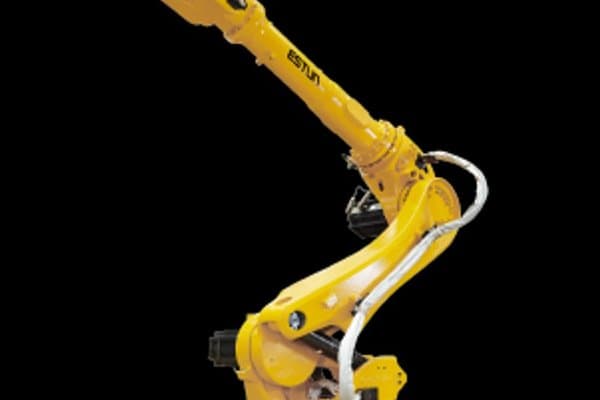
Palletizing is one of the most physically demanding tasks in manufacturing and logistics — and one of the most straightforward to automate. Palletizing robots stack boxes, bags, cases, and cartons onto pallets at consistent speeds without fatigue, injury risk, or quality variation. In 2026, palletizing robot prices range from $25,000 for collaborative palletizers to $150,000+ for high-speed industrial systems, with Chinese manufacturers offering 30-50% savings over Western brands like FANUC, ABB, and KUKA.
This guide covers palletizing robot types, detailed pricing, manufacturer comparisons, ROI calculations, and a step-by-step implementation plan.
Types of Palletizing Robots
Palletizing robots come in several configurations, each suited to different throughput requirements, product types, and budget levels.
1. Articulated Arm Palletizers
The most common type. A 4-axis or 6-axis robotic arm picks products from a conveyor and stacks them onto pallets using a gripper or vacuum end-effector.
- Payload: 20-300 kg
- Speed: 10-30 cycles/minute (depending on payload)
- Reach: 1,700-3,200 mm
- Best for: Medium to high throughput, flexible pallet patterns
- Price range: $30,000 - $150,000 (robot only)
2. Collaborative Palletizers (Cobot Palletizers)
Cobots adapted for palletizing with payload capacities of 10-25 kg. They work alongside human operators without safety caging.
- Payload: 10-25 kg
- Speed: 6-12 cycles/minute
- Reach: 1,300-1,800 mm
- Best for: Low to medium throughput, flexible deployment, small footprint
- Price range: $25,000 - $60,000 (robot only)
3. Gantry (Cartesian) Palletizers
Linear motion systems that move along X, Y, and Z axes to place products. They offer large work envelopes and can handle very heavy products.
- Payload: Up to 500 kg+
- Speed: 5-15 cycles/minute
- Reach: Customizable work envelope
- Best for: Very heavy loads, large pallets, high precision stacking
- Price range: $60,000 - $200,000 (complete system)
4. Layer Palletizers
Form complete layers of product on a table and then transfer the entire layer onto the pallet at once. Very high throughput for uniform products.
- Speed: 30-120+ cases/minute
- Best for: High-speed lines with uniform products (beverages, food packaging)
- Price range: $150,000 - $500,000+ (complete system)
Palletizing Robot Price Comparison
By Robot Type and Payload
| Robot Type | Payload | Chinese Price (FOB) | Western Price | Savings |
|---|---|---|---|---|
| Cobot palletizer | 10-16 kg | $25,000 - $35,000 | $45,000 - $60,000 | 40-45% |
| Cobot palletizer | 20-25 kg | $30,000 - $45,000 | $50,000 - $70,000 | 35-40% |
| Articulated arm (4-axis) | 40-80 kg | $25,000 - $45,000 | $50,000 - $80,000 | 40-50% |
| Articulated arm (4-axis) | 80-160 kg | $35,000 - $65,000 | $65,000 - $110,000 | 40-45% |
| Articulated arm (4-axis) | 160-300 kg | $50,000 - $90,000 | $90,000 - $150,000 | 35-45% |
| Gantry palletizer | Up to 500 kg | $60,000 - $120,000 | $100,000 - $200,000 | 35-40% |
Complete System Cost (Robot + Integration)
The robot arm is typically 35-50% of the total palletizing system cost. Here is what a complete system includes:
| Component | Cost Range (Chinese) | Cost Range (Western) |
|---|---|---|
| Robot arm | $25,000 - $90,000 | $50,000 - $150,000 |
| End-of-arm tooling (gripper/vacuum) | $3,000 - $15,000 | $5,000 - $20,000 |
| Conveyor infeed | $5,000 - $20,000 | $8,000 - $25,000 |
| Pallet dispenser | $5,000 - $15,000 | $8,000 - $20,000 |
| Safety fencing/scanners | $3,000 - $10,000 | $5,000 - $12,000 |
| Controls and PLC | $5,000 - $15,000 | $8,000 - $20,000 |
| Integration and programming | $10,000 - $30,000 | $15,000 - $40,000 |
| Installation | $5,000 - $15,000 | $8,000 - $20,000 |
| **Total system** | **$61,000 - $210,000** | **$107,000 - $307,000** |
Leading Palletizing Robot Manufacturers
Chinese Manufacturers
#### Estun Robotics (埃斯顿)
- Headquarters: Nanjing, China
- Founded: 1993
- Background: China's largest domestic robot manufacturer by revenue. Acquired Germany's Cloos (welding robot company) in 2017.
- Palletizing models: ER80-2000-PL, ER130-2600-PL, ER180-3100-PL, ER210-3100-PL
- Payload range: 80-210 kg
- Key strengths: Vertically integrated (makes own servo motors, controllers, reducers), German engineering influence from Cloos acquisition, excellent value
- Price range: $25,000 - $70,000
#### SIASUN (新松)
- Headquarters: Shenyang, China
- Founded: 2000 (affiliated with Chinese Academy of Sciences)
- Background: China's oldest robot company, publicly listed
- Palletizing models: SR series palletizing robots
- Payload range: 50-300 kg
- Key strengths: Strong in heavy-payload applications, government backing, extensive domestic installation base
- Price range: $30,000 - $85,000
#### EFFORT (埃夫特)
- Headquarters: Wuhu, China
- Founded: 2007
- Background: Acquired Italy's EVOLUT (integration company) and WFC Group. Strong Italian engineering influence.
- Palletizing models: ER series
- Payload range: 50-210 kg
- Key strengths: Italian-influenced design and quality, competitive pricing, good European market presence
- Price range: $28,000 - $75,000
#### Dobot / AUBO / Han's Robot (Cobot Palletizers)
These cobot manufacturers offer palletizing solutions using their 16-20 kg payload cobots with dedicated palletizing software and end-effectors.
- Payload: 10-25 kg (suitable for light cases)
- Price range: $25,000 - $45,000 (complete palletizing kit)
- Best for: Low-medium throughput, no safety fencing needed
Western Manufacturers
| Manufacturer | Headquarters | Palletizing Range | Price Range | Key Strength |
|---|---|---|---|---|
| FANUC | Japan | M-410, CRX-25 | $50,000 - $150,000 | Largest installed base, highest reliability |
| ABB | Switzerland | IRB 460, IRB 660, GoFa | $55,000 - $140,000 | FlexGripper system, fastest cycle times |
| KUKA | Germany | KR QUANTEC PA | $50,000 - $130,000 | Flexible programming, automotive heritage |
| Kawasaki | Japan | CP series | $45,000 - $120,000 | High-speed, food-grade options |
| Yaskawa | Japan | PL series | $45,000 - $110,000 | Reliable, energy efficient |
Chinese vs Western Palletizing Robots: Head-to-Head
| Feature | Chinese (Estun/SIASUN/EFFORT) | Western (FANUC/ABB/KUKA) |
|---|---|---|
| **Price** | $25,000 - $90,000 | $50,000 - $150,000 |
| **Payload range** | 50-300 kg | 40-700 kg |
| **Speed (cycles/min)** | 8-25 | 10-30 |
| **Repeatability** | ±0.1-0.2 mm | ±0.05-0.1 mm |
| **Reliability (MTBF)** | 50,000-70,000 hrs | 70,000-100,000 hrs |
| **Lifespan** | 8-12 years | 10-15 years |
| **Global support** | Growing, regional offices | Established worldwide |
| **Spare parts availability** | 3-10 days (varies) | 1-5 days globally |
| **Software maturity** | Good (improving) | Excellent (decades of refinement) |
| **Integration ecosystem** | Developing | Mature |
When to Choose Chinese
- Budget is a primary consideration
- Standard palletizing patterns (not requiring exotic configurations)
- Payload under 200 kg
- You have in-house or local integration capability
- Speed requirements are moderate (under 20 cycles/minute)
When to Choose Western
- Mission-critical 24/7 operations requiring maximum uptime
- Very high-speed requirements (25+ cycles/minute)
- Heavy payloads (200+ kg)
- Need established local service network immediately
- Complex multi-line integration requiring mature software
ROI Calculation for Palletizing Robots
Labor Cost Savings
Palletizing is typically a 2-3 person operation per shift. With robots:
| Scenario | Manual Palletizing | Robotic Palletizing |
|---|---|---|
| Workers per shift | 2-3 | 0-1 (monitoring only) |
| Shifts per day | 2-3 | 3 (24/7 capable) |
| Monthly labor cost | $10,500 - $31,500 | $0 - $3,500 |
| Annual labor cost | $126,000 - $378,000 | $0 - $42,000 |
| **Annual savings** | — | **$84,000 - $336,000** |
*Based on $3,500/month per worker, fully loaded cost.*
Throughput Improvement
| Metric | Manual | Robotic |
|---|---|---|
| Cases per hour | 150-300 | 400-1,200+ |
| Hours per day (sustainable) | 16 (2 shifts) | 22+ (with charging/maintenance) |
| Consistency | Variable (fatigue) | Constant |
| Error rate (mis-stacked) | 2-5% | <0.1% |
Payback Period by Scenario
| Deployment | System Cost | Annual Savings | Payback |
|---|---|---|---|
| Cobot palletizer (1 line) | $50,000 - $80,000 | $84,000 - $120,000 | 5-11 months |
| Articulated arm (1 line) | $80,000 - $150,000 | $120,000 - $200,000 | 8-15 months |
| Dual-line system | $150,000 - $300,000 | $200,000 - $350,000 | 9-18 months |
| High-speed multi-line | $300,000 - $600,000 | $350,000 - $600,000 | 10-18 months |
Additional ROI Factors
- Injury reduction: Palletizing is a leading cause of warehouse back injuries. Eliminating these saves $5,000-50,000 per incident in workers' compensation and lost productivity.
- Product damage reduction: Consistent robot stacking reduces crushed/damaged products by 80-90%.
- Space efficiency: Robots can stack to full pallet height consistently, maximizing trailer utilization.
Implementation Timeline
A typical palletizing robot implementation follows this timeline:
Week 1-2: Assessment
- Document product types, sizes, weights, and pallet patterns
- Measure line throughput requirements
- Evaluate floor space and utility connections
- Contact manufacturers for proposals
Week 3-6: Design and Order
- Review proposals and select manufacturer/integrator
- Approve system design and pallet patterns
- Place order (30-50% deposit)
- Begin floor preparation if needed
Week 7-12: Manufacturing and Shipping
- Robot and system built at factory
- Factory acceptance test (FAT) — attend if possible
- Sea freight shipping (4-6 weeks) or air freight (1 week)
Week 13-16: Installation and Commissioning
- Mechanical installation (3-5 days)
- Electrical and controls hookup (2-3 days)
- Programming and pattern testing (3-7 days)
- Integration with upstream/downstream equipment (2-5 days)
- Operator training (1-2 days)
Week 17-18: Ramp-Up
- Parallel operation with manual backup
- Fine-tune pallet patterns and speeds
- Validate throughput and quality metrics
Total timeline: 4-5 months from decision to full production.
Frequently Asked Questions
How many pallets per hour can a robot handle?
A single articulated arm palletizer typically handles 15-25 cycles per minute, translating to 3-8 pallets per hour depending on cases per pallet. Cobot palletizers handle 6-12 cycles per minute (2-4 pallets per hour). High-speed layer palletizers can exceed 120 cases per minute.
Can one robot palletize multiple product types?
Yes. Modern palletizing robots store multiple pallet patterns in memory and can switch between products automatically based on barcode scanning or line signals. This is a key advantage over mechanical palletizers.
Do I need a cobot or traditional palletizing robot?
Choose a cobot palletizer if: cases weigh under 15 kg, throughput is under 12 cycles/minute, you want no safety fencing, and deployment flexibility matters. Choose a traditional palletizing robot if: cases are heavier, throughput demands are higher, and maximum speed and reliability are priorities.
What end-of-arm tooling do I need?
- Vacuum grippers: Best for cardboard cases and boxes with flat surfaces ($3,000-8,000)
- Mechanical clamp grippers: Best for bags, irregular shapes ($5,000-12,000)
- Fork-style grippers: Best for slip sheets and multiple cases at once ($4,000-10,000)
- Hybrid grippers: Combine vacuum and mechanical for mixed products ($8,000-15,000)
What floor requirements are there?
Palletizing robots need a level concrete floor with adequate anchor points. Floor flatness should be within 5mm over the robot's reach. For heavy-payload robots (150+ kg), floor load capacity should be verified.
Can palletizing robots handle bags?
Yes. Bag palletizing is common in food, chemical, and building material industries. It requires specialized grippers (typically mechanical clamps or fork-type) and careful pattern programming to ensure stable stack formation.
Next Steps
GrabaRobot partners with China's leading palletizing robot manufacturers including Estun, SIASUN, and EFFORT, as well as cobot palletizer solutions from Dobot and AUBO. We help you select the right solution, manage procurement, and coordinate installation.
Ready to automate your palletizing operation? Get a customized quote based on your product specs and throughput requirements.