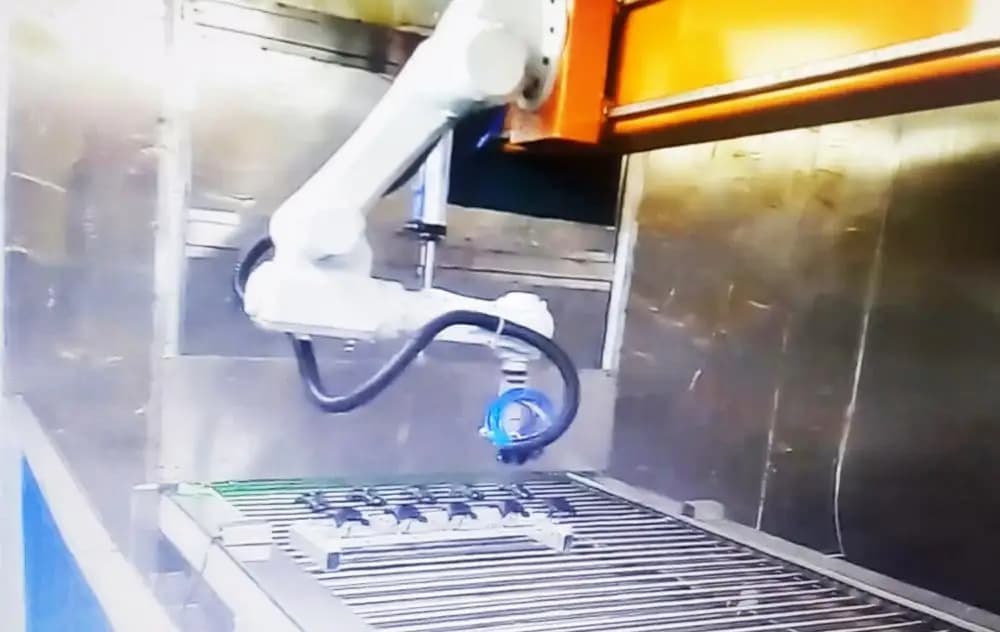
Industrial painting robots are transforming manufacturing by delivering consistent finish quality, reducing paint waste by up to 30%, and eliminating worker exposure to hazardous fumes. Whether you are painting car bodies, furniture panels, or ship hulls, a robotic painting system pays for itself faster than most other automation investments.
Prices range from $30,000 for a basic Chinese spray painting arm to $150,000+ for an explosion-proof, multi-axis ABB or FANUC system with vision-guided path planning. This guide covers every factor that drives cost so you can budget with confidence.
Types of Painting Robots
Painting robots are not one-size-fits-all. The technology you need depends on your coating material, substrate, and finish requirements.
Spray Painting Robots
The most common type. A 6-axis arm fitted with an air-atomized or airless spray gun applies liquid paint in programmed patterns. Ideal for automotive parts, furniture, appliances, and general industrial coating.
- Pros: Versatile, easy to program, wide range of coatings
- Cons: Overspray waste (10–30%), requires spray booth ventilation
- Price range: $30,000 – $100,000 (robot arm + gun)
Electrostatic Painting Robots
The robot charges the paint particles so they are attracted to the grounded workpiece. Transfer efficiency jumps from 40–60% (conventional spray) to 80–95%.
- Pros: Dramatically less paint waste, better wrap-around coverage
- Cons: Higher equipment cost, requires conductive primers on non-metal substrates
- Price range: $50,000 – $130,000
Powder Coating Robots
Dry powder is sprayed electrostatically, then cured in an oven. Produces a thicker, more durable finish than liquid paint.
- Pros: Near-zero VOC emissions, overspray is reclaimed and reused, extremely durable
- Cons: Limited color-change flexibility, oven required, thicker minimum coat
- Price range: $45,000 – $120,000
UV / Automated Lacquering Robots
Used in high-end furniture and electronics to apply thin, precise lacquer coats that cure instantly under UV light.
- Pros: Fast cycle, mirror-smooth finish
- Cons: Expensive consumables, limited to flat or gently curved surfaces
- Price range: $60,000 – $150,000
Painting Robot Price Breakdown by Application
| Application | Robot Type | Typical System Cost (Chinese) | Typical System Cost (European/Japanese) |
|---|---|---|---|
| Small parts / components | 6-axis spray | $30,000 – $50,000 | $70,000 – $100,000 |
| Furniture panels & frames | Spray or electrostatic | $40,000 – $70,000 | $90,000 – $130,000 |
| Automotive body / bumpers | Electrostatic, 7-axis | $60,000 – $100,000 | $120,000 – $200,000 |
| Metal fabrication / fencing | Powder coating robot | $45,000 – $80,000 | $100,000 – $150,000 |
| Marine / large structures | Long-reach spray | $55,000 – $90,000 | $110,000 – $160,000 |
| Construction steel | Spray, high-reach | $50,000 – $85,000 | $100,000 – $150,000 |
Chinese vs Global Brand Pricing
Chinese painting robot manufacturers have closed the technology gap significantly since 2022. For standard spray and powder coating, they deliver comparable results at 40–60% lower cost.
Chinese Painting Robot Manufacturers
| Brand | Popular Model | Payload | Reach | Price (FOB) | Specialty |
|---|---|---|---|---|---|
| Estun | ER10-1600P | 10 kg | 1,600 mm | $28,000 – $40,000 | General spray painting |
| SIASUN | SR10P | 10 kg | 1,700 mm | $32,000 – $45,000 | Explosion-proof certified |
| CRP Robot | CRP-RP10-1800 | 10 kg | 1,800 mm | $25,000 – $38,000 | Furniture & wood coating |
| Estun | ER20-2000P | 20 kg | 2,000 mm | $35,000 – $50,000 | Large part painting |
| EFORT | QJR10P | 10 kg | 1,650 mm | $30,000 – $42,000 | Automotive suppliers |
Global Brand Comparison
| Brand | Popular Model | Payload | Reach | Price | Origin |
|---|---|---|---|---|---|
| ABB | IRB 5500 | 13 kg | 2,975 mm | $80,000 – $120,000 | Sweden |
| FANUC | P-250iB/15 | 15 kg | 2,850 mm | $75,000 – $110,000 | Japan |
| KUKA | KR 10 R1100 | 10 kg | 1,101 mm | $70,000 – $100,000 | Germany |
| Yaskawa | MPX3500 | 15 kg | 2,700 mm | $70,000 – $105,000 | Japan |
| Dürr | EcoRP E043i | 8 kg | 1,600 mm | $90,000 – $140,000 | Germany |
Detailed Specs Comparison Table
| Specification | Estun ER10-1600P | ABB IRB 5500 | FANUC P-250iB/15 |
|---|---|---|---|
| Axes | 6 | 6 (7 optional) | 6 |
| Payload | 10 kg | 13 kg | 15 kg |
| Reach | 1,600 mm | 2,975 mm | 2,850 mm |
| Repeatability | ±0.08 mm | ±0.05 mm | ±0.04 mm |
| IP Rating | IP54 / optional IP67 | IP67 | IP67 |
| Explosion-proof | Optional (ATEX Zone 1) | Standard (ATEX Zone 1) | Standard (ATEX Zone 1) |
| Max speed | 1,200 mm/s | 2,000 mm/s | 1,800 mm/s |
| Weight | 155 kg | 255 kg | 250 kg |
| Price (arm only) | $28,000 – $40,000 | $80,000 – $120,000 | $75,000 – $110,000 |
Applications in Detail
Automotive Painting
Automotive painting is the original use case for painting robots. Modern car plants use 30–60 robots per paint line, applying primer, basecoat, and clearcoat in fully automated spray booths.
- Requirements: Electrostatic bell atomizers, 7-axis motion, color-change systems, strict ATEX compliance
- Cycle time: 45–60 seconds per body
- Typical investment: $500,000 – $2,000,000 per booth (multiple robots)
- Chinese opportunity: Tier 2/3 automotive suppliers painting bumpers, mirrors, and interior trim can save 40–50% using Estun or SIASUN
Furniture and Wood Coating
Furniture manufacturers face high labor turnover in paint shops due to fume exposure. Robots solve this while improving finish consistency.
- Requirements: Spray guns compatible with lacquer/stain, dust-free environment, simple fixtures
- Cycle time: 15–45 seconds per panel
- Typical investment: $40,000 – $80,000 (Chinese system)
- ROI: 12–18 months replacing 2–3 manual sprayers
Construction and Structural Steel
Bridges, buildings, and infrastructure require corrosion-resistant coatings. Robots are increasingly used for shop priming and finish coating of beams and plates.
- Requirements: High reach (2,000 mm+), heavy-duty spray guns, tolerance for rough positioning
- Cycle time: Varies by part size
- Typical investment: $50,000 – $90,000 (Chinese system)
Marine and Shipbuilding
Ship hulls and deck structures require thick anti-corrosion and anti-fouling coatings. Painting robots are deployed on gantry systems to cover large surfaces.
- Requirements: Long reach, high paint flow rate, corrosion-resistant robot body
- Typical investment: $80,000 – $200,000 (complete gantry + robot)
Safety and Explosion-Proof Requirements
Painting environments are classified as hazardous areas due to flammable solvents and paint mist. Your painting robot must meet strict safety standards.
Hazardous Area Classifications
| Standard | Zone | Description |
|---|---|---|
| IEC/ATEX | Zone 1 | Explosive atmosphere likely during normal operation |
| IEC/ATEX | Zone 2 | Explosive atmosphere unlikely, only in abnormal conditions |
| NEC (US) | Class I, Div 1 | Equivalent to Zone 1 |
| NEC (US) | Class I, Div 2 | Equivalent to Zone 2 |
Key Safety Requirements
- Intrinsically safe design: All electrical components in the arm must be sealed or purged
- Purge and pressurization: Robot arm is pressurized with clean air to prevent solvent vapor ingress
- Grounding: Electrostatic systems require proper grounding of workpiece, conveyor, and robot
- Fire suppression: Spray booth must have automatic fire suppression
- Ventilation: Downdraft or cross-draft booths to maintain air velocity above 0.5 m/s
Chinese painting robots from Estun and SIASUN now offer ATEX Zone 1 certified models. However, verify certification documents carefully — some Chinese models are Zone 2 only, which may not meet your local regulations for liquid spray painting.
ROI Analysis: Painting Robot Investment
Cost Comparison: Robot vs Manual Painter
| Factor | Manual Painter | Painting Robot |
|---|---|---|
| Annual labor cost | $40,000 – $60,000 per painter | N/A |
| Paint transfer efficiency | 40–60% | 70–95% (electrostatic) |
| Paint waste (annual) | $15,000 – $30,000 | $5,000 – $12,000 |
| Rework / defect rate | 5–15% | 1–3% |
| Workers replaced | — | 2–4 painters |
| Working hours / day | 6–7 effective | 18–22 |
Payback Calculation
Scenario: Furniture manufacturer, 3 painters at $45,000/year, switching to Estun spray painting system.
| Item | Value |
|---|---|
| Current annual painting labor | $135,000 |
| Annual paint waste (manual) | $20,000 |
| Robot system cost (Estun) | $65,000 |
| Annual robot operating cost | $10,000 (maintenance, paint, power) |
| Annual paint waste (robot) | $8,000 |
| Annual savings | $135,000 + $20,000 - $10,000 - $8,000 = $137,000 |
| **Payback period** | **~6 months** |
The paint savings alone (reduced overspray) often cover 15–25% of the robot cost annually.
How to Choose the Right Painting Robot
- Define your coating: Liquid spray, electrostatic, powder, or UV — this determines the robot configuration
- Measure your parts: Maximum part size dictates the robot reach and workspace layout
- Count your colors: Frequent color changes favor fast-flush systems; single-color lines can use simpler setups
- Check your regulations: ATEX/NEC zone classification determines which robots are compliant
- Consider throughput: Parts per hour determines if you need one robot or multiple
- Budget for the full system: Robot arm is only 30–50% of total system cost — include booth, conveyor, fixtures, and integration
Frequently Asked Questions
How much does a painting robot cost?
A painting robot arm costs $28,000 – $50,000 (Chinese brands) or $70,000 – $140,000 (ABB, FANUC, Dürr). A complete painting system with booth integration runs $50,000 – $200,000+.
Are Chinese painting robots explosion-proof?
Yes, leading Chinese brands like Estun and SIASUN offer ATEX Zone 1 certified painting robots. Always verify the specific certification documents and zone rating before purchasing.
What is the ROI on a painting robot?
Most manufacturers see payback in 6–18 months. Paint material savings from higher transfer efficiency contribute significantly — electrostatic robots save 30–50% on paint consumption alone.
Can a painting robot handle multiple colors?
Yes. Modern painting robots support automatic color-change systems that flush and switch colors in 5–15 seconds. Chinese systems typically support 8–20 color channels.
What maintenance does a painting robot need?
Regular maintenance includes cleaning spray nozzles (daily), checking hoses and seals (weekly), calibrating spray patterns (monthly), and replacing wear parts like nozzle tips (every 500–2,000 hours).
Do I need a spray booth for a painting robot?
Yes. All spray painting operations require a ventilated booth for environmental compliance, worker safety, and fire prevention. Budget $10,000 – $50,000 for a booth depending on size.
Browse Painting Robots on GrabaRobot
GrabaRobot lists painting robots from Estun, SIASUN, CRP Robot, and other verified Chinese manufacturers. Compare explosion-proof models, view detailed specifications, and request factory-direct quotes.
Need a complete painting system designed for your application? Tell us your requirements and we will connect you with qualified integrators.