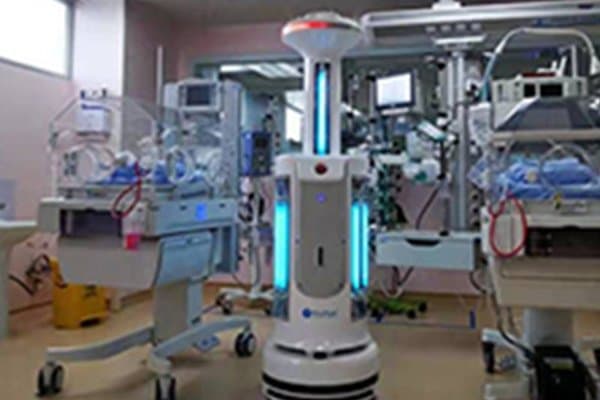
The global market for disinfection robots has grown steadily since the COVID-19 pandemic first demonstrated the value of autonomous sanitization. Hospitals, hotels, airports, schools, and offices now routinely deploy UV and spray disinfection robots to reduce pathogen transmission and improve hygiene standards.
China leads global production of disinfection robots, with manufacturers offering models at 30–50% below Western competitors. This guide breaks down every aspect of pricing, technology, and ROI for disinfection robots in 2026.
Types of Disinfection Robots
Disinfection robots use different technologies depending on the environment and target pathogens.
UV-C Disinfection Robots
UV-C robots use ultraviolet light at 254nm wavelength to destroy the DNA/RNA of bacteria, viruses, and fungi. They are the most common type of disinfection robot.
How it works: The robot autonomously navigates to the center of a room, extends its UV-C lamp array, and irradiates all exposed surfaces for 10–30 minutes depending on room size.
Efficacy: UV-C achieves 99.9%–99.99% kill rates on most pathogens, including MRSA, C. difficile, and coronaviruses, when surfaces receive sufficient UV dose.
| Spec | Typical Range |
|---|---|
| UV-C power | 100–1,500W |
| Coverage area | 20–60 m² per cycle |
| Cycle time | 10–30 minutes |
| Navigation | LiDAR + SLAM |
| Battery | 4–8 hours |
| Price | $15,000–$50,000 |
Limitations: UV-C only disinfects surfaces in the line of sight. Shadowed areas behind objects are not reached. UV-C is also hazardous to human skin and eyes, so rooms must be vacated during operation.
Spray/Mist Disinfection Robots
Spray robots dispense liquid disinfectant as a fine mist or fog, covering all surfaces including shadowed areas.
How it works: The robot carries a tank of disinfectant solution and disperses it through ultrasonic atomizers or electrostatic spray nozzles while navigating the room.
Common disinfectants used:
- Sodium hypochlorite (bleach solution)
- Hydrogen peroxide (3–7.5%)
- Quaternary ammonium compounds
- Peroxyacetic acid
| Spec | Typical Range |
|---|---|
| Tank capacity | 5–20 liters |
| Spray rate | 1–5 liters/hour |
| Coverage area | 50–200 m² per tank |
| Navigation | LiDAR + SLAM |
| Battery | 4–6 hours |
| Price | $8,000–$30,000 |
Advantages: Reaches shadowed areas, lower cost than UV-C robots. Disadvantages: Requires consumable disinfectant, surfaces need drying time, potential chemical residue.
Hydrogen Peroxide Vapor (HPV) Robots
HPV robots generate a dry vapor of hydrogen peroxide that penetrates every surface in a sealed room, achieving the highest level of decontamination.
| Spec | Typical Range |
|---|---|
| H2O2 concentration | 30–35% |
| Cycle time | 60–180 minutes |
| Room volume | Up to 200 m³ |
| Price | $30,000–$80,000 |
Used for: Operating rooms, pharmaceutical cleanrooms, BSL-3/4 laboratories. This is the premium option with the highest efficacy but longest cycle time.
Combination Robots
Some newer Chinese models combine UV-C and spray in a single platform, allowing operators to choose the appropriate method for each situation. These typically cost $20,000–$40,000.
Pricing Breakdown
By Technology Type
| Type | Chinese Manufacturer | Western Manufacturer | Savings |
|---|---|---|---|
| UV-C (mid-range) | $15,000–$25,000 | $30,000–$50,000 | 40–50% |
| Spray/mist | $8,000–$18,000 | $15,000–$30,000 | 35–45% |
| HPV | $30,000–$50,000 | $50,000–$80,000 | 35–40% |
| Combination UV+Spray | $20,000–$35,000 | $40,000–$60,000 | 40–45% |
By Application
| Application | Recommended Type | Price Range |
|---|---|---|
| Hospital patient rooms | UV-C | $20,000–$40,000 |
| Operating rooms | HPV or UV-C | $30,000–$60,000 |
| Hotel rooms | Spray or UV-C | $8,000–$25,000 |
| Office spaces | Spray | $8,000–$15,000 |
| Airport terminals | UV-C (high power) | $25,000–$50,000 |
| Schools/daycare | Spray | $8,000–$15,000 |
| Food processing | HPV or spray | $15,000–$40,000 |
Chinese Brands vs. Western Competitors
Leading Chinese Disinfection Robot Manufacturers
TMiRob (Shanghai Titanium MiRobot)
- China's leading disinfection robot company
- Deployed in 600+ hospitals across China and 40+ countries
- UV-C and spray models
- Price range: $15,000–$35,000
- Strong clinical validation data
Pudu Robotics
- Known for delivery robots, also produces disinfection models
- FlashBot series with UV-C + spray combo
- Price range: $12,000–$25,000
- Good software ecosystem and fleet management
UBTech Robotics (ADIBOT)
- ADIBOT-A (autonomous) and ADIBOT-S (stationary)
- UV-C technology with smart navigation
- Price range: $20,000–$40,000
- International certifications and support
Keenon Robotics
- M2 disinfection robot with UV-C + atomized spray
- Strong hospital deployments
- Price range: $15,000–$28,000
Siasun Robot & Automation
- Industrial robotics giant with healthcare division
- Hospital-grade UV-C and HPV robots
- Price range: $20,000–$50,000
Western Competitors
| Brand | Country | Technology | Price Range |
|---|---|---|---|
| Xenex (LightStrike) | US | Pulsed xenon UV | $80,000–$125,000 |
| Tru-D SmartUVC | US | UV-C | $70,000–$100,000 |
| UVD Robots (Blue Ocean) | Denmark | UV-C | $60,000–$80,000 |
| Bioquell (Ecolab) | UK | HPV | $60,000–$90,000 |
Chinese manufacturers offer 40–70% savings compared to premium Western brands, while delivering comparable disinfection efficacy in independent testing.
Efficacy Data
Disinfection effectiveness depends on multiple factors: UV dose, exposure time, distance, surface type, and organic load.
UV-C Kill Rates (Peer-Reviewed Studies)
| Pathogen | UV Dose Required | Kill Rate | Cycle Time |
|---|---|---|---|
| SARS-CoV-2 | 5–10 mJ/cm² | 99.99% | 5–10 min |
| MRSA | 10–20 mJ/cm² | 99.9% | 10–15 min |
| C. difficile spores | 40–80 mJ/cm² | 99.9% | 20–30 min |
| E. coli | 5–8 mJ/cm² | 99.99% | 5–10 min |
| Influenza A | 3–6 mJ/cm² | 99.99% | 5 min |
Spray Disinfection Efficacy
- Electrostatic spray achieves more uniform coverage than manual wiping
- 99.9% kill rate on most bacteria with appropriate disinfectant concentration
- Requires 5–10 minutes of contact time after application
Application Scenarios
Hospitals and Healthcare Facilities
Hospitals are the largest market for disinfection robots. Healthcare-associated infections (HAIs) affect 1 in 31 hospital patients in the US, costing $28–45 billion annually.
Typical deployment: 2–5 UV-C robots per 200-bed hospital, rotating through patient rooms after discharge, operating rooms between procedures, and common areas overnight.
Results: Studies show a 25–30% reduction in HAIs when UV-C robots supplement standard manual cleaning protocols.
Hotels and Hospitality
Post-pandemic, hotel guests expect higher hygiene standards. Disinfection robots serve double duty as both a cleaning tool and a visible indicator of cleanliness.
Typical deployment: 1–2 spray or UV-C robots per 100-room hotel, disinfecting rooms during turnover and public areas overnight.
Office Buildings
Large office buildings and coworking spaces use disinfection robots during off-hours to maintain a healthy work environment.
Typical deployment: 1 spray robot per 2,000–5,000 m² of office space, running overnight schedules.
Safety Protocols
UV-C Safety
- Room must be vacated: UV-C radiation is harmful to skin and eyes
- Occupancy sensors: Most robots include PIR or LiDAR sensors that pause operation if a person enters
- Warning systems: Audible alarms and flashing lights before and during operation
- Training required: Operators must understand UV-C hazards and safety procedures
- Signage: Place warning signs on doors during disinfection cycles
Chemical Spray Safety
- Ventilation: Ensure adequate air exchange after spray cycles
- Chemical compatibility: Verify disinfectant is safe for room materials and electronics
- PPE: Operators should wear appropriate protection when refilling tanks
- MSDS compliance: Follow material safety data sheets for all chemicals used
ROI Analysis
Hospital Example (200-Bed Facility)
| Cost Item | Manual Cleaning Only | Manual + Robot (3 UV-C) |
|---|---|---|
| Annual cleaning staff cost | $400,000 | $350,000 (reduced overtime) |
| Disinfection robot cost (amortized 5 yr) | $0 | $18,000/year |
| Robot consumables + maintenance | $0 | $6,000/year |
| HAI treatment costs | $1,200,000 | $840,000 (30% reduction) |
| **Total annual cost** | **$1,600,000** | **$1,214,000** |
| **Annual savings** | — | **$386,000** |
Payback period for the 3-robot investment: approximately 7 months.
Hotel Example (150 Rooms)
| Cost Item | Without Robot | With Robot (1 UV-C) |
|---|---|---|
| Additional cleaning labor | $30,000/year | $15,000/year |
| Disinfection robot (amortized 5 yr) | $0 | $5,000/year |
| Consumables | $3,000/year | $4,000/year |
| Marketing value (hygiene positioning) | $0 | $10,000–$20,000 (est.) |
| **Net benefit** | — | **$19,000–$29,000/year** |
Frequently Asked Questions
How often should UV-C disinfection be performed?
For hospitals, after every patient discharge and between surgical procedures. For hotels, during room turnover. For offices, daily or several times per week. The robot's scheduling software handles this automatically.
Can UV-C robots damage equipment or furnishings?
Prolonged UV-C exposure can degrade some plastics and fade colors over time. Standard 15–30 minute cycles are safe for typical room contents. Sensitive items (artwork, certain plastics) can be covered or removed.
Do disinfection robots work on airborne pathogens?
UV-C primarily disinfects surfaces. Some newer models include upper-air UV-C systems or HEPA filtration that can reduce airborne pathogens. HPV robots are the most effective for airborne decontamination as the vapor fills the entire room volume.
What certifications should I look for?
Look for: EPA registration (for disinfectant claims in the US), CE marking for EU markets, FDA clearance (if making medical device claims), and third-party efficacy testing from accredited labs.
How much does it cost to run a disinfection robot daily?
Electricity costs are minimal ($0.50–$1.00/day). For spray robots, disinfectant costs $5–$15/day depending on usage. UV-C bulb replacement every 8,000–12,000 hours costs $200–$800. Total operating cost: $3,000–$6,000/year.
GrabaRobot helps you source disinfection robots from verified Chinese manufacturers with full support for import logistics, quality inspection, and after-sales service.